Welcome back. Last lesson focused on making a clear request or stating a boundary in a single interaction. When the same frustration keeps returning, a well-worded request may be only part of the answer. This lesson looks at how to change a recurring, controllable pattern: define what is happening, consider several options, try a manageable plan, and check whether it helps. Set aside about 35–40 minutes, including time to sketch a small plan of your own.
Decide whether there is a problem you can work on
Imagine that plans with someone have changed on the day of the meeting three times in the past month. You feel irritated because you have rearranged other activities to make room. The irritation matters: it points to a need for more predictable use of your time. It does not, by itself, establish that the other person is inconsiderate.
Problem-solving is useful here because there is a pattern you can describe and something you can influence. You cannot guarantee that the other person will keep the original time. You can ask for earlier confirmation, decide how long to hold a time open, and choose whether a late change still works for you.
The Centre for Clinical Interventions’ What? Me Worry!? Module 7: Problem-Solving offers a practical screen for deciding when to act, followed by a written sequence. Its examples concern worry, but the screen also helps with an ordinary social frustration. A recurring pattern can be actionable even when the most recent incident is over, provided there is a realistic next occasion on which to try something different.
What-Me-Worry---07---Problem-Solving.pdf
Read the Centre for Clinical Interventions’ guide for its six-step structure, rather than for the details of its bill-paying example. The blank worksheet at the end can hold a short plan.
In “Is There A Problem?” on p. 3, read the solvability screen, from its opening question through the guidance after the examples. Focus on whether there is a real issue and some action available to you. Then, under “How To Solve Problems” on pp. 4–5, read the six steps, beginning with Step 1’s advice on defining the problem and ending with Step 6’s instruction to revise an unsuccessful plan. If you would like space to write, find the “Problem-Solving” worksheet on pp. 6–7; its final box contains the review prompts.
A useful distinction is between changing a pattern and making a feeling disappear. Even if you solve a scheduling problem, you may still feel annoyed about past changes. Conversely, calming down may help you think clearly without resolving the scheduling problem. The brief pause you practiced earlier can make problem-solving easier; it does not replace action when action is warranted.
Define the pattern and a realistic goal
The first step is to write a description that another person could, in principle, verify. “They don’t respect my time” is an interpretation. “Three of our last four meeting times changed on the day we planned to meet, after I had set aside the original time” describes the pattern. You can add its effect: “I then had to rearrange my day or miss the meeting.”
Next, set a goal within reach of your actions. “Make them stop changing plans” depends entirely on another person. A more workable goal is: “For the next three plans, know by the previous evening whether the time is confirmed, and avoid rearranging my day for changes I cannot accommodate.” This protects the underlying need—predictability—without requiring you to prove why the changes happened.
The four-part cycle below is a useful overview of the process. Its “diagnose the root cause” segment does not require you to identify someone else’s hidden motive. In a social situation, it can mean noticing conditions that contribute to the pattern: perhaps plans remain tentative, no confirmation time has been agreed, or you routinely keep the entire day free. More than one condition may matter.
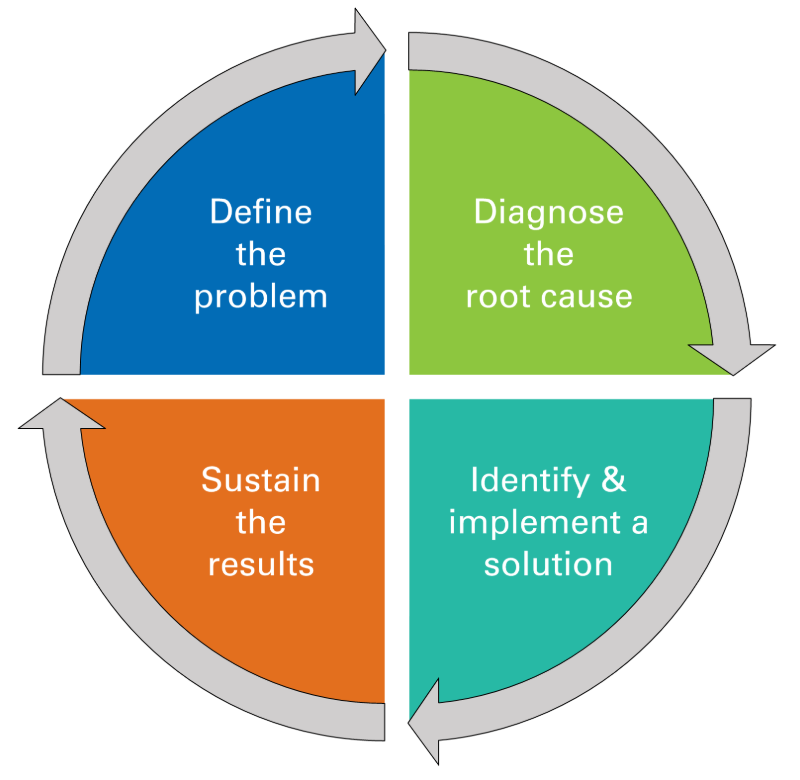
A good definition keeps you from solving the wrong problem. If late changes are unavoidable but you can easily decline them, the issue may be the pressure you feel to accommodate each one. If you want to keep meeting but need firmer plans, an earlier confirmation may matter more. Those possibilities call for different solutions.
Generate options before choosing one
Once the goal is clear, make room for several ways to reach it. For the changing-plans example, options include asking to confirm the time the evening before, agreeing on a flexible meeting window, making a backup plan for your own time, or declining changes that arrive too late for you. At this stage, list ideas without immediately defending or rejecting them. Then consider which are feasible, considerate, and likely to protect your need.
| Option | Possible benefit | Possible limitation |
|---|---|---|
| Request confirmation the evening before | Gives both people a clear planning point | The other person may not know their availability yet |
| Agree on a flexible time window | Allows some changes without disrupting the whole day | May not provide enough certainty for your schedule |
| Keep a backup plan and decline incompatible late changes | Protects your time without depending on agreement | May mean meeting less often |
There is no universally best row. The useful comparison is whether an option addresses this pattern at an acceptable cost to you and others. Doing nothing may also be a deliberate choice for an occasional inconvenience; for a repeated disruption, it is worth noticing what that choice costs.
Suppose you choose to request confirmation and keep a backup plan. That combines a chance to improve coordination with a limit you can carry out yourself. It builds on the distinction from the previous lesson: the request invites cooperation; the boundary concerns what you will do if the plan remains uncertain or changes too late.
Make the first action small, then review what happened
An option becomes a plan when its first action is specific. Rather than “sort out the scheduling,” your plan might be:
- Before the next plan is set, say: “Could we confirm the time by the evening before? It helps me plan the rest of my day.”
- When making the plan, decide what time you will stop holding the slot open if it remains unconfirmed.
- If a late change comes, check your actual availability before answering. Decline it if it no longer works, without treating the change as proof of bad intent.
- After the next few plans, check whether you had enough notice and spent less time rearranging other commitments.
The first action is deliberately modest. It gives the other person information you may not have communicated before, while leaving room for their circumstances. The fallback means your plan can still protect your time if the request is not met.
Problem Solving and Action Plans in DBT and CBT by Self-Help Toons adds a helpful point about making the first step manageable. Watch only the short passages on action planning and review; its longer example addresses a different kind of social difficulty.
Problem Solving and Action Plans in DBT and CBT
Watch “Problem Solving and Action Plans in DBT and CBT” from Self-Help Toons for the transition from a chosen option to an action you can actually take, and for what to do when the plan does not work.
In the action plan, watch from the explanation of breaking a choice into small steps until the narrator turns to a detailed example. Notice the emphasis on a clear first action, timing, and foreseeable obstacles. Then skip to the outcome review for the instruction to revise an approach after seeing what happened.
A review is not a verdict on whether you handled everything perfectly. It is information about the plan. If confirmation happened and your time was easier to manage, keep the arrangement. If the other person could not confirm that early, a flexible window or a different meeting format might serve both of you better. If you made the request but kept rearranging your day despite late changes, the next adjustment may be following through on your own availability limit. Revising the plan is part of solving the problem, not evidence that the first attempt was pointless.
For a short private application, use the worksheet in the reading or a few lines of notes. Record one low-stakes recurring pattern, its effect on a need, a goal that does not require controlling someone else, three possible options, and the first action you could take before its next occurrence. Leave a line for what you will observe afterward. The plan can be small enough to test once.
The takeaway
For a recurring frustration, start with the observable pattern rather than a judgment about someone’s intentions. Define a goal within your influence, generate more than one option, choose a feasible first action, and review its effect on both the situation and your need. Feeling calmer can help you carry out the plan, but it is not a substitute for addressing a changeable problem.
The next lesson will bring the approaches together: deciding when acceptance, reappraisal, communication, or problem-solving is the best place to begin—and when to combine or switch them.