The last lesson used problem-solving to address a recurring frustration you could influence. This lesson brings that approach together with three others you have practiced: allowing a feeling, checking an interpretation, and communicating a need. The aim is not to find one technique that works everywhere. It is to choose a useful first response, then change course if new information shows that something else is needed.
Allow about 40 minutes for the lesson and its short resources. The central example remains familiar: someone changes a plan at short notice. Depending on what has happened before, how strongly you feel, and what you need, the same event may call for a different response.
Begin with intensity, not a verdict
Suppose you receive a message changing tomorrow’s meeting time. Your shoulders tense and you want to reply, “You clearly don’t respect my time.” The tension and irritation are real. The conclusion about the other person’s intention is not yet established, and sending the message may not protect your time.
When an urge feels hard to resist, the first response is usually a pause, even if you later decide to speak up or solve a practical problem. A pause need not be long: set down the phone, feel your feet on the floor, name the feeling, and delay the reply until you can choose its wording. This is regulation rather than suppression because you acknowledge the irritation and leave open the possibility of addressing its cause.
4 Essential Habits for Emotional Regulation, from Therapy in a Nutshell, distinguishes making space before reacting from bottling up a feeling. The later passage connects that space to taking action when a genuine issue remains.
4 Essential Habits for Emotional Regulation
Watch to connect the pause you practiced earlier with the choice between allowing a feeling and addressing a real problem.
In the first habit, watch the pause, focusing on the placeholder response and the distinction between waiting and bottling up. Then skip to the third habit and watch processing feelings. Notice that allowing a feeling and changing a situation are both available; neither requires the feeling to vanish first.
Intensity affects timing, not whether a need counts. A strong reaction may make an immediate message unwise, but it does not prove that your concern is mistaken. Equally, feeling calmer after a pause does not mean a repeated disruption no longer matters. If distress is too high for a brief pause to help, step away and use a more supportive calming strategy before returning to the decision. There is no requirement to conduct a careful conversation at the peak of an emotional surge.
The Centre for Clinical Interventions’ Facing Your Feelings, Module 4: Tolerating Distress puts triggers, warning signs, allowing emotion, and improving a situation into one plan. Read its five-step outline as a way to order your response, not as a demand to make every uncomfortable feeling disappear.
[PDF] Module 4: Tolerating Distress - CCI
The Centre for Clinical Interventions’ outline helps distinguish tolerating an emotion from taking practical action when you have some control.
In “Distress Tolerance Action Plan” (pp. 2–4), read the five steps. Begin with “Triggers,” continue through “Warning Signs,” and stop after step 5, “Improving Distress”; the example plan that follows is optional. Focus on how noticing distress comes before choosing what to do, and on why problem-solving belongs where some control is possible.
Sort the interpretation from the changeable problem
After pausing, the next distinction is between what happened, what it might mean, and what you can influence. In the planning example, “The meeting time changed this afternoon” is an observable event. “They think my time is unimportant” is one possible interpretation. “I need enough notice to plan my day” is a need that remains relevant whether that interpretation is right or wrong.
If the meaning of an event is uncertain and your reaction depends heavily on one untested explanation, reappraisal is a useful initial approach. It means considering a more balanced account of the evidence, not insisting on a pleasant explanation. The person may have encountered an unavoidable change; they may also have been careless. Neither possibility needs to be declared certain before you decide how to protect your time.
The short passages from Self-Help Toons’ Struggling With Emotion Regulation? Fact-Check Your Feelings (DBT) show how different interpretations of an unanswered message can change the emotional response.
Struggling With Emotion Regulation? Fact-Check Your Feelings (DBT)
Watch for the difference between an observed delay and a conclusion about why it happened. Use the method to loosen certainty, not to excuse a repeated problem.
Watch the message example at the beginning. Then skip to alternative interpretations, where the video identifies an initial assumption and constructs a more balanced view. Notice that the balanced view leaves the other person’s reason uncertain.
Reappraisal is less useful when it becomes an argument against clear evidence. If plans have changed at short notice three times, “Perhaps each change had a good reason” does not erase the effect on your schedule. A balanced account can hold both points: I do not know why this keeps happening, and I need a more predictable arrangement.
That second point leads to controllability. You cannot make another person value punctuality or guarantee their availability. You can choose how much time to hold open, ask for earlier confirmation, and decline a change you cannot accommodate. The useful first move depends on whether there is a specific unmet need to express, a recurring arrangement to redesign, or simply an unchangeable event to live through.
Choose a starting approach
These four approaches address different parts of the situation. They are not personality types or rankings from “easy” to “serious.”
| Initial approach | Best starting point when… | In the changing-plans example |
|---|---|---|
| Acceptance | The event has happened and cannot now be changed, and the immediate task is to allow the feeling without an impulsive act. | Allow disappointment about tonight’s canceled meeting without sending an angry message. Decide later whether anything further is needed. |
| Reappraisal | An uncertain interpretation is driving much of the reaction. | Replace certainty that “they did this to insult me” with recognition that the reason is unknown, while retaining the fact that the change was inconvenient. |
| Communication | A need or boundary could be addressed through a clear, respectful exchange. | Explain that late changes disrupt your day and request confirmation by the previous evening, or state when a new time will not work for you. |
| Problem-solving | A recurring, partly controllable pattern needs more than a single reply. | Compare confirmation times, flexible meeting windows, and a backup plan; try one arrangement and review whether it helps. |
Acceptance concerns reality, not approval. You can accept that tonight’s meeting will not happen and still decide tomorrow that the scheduling pattern needs to change. It is particularly useful when no immediate action can undo what occurred, or when acting on a surge of feeling would create a second problem. It becomes resignation if “accepting” is used to avoid a feasible response to a persistent unmet need.
Communication concerns needs, not proof of blame. A request can be warranted even if the other person meant no harm: “When plans change on the day, I have difficulty rearranging my schedule. Could we confirm by the previous evening?” Last lesson developed this distinction between a request and a boundary. The Centre for Clinical Interventions’ one-page Assertive Communication sheet offers a quick reminder of how to stay factual and direct.
Review this Centre for Clinical Interventions information sheet for the wording of a response that protects a need without turning an uncertain interpretation into an accusation.
On the one-page sheet, find “So Assertiveness is….” Read the practical tips beginning with clear requests and facts. Stop after the example contrasting a factual description with a judgment. Focus on the difference between describing the impact of a change and claiming to know the other person’s motive.
Problem-solving concerns the pattern. It is a stronger starting point than repeated, improvised messages when the same friction keeps occurring. As in the last lesson, define the pattern, set a goal within your influence, compare options, try one, and review it. Communication may be one step within that plan; a backup arrangement may be another.
The supplied Problem Solving & Opposite Action chart offers a useful additional check: whether an emotion fits the known facts is separate from whether acting on its immediate urge would be effective.
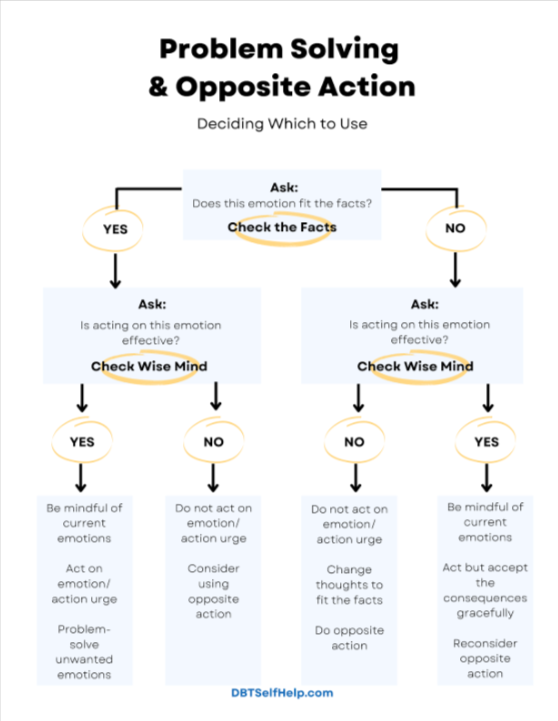
Use the chart as a check, not a rigid rule. Anger can make sense after a genuine inconvenience while an accusatory reply is still ineffective. Conversely, uncertainty about someone’s intentions does not remove your need for reliable plans. The chart includes “opposite action”—choosing not to follow an unhelpful emotional urge—but the four approaches in this lesson still answer the practical question of what deserves your attention next.
Combine approaches, then switch when the evidence changes
Consider two versions of the same short-notice change. In the first, plans have usually been reliable, and the message gives little explanation. You feel a sharp flash of anger. Acceptance can be the first few minutes: allow the anger and avoid sending the drafted accusation. Reappraisal follows because the meaning of this isolated change is uncertain. You may then find that no further action is needed—or send a simple reply about what time works.
In the second version, this is the third late change in a month. The same pause still helps, and you still need not assign a hostile motive. But stopping at reappraisal would leave your scheduling need unaddressed. Communication is a reasonable next move if the other person does not know the impact. Problem-solving becomes useful if a new confirmation arrangement and a backup plan are needed to prevent the disruption from recurring.
A workable decision can therefore have more than one stage:
- Match the first move to the intensity. When an impulse threatens to choose your words for you, pause and allow the feeling before replying.
- Check the certainty of the story. When the reaction rests on an assumed intention, consider the evidence and other plausible explanations.
- Protect the need at the right scale. For a specific request or limit, communicate. For a repeated, changeable pattern, make and test a plan. For what cannot be changed, practice acceptance without pretending to like it.
Switch approaches when the information or outcome changes. If a calm request resolves the issue, an elaborate plan may be unnecessary. If the request is understood but the pattern continues, revise what you will do rather than repeating it more forcefully. If new facts establish that your initial interpretation was mistaken, update it. If calming down leaves a genuine boundary unmet, return to communication or problem-solving. The measure is not whether every uncomfortable feeling has gone; it is whether your response has reduced impulsive harm and given due attention to the need the feeling signaled.
The takeaway
Choose a response by considering three things together: emotional intensity, what is within your influence, and whether a need remains unmet. Acceptance makes room for a feeling or an unchangeable event; reappraisal tests an uncertain interpretation; communication expresses a specific need; problem-solving changes a recurring pattern where you have some leverage. Starting with one does not commit you to using only one.
This completes the module on matching a response to the situation. The next module turns these choices into practice: rehearsing a response to a minor frustration, repairing an impulsive one, and preparing a plan for a recurring trigger.