Welcome to this module on matching your response to the situation. The focus now shifts from creating space before reacting to deciding what to do with that space. This lesson begins with acceptance: allowing an uncomfortable feeling to be present without immediately obeying its action urge. Acceptance does not mean approving of what happened, giving up on change, or setting aside a legitimate need.
Acceptance gives you room to choose
Imagine that someone starts talking while you are still making a point. Irritation appears, along with an urge to say something sharp. There are two different things happening: you feel irritated, and you have an urge to interrupt back. Neither requires you to act immediately.
You might also notice a second reaction: I shouldn’t be so bothered by this. Now you are dealing with the interruption and fighting your own feeling about it. Acceptance begins by dropping that second struggle. You can acknowledge, “I’m irritated; I wish this interaction had gone differently,” without deciding yet what the interruption meant or how to respond.
Watch these portions of Stop Fighting Reality — Learn Radical Acceptance (DBT Skills) from Self-Help Toons. The distinction between acknowledging a present fact and endorsing it is central to this lesson.
Stop Fighting Reality — Learn Radical Acceptance (DBT Skills)
Self-Help Toons explains acceptance as recognizing present reality, then shows why that recognition can support action rather than replace it.
Watch acceptance defined for the distinction between acceptance and giving up. Continue with facts and predictions: notice why a present feeling can be acknowledged without treating a fearful prediction as fact. In added struggle, focus on how resisting an event that has already happened can add distress. Finish with practical steps, especially naming an emotion and noticing a thought without having to follow it.
The scope of acceptance matters. In the interruption example, “I feel irritated right now” describes your experience. “They intended to disrespect me” is an interpretation that may need checking. Acceptance asks you to make room for the feeling, not to certify the interpretation. It also acknowledges that the interruption has already occurred; it does not say that future interruptions must go unaddressed.
Approval would mean deciding the behavior is fine with you. Resignation would mean assuming there is nothing worth doing about it. Acceptance requires neither. You can feel the irritation now and later ask to finish your point. Likewise, keeping your voice measured for a moment need not be emotional suppression: the difference is whether you are privately acknowledging what you feel or insisting that you feel nothing and that your need does not matter.
Observe the feeling instead of arguing with it
A useful way to practice acceptance is to describe your experience with modest precision: “There is irritation. My jaw is tight. I want to cut in.” This separates the emotion, its bodily sensations, and the action urge. The description does not have to make the feeling vanish. Its job is to help you notice what is happening while retaining a choice about what you do.
The Centre for Clinical Interventions’ Facing Your Feelings – Module 2: Accepting Distress develops this observing stance and offers a short script for using it during distress.
[PDF] Facing Your Feelings – Module 2: Accepting Distress
Read the Centre for Clinical Interventions’ guidance to see what observing and allowing an emotion can sound like in practice.
On p. 3, under “How To Accept Distress,” read the “Watch or Observe” subsection from observing feelings. Then read “Label or Describe” from naming feelings, including its examples. In “Curious and Non-judgemental,” read from the attitude. On p. 7, find “Practicing Acceptance When Distressed” and its “Example Mindfulness of Distress Script.” Read from the example script. Focus on its sequence of allowing, watching, returning attention to the present, and responding when the feeling comes back.
Notice the modesty of this skill. If irritation holds steady or returns after a pause, that is not a failure. “It’s still here” is another observation you can make. Acceptance is a way of relating to the feeling—not a technique that succeeds only when the feeling quickly disappears.
Let an urge be present without obeying it
An urge often feels more commanding than an emotion: Send the cutting reply now. Prove your point now. Leave before they can speak again. Yet an urge is an experience, not an instruction. You can notice it, postpone the impulsive action, and still take a deliberate action later.
The following video uses a wave to illustrate this distinction. Its examples concern unwanted urges in several settings; for this lesson, apply the principle to a low-stakes social urge, such as interrupting back or sending a sarcastic message.
Urge Surfing Demonstration and Explanation by a Therapist | Effectively manage cravings and urges
In Urge Surfing Demonstration and Explanation by a Therapist, Therapy in ACTion explains how an urge can change while you refrain from automatically acting on it.
Watch the urge wave for the trigger, rise, peak, and decline metaphor and the difference between immediate relief and waiting before acting. Then watch the purpose: focus on retaining a choice over behavior while an urge is present. The later food-based demonstration is not needed for this social-interaction practice.
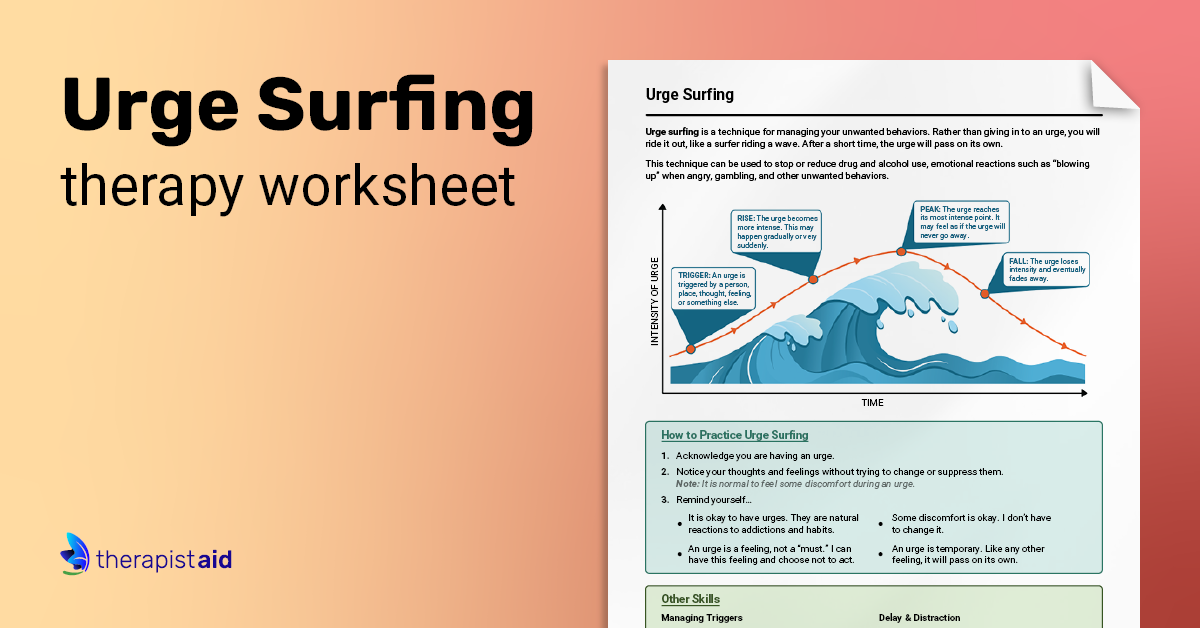
You do not need to wait for a perfectly identifiable “peak.” An urge may rise and fall unevenly, linger, or return. The useful discovery is smaller: you can feel an urge and choose not to carry out its first proposed action. Sometimes that choice lasts only a few breaths before you decide what needs attention. That still counts.
A brief acceptance practice
Use a mild social frustration, rather than a highly distressing event, for this first practice. Set aside about four minutes in a place where you can pause safely. The aim is to experience the distinction between allowing a feeling and acting on an urge, not to produce calm on demand.
- Settle and recall. Feel your feet on the floor or the support beneath you. Bring to mind a minor interaction that still produces a little discomfort. Keep the recollection light; there is no need to reconstruct every detail.
- Name what is here. Silently use a phrase such as, “There is irritation,” or “There is disappointment.” Notice one bodily sensation and, if present, one action urge: “My shoulders are tense, and I want to argue.”
- Allow and observe. For several breaths, let the sensation be present without trying to force it away and without rehearsing an impulsive response. Notice whether its intensity changes, stays similar, or shifts location. A phrase such as “I can make room for this feeling for now” may help.
- Return to your surroundings. Notice a sound, the contact of your feet with the floor, or an ordinary task in front of you. If the feeling returns, acknowledge it again. Then close the practice.
If the memory becomes too intense, stop recalling it and orient to your surroundings. This practice is not a requirement to endure overwhelming distress or remain in an unsafe interaction.
In daily life, a shorter version may be enough: “I’m angry. My jaw is tight. I want to snap. I can pause before deciding.” Once you have that space, you can still assess whether something needs to change. If an immediate safety issue calls for action, act on it; acceptance does not require delay in the face of danger.
Acceptance is a beginning, not the whole response
Return to the interruption example. After allowing the initial irritation, you may decide that it was a one-off and let it pass. You may decide that your point still needs to be heard. Or you may notice a recurring pattern that needs addressing. Acceptance does not make those decisions for you. It helps prevent the first surge of feeling from making them automatically.
A useful sign that you are practicing acceptance rather than resignation is that your options remain open. You can acknowledge a feeling without treating it as proof of wrongdoing; you can refrain from snapping without pretending the interaction was fine. The need for a turn to speak may still be real.
The key takeaway is simple but demanding: let the feeling and urge be present long enough to choose your behavior. In the next lesson, that choice becomes more concrete through a respectful request or boundary that addresses an unmet need.