Hello, and welcome to the final lesson in our module on Budget Allocation & Bidding. In our last session, we developed a framework for diagnosing overspending and underspending by analyzing how budget flows relative to performance. We established that these patterns are often symptoms of deeper structural issues, like rigid budgets or a lack of a systematic rebalancing process.
Today, we'll examine the core mechanism that governs this budget flow: the choice between Ad Set Budget Optimization (ABO) and Campaign Budget Optimization (CBO), now officially called Advantage+ campaign budget. Your decision here is one of the most fundamental strategic levers you have for controlling cost, scale, and performance. For your audit, understanding not just what they are, but why and when to use each one is crucial for unlocking efficiency. We will establish how to audit your current usage and build a sophisticated framework for choosing the right strategy for the right job.
1. The Fundamental Choice: Control vs. Efficiency
At its heart, the ABO vs. CBO decision is a trade-off. You are choosing between direct, granular control over your spending and automated, algorithmic efficiency. As a performance marketer, you've certainly toggled this setting many times, but let's formalize the definitions to ground our audit.
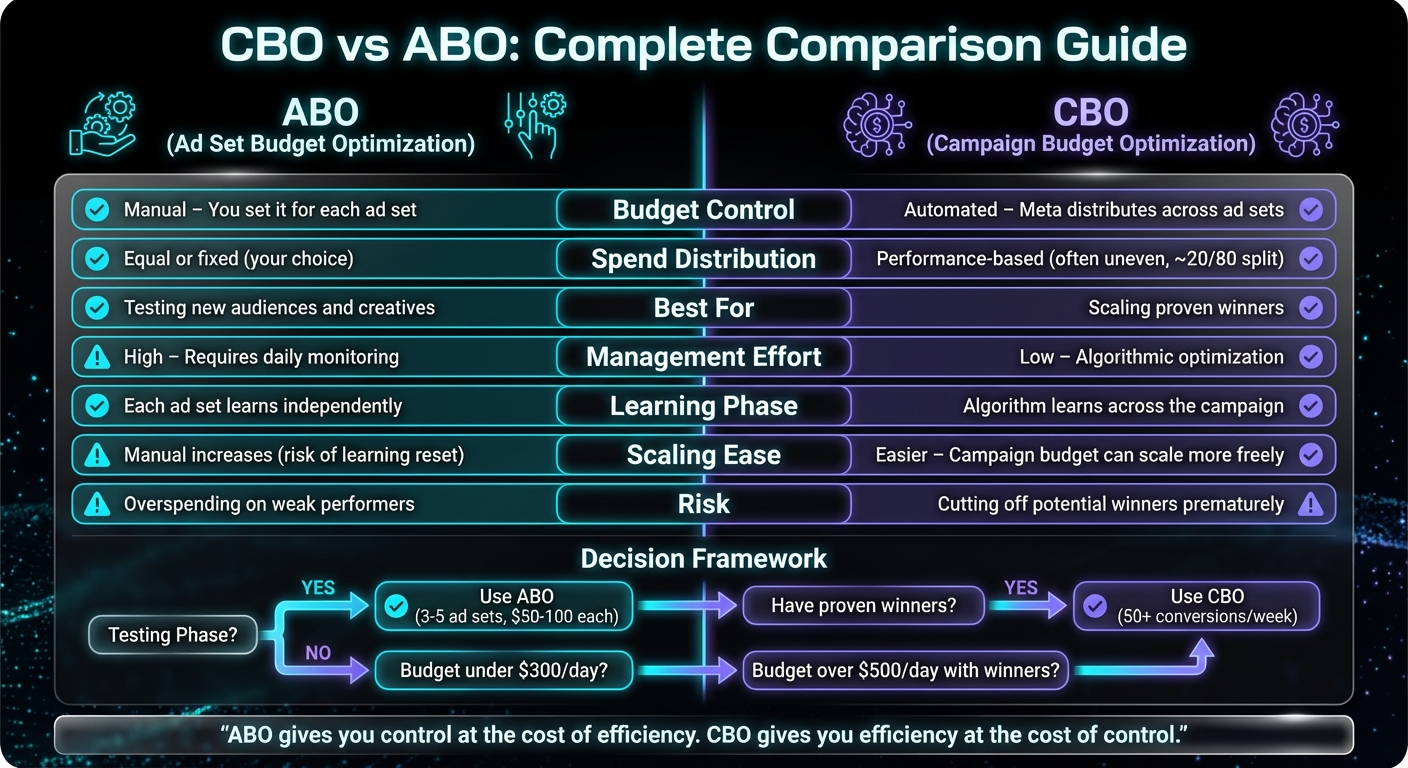
- Ad Set Budget Optimization (ABO): You set a specific budget for each ad set. Meta is obligated to spend that budget on that ad set, regardless of its performance relative to other ad sets in the campaign.
- Campaign Budget Optimization (CBO): You set a single, unified budget at the campaign level. Meta's algorithm then dynamically distributes that budget across all the ad sets within the campaign, aiming to spend more on the ad sets it predicts will deliver the best results.
This visual from Ads Uploader perfectly illustrates the difference in budget flow.

The article where this image originates provides an excellent primer on the core concepts.
ABO vs CBO: Which Budget Strategy Actually Works in 2026
This article from Ads Uploader provides a practitioner-focused breakdown of ABO and CBO. It cuts through the typical jargon to focus on practical application.
Read the introduction, followed by the sections defining ABO and defining CBO. This will establish the foundational mechanics we'll build on.
The fundamental trade-off, as the article states, is that "ABO gives you control at the cost of efficiency. CBO gives you efficiency at the cost of control." Your audit must determine if the account is making this trade-off consciously and correctly.
2. Auditing Your Current CBO vs. ABO Implementation
Your first step in the audit is to inventory your current campaign structures. Export your campaign list and create a column indicating whether each uses ABO or CBO. Then, for each type, analyze its effectiveness.
Auditing ABO Campaigns
For campaigns using Ad Set Budgets, you are looking for signs of manual inefficiency. In Sam Piliero's video, he walks through a classic example of a flawed ABO account.
Facebook Ads ABO vs CBO - Which Should You Use in 2026?
This video critically examines an ABO campaign structure, highlighting common red flags that indicate wasted spend and manual toil.
Watch the segment from this example where he breaks down an ABO account. Pay close attention to his critique: one of the highest-spending ad sets has one of the worst ROAS figures. This is the primary risk of ABO—manually overspending on underperformers.
As you review your own ABO campaigns, ask these questions:
- Is spend proportional to performance? Sort your ad sets by spend and then by your primary KPI (ROAS, CPA). Are your highest-spending ad sets also your best performers? If not, you are manually perpetuating the "overspending" we identified in the last lesson.
- How much "gardening" is required? Look at the number of paused ad sets. A high volume of manually paused ad sets suggests you are spending significant time and effort acting as a human CBO algorithm, a role Meta's machine learning can often perform more efficiently.
- Are you testing or scaling? If these are evergreen scaling campaigns, why are you forcing budget into specific ad sets rather than letting the algorithm find the most efficient placements?
Auditing CBO Campaigns
For CBO campaigns, you're auditing the algorithm's decisions and whether you're creating the right conditions for it to succeed.
CBO often results in a Pareto distribution of spend—roughly 80% of the budget flows to 20% of the ad sets. This is by design. However, you need to verify this is working in your favor.
While reviewing your CBO campaigns, consider these points:
- Is the algorithm picking the right winners? Verify that the ad sets receiving the most budget are, in fact, the ones with the best CPA or ROAS. Sometimes, as the AdStellar article notes, CBO can get this wrong.
- Are you over-constraining the algorithm? In the last lesson, we discussed using ad set spend limits to control test budgets. In your audit, check if you are using minimum or maximum spend limits permanently. Using them indefinitely defeats the purpose of CBO. The goal is to provide guardrails, not handcuffs.
- Is creative fatigue a factor? As noted in the resource below, CBO may shift budget away from a fatigued ad, but the alternatives may be worse. This is a potential failure mode to check for.
Meta Advertising Budget Allocation Problems: Fix Guide
This article from AdStellar explores the root causes of budget allocation problems, including how CBO can sometimes make suboptimal decisions.
Read the subsection on CBO's potential pitfalls. The key insight is that the algorithm may prioritize ad sets that can spend easily (e.g., large audiences) over those that spend profitably.
3. A Strategic Framework for Choosing Your Strategy
After auditing what is, the next step is to determine what should be. There is no single "best" strategy; the optimal choice depends entirely on your objective for that specific campaign.
The "ABO vs CBO" article provides a clear, actionable framework for this decision.
ABO vs CBO: Which Budget Strategy Actually Works in 2026
This resource moves beyond definitions to provide a strategic decision framework based on your goals and resources.
Read the sections When ABO Actually Makes Sense and When CBO Makes More Sense. This is the core strategic guide for your audit.
Here's a summary of the key decision criteria from the article:
Use ABO when:
- Your Goal is a Fair Test: You need to force equal spend across several ad sets to gather clean performance data on new creatives or audiences. CBO will not guarantee this.
- You Have a High Creative "Hit Rate": This is a critical point. If you know from experience that 7 out of 10 new ads you launch are successful, ABO is efficient because you're mostly forcing spend into winners. If your hit rate is low (e.g., 2 out of 10), ABO guarantees you will waste 80% of your testing budget on losers.
- You are Prepared for Hands-On Management: ABO requires daily monitoring and manual adjustments.
Use CBO when:
- Your Goal is Scaling Proven Winners: You've already identified your best-performing ads and audiences. CBO is the most efficient way to allocate a large budget across these winners to maximize overall results.
- Your Creative Hit Rate is Uncertain: CBO acts as a safety net. It will automatically reduce spend on losing ad sets, protecting your budget from being wasted.
- You Prefer Stability and Less Management: CBO automates the budget allocation and allows for larger budget increases without resetting the learning phase, making it more stable for scaling.
4. Advanced Hybrid Models for Pros
The most sophisticated advertisers don't see this as an "either/or" choice. They use both strategies in a structured workflow.
Model 1: The "Happy Medium" - CBO with Temporary Minimums
This model attempts to get the best of both worlds: testing fairness and scaling efficiency. It's an excellent strategy for most situations.
Facebook Ads ABO vs CBO - Which Should You Use in 2026?
Sam Piliero outlines his preferred method for testing within a CBO environment, which provides a practical solution to the "fair test" problem.
Watch his explanation from ad set budget minimums. He explains how to set a minimum daily spend (e.g., 1x your target CPA) on a new ad set for 7-14 days. This forces an initial test. After that period, you remove the minimum and let the ad set compete freely within the CBO.
This approach, also detailed in the adsuploader.com article, is powerful because it guarantees an initial read on new creative without sacrificing the long-term efficiency of CBO.
Model 2: The Two-Campaign Workflow & A Critical Counterpoint
A classic advanced setup involves physically separating testing and scaling campaigns.
ABO vs CBO: Which Budget Strategy Actually Works in 2026
This section details the workflow used by many high-level media buyers to separate testing and scaling functions.
Read the section How Top Media Buyers Use Both Together. The workflow is: Test new creatives in a dedicated ABO campaign to get clear, controlled data. Identify winners. Move the winning ad (using its Post ID to preserve social proof) into a large CBO campaign for efficient scaling.
This is a clean, logical system. However, there's a critical counter-argument you need to consider, which Nick Theriot explains brilliantly.
Facebook Ads 2024: ABO or CBO (Explained!)
In this video, Nick Theriot explains why his thinking evolved from using ABO for testing to using a pure CBO approach.
Watch his explanation of the "low-hanging fruit" problem. His key insight is that an ad that "wins" on a small $20/day ABO budget is often just capturing the easiest conversions. When you move that ad to a highly competitive, high-spend CBO campaign, it often fails because it can't compete for more expensive, harder-to-get conversions. Then, watch how this changed his definition of a winning ad. A true winner isn't one with a good ROAS on a small budget; it's an ad that can command a large portion of a CBO budget and improve the entire account's CPA. Finally, see how he tests now by launching directly into a CBO and judging an ad by its ability to capture spend.
This perspective is vital for your audit. If you see a testing structure that relies on low-budget ABO campaigns, you should question whether the "winners" it produces are truly scalable. The ultimate test of an ad is its ability to perform in the hyper-competitive, high-spend environment of your main CBO scaling campaign.
Conclusion
Auditing your account's use of CBO and ABO is not about finding a single "correct" setting. It's about ensuring your budget strategy aligns with your campaign goals.
Your key takeaways are:
- The Core Trade-Off: ABO offers manual control, ideal for forced-spend testing. CBO offers algorithmic efficiency, ideal for scaling proven winners.
- Audit with Intent: Analyze your existing campaigns to see if the chosen budget strategy matches the campaign's objective (testing vs. scaling). Look for signs of inefficiency, like manually managed ABO campaigns with poor performance, or over-constrained CBOs.
- Adopt a Strategic Framework: Use criteria like your creative hit rate, management capacity, and campaign goal to decide which strategy to deploy.
- Consider Advanced Models: For a robust system, use hybrid approaches like CBO with temporary minimums or test directly within a competitive CBO environment to find truly scalable winners.
In this module, we've dissected your account's financial engine: budget levels, bid strategies, spending patterns, and now, the budget allocation method. With this complete, we are ready to move on. Our next module, Audience Strategy Audit, will look at who you are spending this budget on, starting with one of the most common sources of inefficiency: audience overlap.