Introduction
In our last lesson, we deconstructed the climax into a precise mechanism: a Forced Decision leading to a Decisive Action that produces an Irreversible Outcome. That final component, the Irreversible Outcome, is the moment the story's central conflict is settled. It provides the definitive answer to the core question you posed at the beginning of the narrative.
Today, we will focus on what happens immediately after that answer is delivered. While the climax resolves the conflict, the story isn't quite over. The reader needs to see and process the consequences of that resolution. Our goal is to distinguish between resolution (answering the core question) and denouement (showing the new normal). We will treat these not as vague synonyms but as two distinct, sequential mechanical components of a story's ending.
1. A Precise Functional Distinction
In many contexts, the terms "resolution" and "denouement" are used interchangeably, leading to confusion. For our purposes as writers engineering a story, we will define them with functional precision. A good way to separate them is by looking at their origins, which hint at their different jobs.
- Resolution: This term comes from the Latin resolvere, meaning "to loosen, to reduce into simpler forms." Think of this as the act of solving the problem. The resolution is the direct, immediate result of the climax—the single moment the core question is answered.
- Denouement: This term is French for "untying." Think of this as the process of showing the untied knot. It's not the single moment of solving, but the aftermath where all the resulting loose ends are tied up and the consequences are displayed.
Visually, you can map these to the plot's structure:
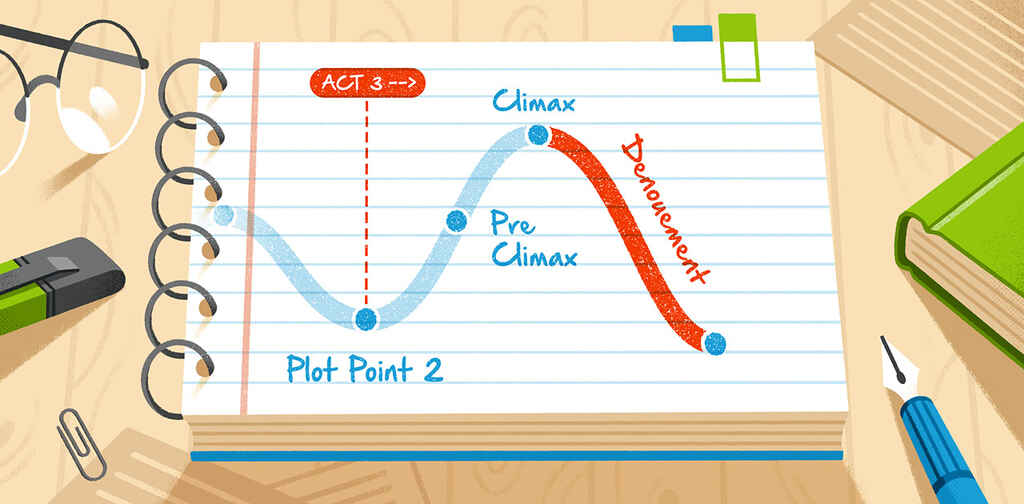
So, our formal definitions are:
- Resolution: The direct, irreversible outcome of the climax that answers the central story question.
- Denouement: The sequence of scenes following the resolution that validates the story's changes and establishes the "new normal."
2. The Function of Resolution: Answering the Question
The function of the resolution is singular: to answer the story's core question. It is the immediate effect of the protagonist's decisive action in the climax.
Let's revisit the example from our last lesson, The Hunger Games:
- Core Question: Can Katniss survive the Games without losing her humanity by killing Peeta?
- Climax: Katniss and Peeta decide to eat the poisonous berries, defying the Capitol.
- Resolution: The Gamemakers capitulate and declare them both winners.
The resolution is that one, clear outcome: they both survive. The central problem of the climax is solved.
Let's look at another example from the discussion on the Writing Stack Exchange.
Denouement vs Resolution - plot
The selected answer in the post 'Denouement vs Resolution' on Writing Stack Exchange offers several clear examples that help isolate the 'problem-solving' nature of a resolution.
Please read the examples provided for the movies Lucky Number Slevin, Signs, and The 6th Sense. For each one, identify the core problem that is being solved in what the author calls the 'resolution.'
In Signs, the resolution is the family surviving the alien attack. The problem is "Will they survive?" and the resolution is "Yes." It's a direct, binary answer. The story's primary tension is released at this moment.
3. The Function of Denouement: Showing the New Normal
If the resolution is the event, the denouement is the fallout. Its job is not to resolve the main conflict (that's already done) but to show the reader the shape of the world after that resolution. This has two primary mechanical functions: validating the change and establishing the new status quo.
To understand this, let's look at a resource that explains the denouement's purpose in detail.
Story Structure Explained: Climax, Denouement, Epilogues ...
The article 'Story Structure Explained...' by September C. Fawkes provides a clear, functional breakdown of the denouement. We'll use it to define its core responsibilities.
Please read the section titled 'Denouement.' Focus on its two key jobs: first, 'validating' that the events of the story mattered, and second, establishing the 'new normal' in a way that complements the story's setup.
Based on this reading, we can codify the two functions of the denouement:
- To Validate Change: The denouement provides proof that the climax had real consequences. It shows the antagonist is truly defeated, the lovers are happy together, a death is mourned, or a character's internal transformation is permanent. Without this validation, the climax can feel cheapened or unbelievable.
- To Establish the "New Normal": A story moves a character and their world from an initial state of normality (the Setup) to a final one. The denouement's job is to paint a picture of this new normal. It acts as a mirror to the Setup, highlighting the changes. If the Setup showed a lonely character, the denouement might show them surrounded by friends.
Test your understanding!
Scenario:
- Setup: A brilliant but arrogant surgeon is fired from his prestigious job after his recklessness harms a patient. He loses his status, wealth, and identity.
- Climax/Resolution: In a remote, under-equipped clinic, he uses improvised tools and clever thinking to successfully perform a life-saving surgery on a child, prioritizing the patient's life over his ego for the first time.
What scenes would you expect to see in the denouement to validate his change and establish his new normal?
Show answer
A well-constructed denouement would need to show proof of the change. We might see scenes like:
- Validation: The surgeon patiently teaching a local nurse a medical technique, showing a shift from arrogance to mentorship.
- Validation: He receives a job offer from a big city hospital but turns it down, showing his values have changed.
- New Normal: We see him weeks later, still working at the remote clinic, looking content and fulfilled despite the lack of prestige. This visually contrasts with his initial state of wealthy misery.
These scenes don't resolve the main conflict (that happened in the surgery) but demonstrate the lasting impact of that resolution.
4. Case Study: Deconstructing the Spider-Verse Denouement
Let's apply this framework to a complete example. The Spider-Verse breakdown in the resource we just read is an excellent case study for seeing these functions in action.
Story Structure Explained: Climax, Denouement, Epilogues ...
Now, let's analyze the detailed breakdown of the denouement in Into the Spider-Verse from the same article to see how each moment serves a specific structural purpose.
Please review the section under the heading 'In Spider-verse' within the 'Denouement' part of the article. As you read, map each beat to one of our two defined functions: 'Validating Change' or 'Establishing the New Normal.'
Let's systematize the analysis from the article into a table.
| Denouement Beat from Into the Spider-Verse | Function 1: Validate Change | Function 2: Establish New Normal |
|---|---|---|
| Kingpin is shown caught in a web, being arrested. | Validates that the antagonist is truly defeated and facing consequences. | The city is now safe from Kingpin's collider threat. |
| Miles says "I love you" to his dad by choice, not by force. | Validates his character arc and the healing of his family relationship. | Miles has a healthier, more open relationship with his father. |
| The other Spider-people are shown safe and sound in their home dimensions. | Validates the success of the mission and their survival after the climax. | Their own stories continue, reinforcing the multiverse concept. |
| Peter B. Parker brings flowers to Mary Jane. | Validates his climactic decision to face his personal failures. | He is actively working to repair his marriage, starting a new chapter in his life. |
| Miles applies himself at school and puts up his art with his dad. | Validates his newfound confidence and acceptance of responsibility. | Miles is no longer running from his potential, integrating both sides of his life. |
| Miles delivers the monologue: "Anyone can wear the mask." | Validates the final step of his internal journey into becoming Spider-Man. | He has fully embraced his new identity and role as the city's protector. |
This systematic breakdown shows that no part of the denouement is random. Every beat serves the mechanical purpose of demonstrating the consequences of the climax, providing the reader with both logical and emotional closure.
Conclusion
Today, we've dissected the final moments of a story's structure, establishing a clear, functional difference between the resolution and the denouement.
Key Takeaways:
- Resolution is the singular, irreversible outcome of the climax. It is the event that directly answers the central story question.
- Denouement is the sequence that follows the resolution. Its function is to demonstrate the aftermath.
- The denouement has two primary jobs: validating the changes that occurred and establishing the "new normal" for the characters and their world.
- A useful model is to think of the denouement as a mirror image of the story's Setup, providing a before-and-after picture that makes the story's total transformation clear.
Preview of the Next Lesson:
Now that we have examined the complete macro-structure of a narrative—from the initial setup, through the midpoint and climax, to the final denouement—we will begin to zoom in on the building blocks of that structure. In our next lesson, we will focus on scene order logic, and you will learn to analyze how rearranging scenes can strengthen or break a story's crucial chain of cause and effect.