Introduction
In our last lesson, we completed our high-level overview of a story's architecture by distinguishing between the resolution and the denouement. We established that the resolution is the singular event that answers the core story question, while the denouement is the sequence of scenes that demonstrates the consequences and establishes the "new normal."
Having mapped the entire narrative from start to finish, we will now zoom in to analyze the logical connections that hold this structure together. The learning outcome for this lesson is to analyze scene order by testing if rearranging scenes breaks the story's causal logic. We will treat scene sequencing not as an intuitive art but as a problem of logical dependency. The goal is to understand the underlying algorithm that dictates why Scene C must follow Scene B, which in turn must follow Scene A.
1. The Causal Chain: "Therefore" vs. "And Then"
At its core, a plot is a chain of cause and effect. A random sequence of events, even if interesting, does not constitute a plot. For a narrative to feel cohesive and compelling, each scene must be the logical result of what came before it.
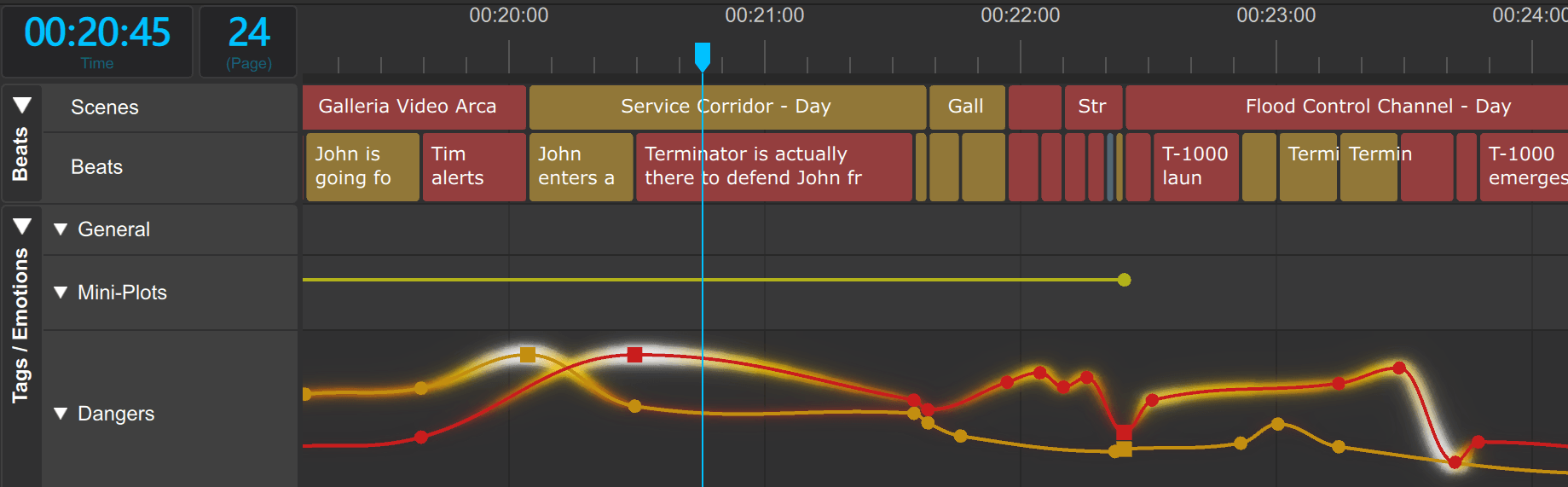
Imagine a writer planning their story by arranging scenes on a wall, like a storyboard.

A simple but powerful diagnostic for testing the strength of your scene order comes from author and writing teacher David Corbett. He suggests a simple test for the transition between any two scenes.
The provided handout, 'The Mechanics of Scene' by David Corbett, contains a concise and highly effective test for causal logic. We'll extract this core principle to use as our primary tool.
Please read the short paragraph under the heading 'The Character’s Perspective' that begins with 'Important: Focus on causality...'. Pay close attention to the 'But' or 'Therefore' test.
As the resource states, the transition between scenes should be expressible as "Therefore" or "But."
- "Therefore" implies a direct, expected consequence. (The detective found the clue, therefore he went to the warehouse.)
- "But" implies a consequence that introduces conflict or reversal. (The detective found the clue and went to the warehouse, but it was a trap.)
If the transition can only be described as "And then...", you have an episodic structure, not a causal one. (The detective found the clue, and then he went bowling, and then a different character did something unrelated.) An "And then..." sequence breaks the chain of causality, often leading to a story that feels meandering and lacks momentum.
2. A Mechanical Model for Causality: Scene and Sequel
While the "Therefore/But" test is an excellent diagnostic, we also need a generative model for building these causal chains. A robust mechanical framework for this is the Scene/Sequel structure, as codified by Dwight Swain.
This model breaks down all narrative units into two types of building blocks: Scenes and Sequels.
To understand this model, we'll turn to Randy Ingermanson's article 'Writing The Perfect Scene,' which provides a clear explanation of Swain's system.
Please read the section titled 'Large-Scale Structure of a Scene.' Focus on the three-part patterns for both a 'Scene' (Goal, Conflict, Disaster) and a 'Sequel' (Reaction, Dilemma, Decision), and most importantly, how the end of one logically initiates the next.
Let's break down this narrative algorithm:
-
The Scene (Action Phase):
- Goal: The POV character enters the scene with a specific, tangible objective.
- Conflict: They face obstacles in trying to achieve this goal.
- Disaster: The scene ends in failure. The goal is not met, or is met at a terrible cost. This outcome is a "disaster" for the character's immediate plan.
-
The Sequel (Reaction Phase):
- Reaction: The POV character processes the emotional and physical impact of the Disaster.
- Dilemma: After the initial reaction, the character assesses their new, worsened situation and realizes they have no good options.
- Decision: They are forced to make a choice, committing to a new course of action. This decision becomes the Goal for the next Scene.
The power of this model lies in its inherent causal linkage.Disaster(Scene_N) -> Reaction(Sequel_N) -> Dilemma(Sequel_N) -> Decision(Sequel_N) -> Goal(Scene_N+1)
This creates a continuous loop where each action phase (Scene) logically necessitates a reaction phase (Sequel), which in turn generates the motivation for the next action phase. It's a system designed to prevent "and then..." storytelling.
Test your understanding!
Here are four jumbled plot beats for a spy thriller. Your task is to arrange them in a logical causal order using the Scene/Sequel framework.
A. The spy, hiding in an air duct, realizes her only two options are to surrender to the guards below or attempt a dangerous jump to a nearby rooftop.
B. The spy decides to risk the jump, formulating a new goal: get to the rooftop extraction point.
C. The spy's attempt to download the secret files is interrupted when alarms blare and guards storm the server room, forcing her to abandon the computer.
D. Adrenaline surging, the spy scrambles for cover as bullets fly, feeling the sting of failure and the terror of being trapped.
Show answer
The correct order is C -> D -> A -> B. Here's the breakdown:
- C (Disaster): This is the end of a Scene. The spy had a goal (download files) and met conflict (alarms, guards), ending in disaster (mission aborted, trapped).
- D (Reaction): This is the immediate, visceral reaction to the disaster. It's pure emotion and reflex.
- A (Dilemma): After the initial reaction, the spy assesses her situation, which presents a clear dilemma with no good options.
- B (Decision): The spy makes a choice, which creates a new Goal (get to the rooftop), setting up the next Scene.
3. Causality at the Micro-Scale: Motivation-Reaction Units (MRUs)
This same principle of cause and effect doesn't just operate at the scene level; it functions at the paragraph and even sentence level. Swain calls this micro-structure Motivation-Reaction Units (MRUs). This is the same logic as Scene/Sequel, just zoomed in.
Let's return to the 'Writing The Perfect Scene' article to see how this causal logic is implemented at a granular level.
Read the section 'Small-Scale Structure of a Scene.' Focus on the alternating pattern of Motivation (external, objective) and Reaction (internal, subjective), and the specific order within the Reaction (Feeling -> Reflex -> Rational Action).
The MRU pattern is an algorithm for a single exchange of cause and effect:
-
Motivation: An external event occurs. The character sees, hears, or feels something. It's presented objectively.
Example:The tiger dropped out of the tree and sprang toward Jack. -
Reaction: The character reacts to that motivation. This is internal and subjective, and must follow a specific physiological order:
- Feeling (instantaneous): Adrenaline, fear, surprise.
- Reflex (instinctive): Flinching, dodging, raising a weapon.
- Rational Action/Speech (deliberate): Thinking, acting on a plan, speaking.
Example:A bolt of raw adrenaline shot through Jack’s veins (Feeling). He jerked his rifle to his shoulder (Reflex), sighted on the tiger’s heart, and squeezed the trigger (Rational Action).
The result of the character's reaction then becomes the next motivation for another character or a change in the environment, creating a micro-causal chain that propels the scene forward beat by beat.
Understanding this shows that causal logic is a fractal principle in narrative: the same pattern of "stimulus and response" that connects scenes also connects the paragraphs and beats within them.
Conclusion
In this lesson, we have established that effective scene order is not arbitrary but is governed by a strict logic of cause and effect. Breaking this logic results in an episodic, meandering narrative that lacks drive.
Key Takeaways:
- A strong plot is a chain of causality. Scenes should be linked by "Therefore" or "But," not "And then..."
- The Scene/Sequel model provides a robust mechanical framework for ensuring this causal linkage. A Scene's Disaster causes a Sequel's Reaction, and a Sequel's Decision provides the next Scene's Goal.
- This principle of causality is fractal. The Motivation-Reaction Unit (MRU) applies the same cause-and-effect logic at the micro-level of beats and paragraphs within a scene.
- By analyzing a story's structure through this lens, you can test its logical integrity. If you can rearrange two sequential scenes without breaking the narrative's logic, it's a sign that the causal link between them is weak or nonexistent.
Preview of the Next Lesson:
Now that we have analyzed the logical ordering of scenes, we will turn our attention to the handling of time within those scenes. In the next lesson, we will learn to identify the strategic use of time compression (summary) versus time expansion (dramatization), giving you control over the story's pacing.