Introduction
Welcome back. In our previous lessons, we established the first two components of our scene-writing algorithm: Goal and Conflict. A character with a clear Goal meets an Opposing Force. This creates the potential for a story.
Today, we analyze the dynamic process that unfolds from that initial collision. Conflict is not a static wall; it's a chain reaction. The learning outcome for this lesson is to analyze conflict escalation within a scene, tracking the progression of actions and reactions.
We will deconstruct this process into its mechanical parts. You will learn how a conflict grows in intensity, how the stakes are raised, and how a sequence of causally-linked actions and reactions creates the forward momentum of a scene.
1. Conflict Escalation as a Domino Effect
At a high level, conflict escalation functions like a domino effect. A character's attempt to overcome an obstacle doesn't solve the problem; instead, it triggers a new, often worse, consequence. This consequence then forces the character to act again, which in turn leads to another consequence, and so on. The conflict intensifies with each exchange.
How To Write Conflict In A Scene \\ Writing Great Scenes, Video 3
The video 'How To Write Conflict In A Scene' by Heart Breathings provides an excellent breakdown of this principle. It demonstrates how to layer conflict and create a causal chain of negative consequences, which is the essence of escalation.
Watch the video, paying close attention to these key sections: The Roommate Example (08:27 - 13:52): Observe how a simple conflict (getting rent money) escalates. The initial failure leads to a fight with the boyfriend, which leads to losing a job. This is a perfect illustration of the domino effect. Intensity and Stakes (13:52 - 15:37): Note the direct relationship between the potential consequences (stakes) and the intensity of the conflict. The Fantasy Example (16:42 - 18:42): See how the heroine's failure to persuade the prince doesn't just end the scene; it creates a much worse situation (imprisonment) with dire consequences for her sister, escalating the overall problem. Focus on how each action and its outcome makes the character's situation progressively more difficult.
As the video shows, escalation isn't about making a scene louder or more violent. It's about systematically increasing the pressure on the character by making the consequences of their actions more severe. The situation moves from bad to worse.
2. The Engine of Escalation: Chaining Actions and Reactions
The domino effect we just discussed is built from smaller, interlocking parts. The micro-structure of this escalation is a chain of Motivation-Reaction Units (MRUs).
In our previous lessons, we defined an MRU as a pair:
- Motivation: An objective, external event.
- Reaction: The character's subjective response.
The key to escalation is that in a conflict, one character's Reaction becomes the other character's Motivation. This creates a back-and-forth exchange that drives the scene forward.
Let's revisit the core principle from "Writing The Perfect Scene," which you studied previously. An MRU doesn't exist in isolation. As Randy Ingermanson writes, "after the Reaction comes . . . another Motivation. This is the key. You can’t afford to write one perfect MRU and then be happy. You’ve got to write another and another and another."
Consider this simple, escalating chain:
- Motivation (Opponent): A tiger drops from a tree toward Jack.
- Reaction (Jack): Feels fear, jerks his rifle up, and shoots.
- New Motivation (Opponent): The bullet only wounds the tiger. It roars and leaps directly at Jack's throat.
- New Reaction (Jack): ???
Jack's reaction (shooting) did not solve the problem; it created a new, more immediate, and more dangerous motivation (an enraged, wounded tiger attacking). The conflict has escalated.
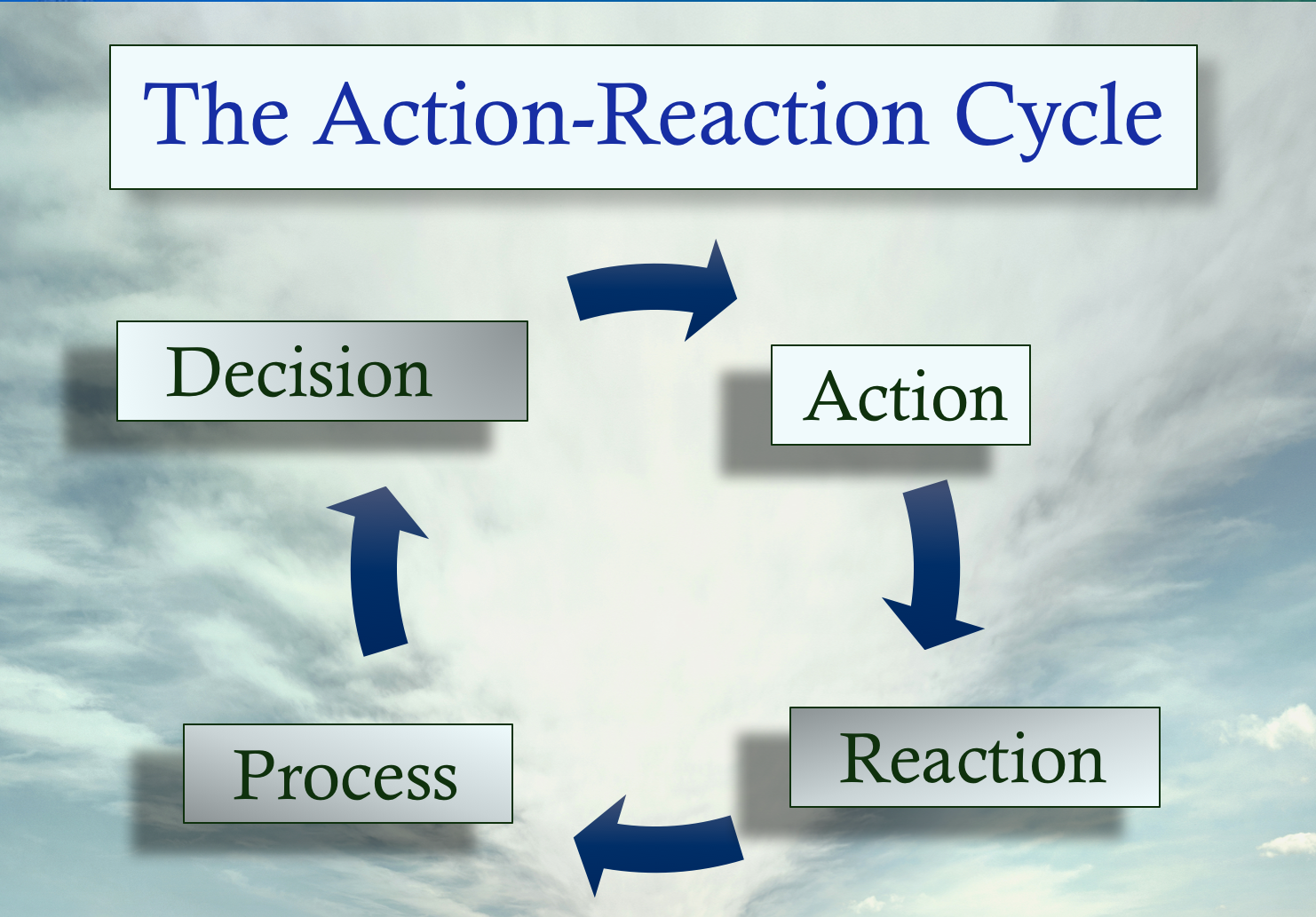
This cycle of action and reaction is the fundamental engine of narrative progression.
3. The Anatomy of a Reaction: A Sequential Algorithm
To track the action-reaction chain accurately, we must understand the internal structure of a single reaction. Human responses to stimuli are not random; they follow a predictable, physiological sequence from involuntary to voluntary. For a writer, this provides a clear algorithm.
Writing Motivation-reaction Units (MRUs According to Swain)
The article 'Writing Motivation-reaction Units' offers a precise, technical breakdown of this sequence. It refines the basic MRU concept into a more granular process that is essential for tracking escalation clearly.
Please study two sections of this article: Start under the heading 'In Swain's approach to MRUs, he outlines the natural reactions in this order'. Read about the sequence: Feeling -> Action -> Speech. This is the classic model, moving from the most involuntary to the most intentional response. Notice how putting these out of order can disrupt the reader's sense of cause and effect. Next, read the section titled 'Updates to Swain's MRUs'. This section provides a more comprehensive, updated algorithm from Ross Hartmann. Pay close attention to this list: Physiological Reaction (heart rate, sweating) Physical Reaction (instinctual reflex) Emotional Reaction (crying, sighing) Analytical Reaction (conscious reasoning, weighing options) Anticipation (projecting future outcomes) This detailed sequence is a powerful diagnostic tool for analyzing and constructing character responses.
This ordered sequence is critical. It ensures that a character's response feels authentic and allows the reader to follow their internal processing. When analyzing a scene's escalation, you are essentially tracking how each Motivation triggers this sequence in a character, and how their final Analytical Reaction and subsequent action then becomes the next Motivation for the opposing force.
4. Case Study: Deconstructing an Escalating Scene
Let's apply this framework to the "warrior's quest" example from the video how to write interesting conflict, which you analyzed in the previous lesson. We will now re-examine it not just for the types of conflict, but for the escalation of conflict through a chain of actions and reactions.
Initial State: Warrior's goal is to find a cure. Conflict is the journey itself.
- ACTION (Opponent): A lone bandit attacks the warrior.
- Conflict: Simple personal/physical threat.
- REACTION (Warrior):
- Physical: Easily disarms the bandit.
- Analytical: Decides to apply the law (punishment).
- The conflict appears resolved.
- NEW MOTIVATION: Warrior sees the bandit is a hungry child.
- REACTION (Warrior):
- Physiological/Emotional: Feels pity, hesitation, guilt.
- Analytical: Abandons her plan to punish him. She questions him instead.
- The conflict has escalated from a physical fight to an internal, moral dilemma.
- NEW MOTIVATION: The child explains his family is starving because of the king's new tax policy.
- REACTION (Warrior):
- Emotional: Feels complicit and disillusioned with the king she serves.
- Analytical/Action: Lets the child go.
- The conflict escalates further, becoming ideological. Her duty to the king is now in conflict with her duty to the people.
- NEW ACTION (Consequence): The child returns with a group of bandits who ambush the warrior.
- REACTION (Warrior):
- Emotional: Hesitates due to her guilt over the child.
- This hesitation creates a fatal opening.
- NEW MOTIVATION (Consequence): The bandits capture her.
- The conflict has escalated dramatically. The stakes have gone from a simple robbery to capture and potential death, all layered with her internal and ideological turmoil.
Each step in this chain is a direct consequence of the one before it. The warrior's attempt to handle one problem (the bandit) leads to a new one (the moral dilemma), and her solution to that (letting him go) leads to a far worse one (being captured). This is a masterclass in conflict escalation.
Test your understanding!
A corporate spy's scene goal is to copy a sensitive file from a rival company's server before a 5-minute timer runs out. The opposing force is a network security admin.
Analyze the following sequence. Identify the action-reaction pairs and explain how the conflict escalates.
- Spy's Action: Initiates the file transfer. A progress bar appears: 4% complete.
- Admin's Action: An intrusion alert flashes on the admin's screen. The admin begins tracing the spy's connection.
- Spy's Action: A warning icon appears on the spy's screen: "TRACE DETECTED." The spy activates a program to reroute their IP address through multiple servers. The file transfer slows down.
- Admin's Action: The admin's system identifies the rerouting protocol. The admin launches a "logic bomb" targeted at the spy's origin IP, set to detonate and wipe the spy's hard drive in 60 seconds.
Show answer
- Action-Reaction Pair 1: The spy's initial action (file transfer) becomes the motivation for the admin's reaction (starting a trace). The conflict begins.
- Action-Reaction Pair 2: The admin's trace becomes the motivation for the spy's reaction (rerouting the IP). The spy's counter-move introduces a new complication: the transfer slows, increasing the time pressure. The conflict has escalated from a simple theft to an active cat-and-mouse game.
- Action-Reaction Pair 3: The spy's rerouting becomes the motivation for the admin's final reaction (launching a logic bomb). The conflict escalates from risk of being caught to the risk of total data loss and system destruction. The stakes have been raised from failing the mission to catastrophic personal failure.
Conclusion
Today we have broken down conflict escalation into a predictable, mechanical process. It is not a mysterious art but a craft of building causal chains.
Key Takeaways:
- Escalation is a Chain Reaction: Conflict intensifies when a character's actions lead to new, worsening consequences, like a series of falling dominoes.
- The Engine is the MRU Chain: Escalation is driven by a back-and-forth exchange where one party's Reaction becomes the Motivation for the other.
- Reactions are Algorithmic: A character's response to a stimulus follows a logical and physiological sequence, from involuntary feeling to deliberate action. Tracking this sequence allows you to map the conflict precisely.
- Escalation Raises the Stakes: An effective escalation chain doesn't just make the situation more difficult; it raises the stakes, making the potential cost of failure much higher than it was at the start of the scene.
Preview of the Next Lesson
This constant escalation of action and reaction cannot continue forever. It builds pressure until something has to break, forcing a fundamental change in the situation. This moment is the scene's turning point. In our next lesson, we will learn to identify a scene's turning point by pinpointing a critical shift in information, power dynamics, or available options.