Introduction
Welcome back. In our last lesson, we analyzed how conflict escalates within a scene through a chain of actions and reactions. We saw this as a process of building pressure, where each attempt by the character to achieve their goal is met with an opposition that makes the situation progressively worse.
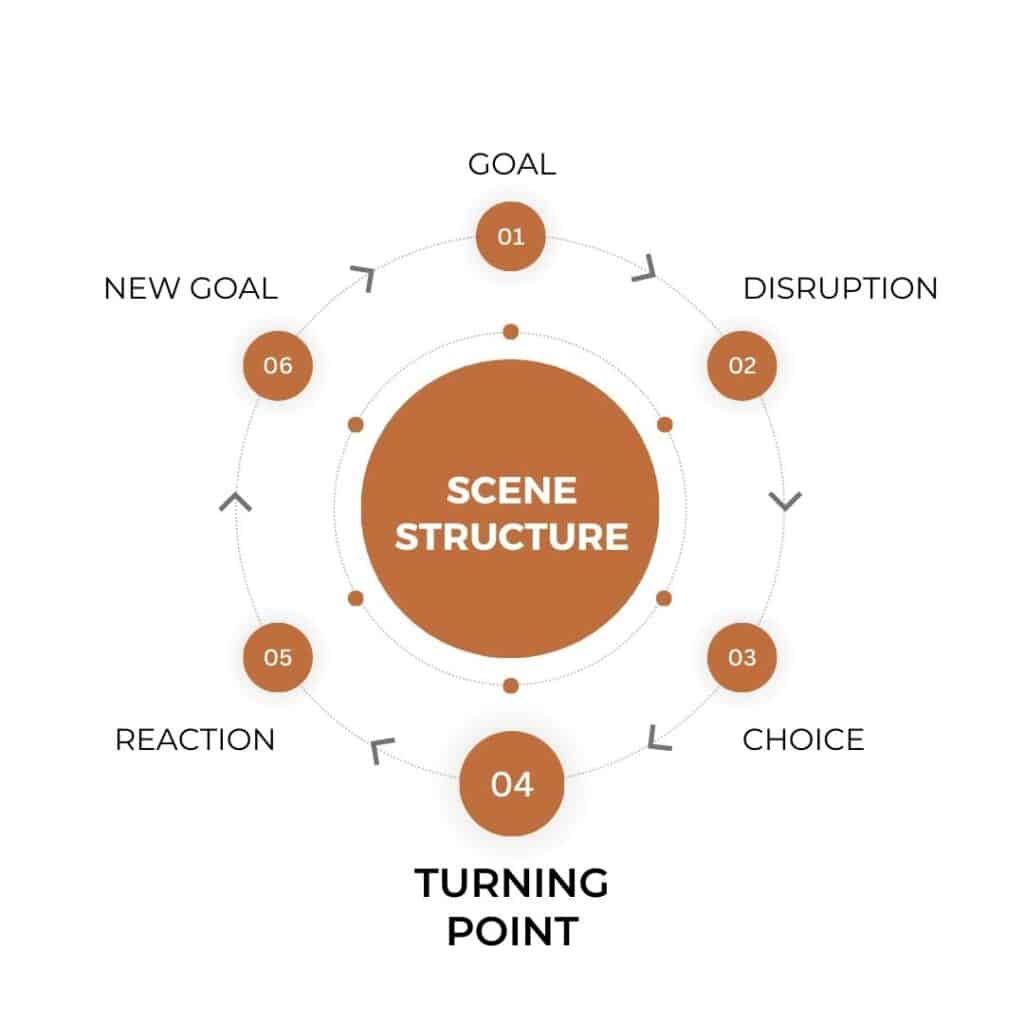
This escalating pressure cannot build indefinitely. It must lead to a breaking point—a moment where the scene's dynamic fundamentally shifts and the character's original plan becomes unworkable. This moment is the scene's turning point.
Today, we will focus on this critical component of scene structure. Your learning outcome is to identify a scene's turning point by pinpointing a shift in information, power dynamics, or available options. We will define what a turning point is, classify its primary types, and analyze examples to see how it functions as the pivot upon which a scene's outcome depends.
1. The Function of a Turning Point
A turning point is the fulcrum of a scene. It's the specific moment or event that caps the escalating conflict and forces the character into a new situation, compelling them to make a new, often more difficult, decision.
To begin, let's watch a segment that introduces the concept and its effect on the narrative.
How to Write Great Scenes — 4 Elements Every Scene Should Have
The video 'How to Write Great Scenes' from StudioBinder provides a concise definition of the turning point based on the work of screenwriting analyst Robert McKee.
Watch the section from 12:34 to 15:06. Focus on the four effects of a turning point as described by McKee: surprise, increased curiosity, insight, and new direction. Observe how the example from The Searchers demonstrates a dramatic shift in the story's trajectory.
As the video explains, a turning point isn't just another complication; it's a game-changer. It takes the existing conflict and either twists it, reverses it, or reveals a hidden truth that changes everything. Its function is to invalidate the character's current approach and force them to re-evaluate.
2. A Technical Classification of Turning Points
Your goal is to identify these shifts with precision. To do that, we can classify turning points into two primary categories, based on how they change the character's situation. This gives us a systematic way to analyze their mechanics.
How to Write a Well-Structured Scene
The article 'How to Write a Well-Structured Scene' by Savannah Gilbo offers a clear, practical distinction between the two main types of turning points.
Please read the section titled 'Commandment #2: There needs to be a turning point.' Pay close attention to the definitions provided for an active turning point and a revelatory turning point. This is the core classification system we will be using.
Let's codify these definitions:
- Active Turning Point: An action occurs in the scene's external reality that changes the conditions of the conflict. This could be an opponent's move, a physical event, or an unexpected arrival. This type of turning point directly impacts the power dynamics or the available options.
- Revelatory Turning Point: The character gains new information. This is an internal shift—a realization or discovery that reframes their understanding of the conflict. The change happens in the character's mind, but it is just as potent as an external event.
This binary classification—action vs. information—is a powerful diagnostic tool for pinpointing the exact moment a scene turns.
3. Case Studies: Identifying Shifts in the System
Let's use this framework to analyze examples. We will look for the specific moment that shifts the scene and classify it as active or revelatory.
The article "How to Write Scenes" from Story Grid provides excellent, pre-analyzed examples that we can deconstruct.
How to Write Scenes: Structure, Examples, and Definitions
This Story Grid resource provides several clear examples of the 'Turning Point Progressive Complication' (their term for the turning point) within the Five Commandments framework.
Focus on the 'Five Commandments' breakdown for each of the three examples provided: Hamilton, Pride and Prejudice, and The Silence of the Lambs. Specifically, examine the entry labeled 'Turning Point Progressive Complication' for each one.
Let's analyze these case studies using our classification system:
Case Study 1: Shift in Information (Revelatory)
- Source: The Silence of the Lambs
- Scene: Clarice Starling questions a man she thinks is a witness.
- Goal: Get information about a suspect.
- Turning Point: "Revelatory. Clarice realizes that the man who had called himself Jack Gordon is really Buffalo Bill."
- Analysis: This is a pure revelatory turning point. No external action forces the change; it is a moment of cognitive synthesis in Clarice's mind. The information she possesses clicks into place. This instantly changes her goal from "gather information" to "survive and capture." All her previous options are now obsolete.
Case Study 2: Shift in Available Options (Active)
- Source: Pride and Prejudice
- Scene: Mr. Darcy proposes to Elizabeth Bennet.
- Goal: Secure Elizabeth's hand in marriage.
- Turning Point: "Active. Elizabeth refuses Darcy’s proposal of marriage."
- Analysis: This is a quintessential active turning point. Elizabeth's refusal is an action that completely destroys Darcy's plan. His primary option—to get a "yes"—is removed from the table. The power dynamic shifts from him holding the power of the proposal to her holding the power of refusal.
Case Study 3: Shift in Power Dynamics (Active)
Now let's revisit the StudioBinder video for a visual example of a power shift.
How to Write Great Scenes — 4 Elements Every Scene Should Have
This segment from the StudioBinder video uses blocking and staging to physically manifest a turning point.
Watch the clip from 16:28 to 17:53, which analyzes a scene from Citizen Kane. Observe how the characters' physical positions in the room change. The moment Kane rises and looks down on Thatcher is the turning point.
- Analysis: In the Citizen Kane example, the turning point is active. It's a series of actions—Kane's speech, his change in posture, the camera's movement—that culminates in him physically and metaphorically towering over Thatcher. The power dynamic in the room is visibly inverted. Thatcher came in to lecture Kane; he leaves having been put in his place.
Test your understanding!
A negotiator (Sarah) is trying to convince a desperate man (Mark) not to detonate a bomb in a bank. Her goal is to talk him down. Mark's goal is to get a helicopter for a clean getaway. Sarah has been making progress, calming him down by promising to consider his demands.
Suddenly, a police sniper's red laser dot appears on Mark's chest. Mark sees it and his eyes go wide with panic and fury. "You were lying to me!" he screams, his hand tightening on the detonator.
What is the turning point of this scene? Classify it and explain how it shifts information, power, or available options.
Show answer
The turning point is the appearance of the sniper's laser dot.
-
Classification: This is an active turning point. It is an external event, an action taken by a third party (the sniper), that fundamentally changes the conditions of the scene.
-
Analysis of Shifts:
- Shift in Available Options: Sarah's primary option—de-escalation through trust and negotiation—is instantly vaporized. The situation is no longer a negotiation; it's a standoff seconds from detonation.
- Shift in Information: For Mark, the laser dot is new information that tells him Sarah's promises are (in his view) worthless and that he is about to be killed. This confirms his worst fears.
- Shift in Power Dynamics: While Mark was desperate, Sarah held the procedural power. The laser dot shifts all leverage away from her careful words and places it squarely on Mark's thumb on the detonator. His desperation is now coupled with a sense of betrayal, making him far more dangerous.
Conclusion
The turning point is the functional core of a scene. It is the specific event that makes the escalating conflict unsustainable and forces a fundamental change. By learning to identify this moment, you gain a critical tool for analyzing and constructing narrative.
Key Takeaways:
- A scene's turning point is the breaking point of the escalating conflict, invalidating the character's initial plan.
- It functions to create surprise, curiosity, insight, and a new direction for the story.
- We can classify turning points into two mechanical types:
- Active: An external action shifts the power dynamics or available options.
- Revelatory: New information shifts the character's understanding of the conflict.
Preview of the Next Lesson
The turning point forces the character to a crossroads. Their old plan is gone, and they must now make a difficult choice. This moment of decision is called the Crisis. Following the crisis, the character acts, leading to the scene's Outcome. In our next lesson, we will analyze these final components of the scene's micro-structure, specifically how to categorize a scene's outcome as a "Yes," "No," or "Yes, but.../No, and..." result for the character's goal.