Introduction
Welcome back. In our previous lesson, we examined the scene's turning point—the specific moment of action or revelation that invalidates a character's initial plan. This turning point acts as the fulcrum, pivoting the scene toward its conclusion.
Today, we will analyze that conclusion, which is known as the scene's outcome. After the turning point forces a character's hand, they must act, and that action results in a consequence. This consequence is the output of the scene's entire dramatic process. Your learning outcome for this lesson is to categorize a scene's outcome as a 'Yes,' 'No,' or 'Yes, but.../No, and...' result for the POV character's goal.
This classification is not just academic; it is a powerful system for controlling plot momentum. By understanding the mechanical function of each outcome type, you gain precise control over your story's pacing, tension, and narrative trajectory.
1. The Engine of Plot: Moving Beyond Simple Outcomes
A scene's primary function is to create meaningful change. If a character pursues a goal and either gets it easily or fails completely with no new developments, the story can stall. Simple "Yes" or "No" outcomes often fail to generate the momentum needed to propel the reader forward.
Let's begin by examining why these simple outcomes can be problematic.
Write GREAT SCENES by NEVER saying YES or NO
The video 'Write GREAT SCENES by NEVER saying YES or NO' by Jane Kalmes explains the core problem with relying on straightforward success or failure in scenes.
Watch from 00:29 to 02:01. Pay close attention to the reasoning provided for why a simple 'No' can render a scene a 'non-event' and why a string of simple 'Yes' outcomes can make a plot feel simplistic or 'on rails.'
As the video argues, the most effective scenes don't just answer the character's goal with a simple positive or negative. They introduce complications. This is the key principle: the outcome of one scene should contain the seed of the next scene's conflict. This is achieved by moving beyond simple wins and losses to more complex, layered results.
2. A Classification System for Scene Outcomes
To systematically analyze and construct scenes, we can use a clear classification system for outcomes. While different authors use slightly varying terminology, the underlying mechanics are consistent. We'll build our system around four primary categories, plus a fifth for special cases.
The most comprehensive breakdown of these types comes from K.M. Weiland.
The 5 Types of Scene Endings Every Writer Must Master
The article 'The 5 Types of Scene Endings Every Writer Must Master' from Helping Writers Become Authors provides a clear, structured overview of each outcome type, with its function, risks, and examples.
Read from the heading 'The 5 Types of Scene Endings Writers Must Know (With Examples)' through to the end of section '5. “No, But…” Scene Ending'. For each of the five types, focus on its definition and its effect on plot and tension.
Based on that reading, let's codify the four primary outcomes relevant to your learning goal, presenting them as a logical system. Think of the scene goal as the input and the outcome as the output, which then becomes the input for the next scene.
| Outcome Type | Formula | Effect on Plot |
|---|---|---|
| Yes | Goal Achieved | Moves plot forward, but risks reducing tension. |
| No | Goal Failed | Stalls plot momentum if overused, but can mark a major defeat. |
| Yes, but... | Goal Achieved + New Complication | The Workhorse: Moves plot forward AND increases tension. |
| No, and... | Goal Failed + Worsening of Situation | The Escalator: Creates a setback AND increases tension. |
Let's dissect the two most powerful types, "Yes, but..." and "No, and...". These are the engines of most compelling narratives.
-
"Yes, but..." (The Complicated Victory): The character gets what they wanted, but the victory comes at a price or reveals a new, unexpected problem.
- Example: A detective gets the key witness to talk (Yes), but the witness's testimony implicates the detective's own partner (but...). The goal is achieved, but the situation is now far more complex.
-
"No, and..." (The Escalating Failure): The character fails to get what they wanted, and as a direct result, the situation becomes even more dangerous or difficult. Some sources refer to this as "No, and furthermore...".
- Example: The hero tries to disarm the bomb (No), and the failed attempt accelerates the countdown timer (and...). The failure makes things actively worse.
The article you read also mentions a "No, but..." outcome (Failure + Silver Lining). This is a useful variation, often used for character development, but the core four above are the fundamental building blocks of plot mechanics.
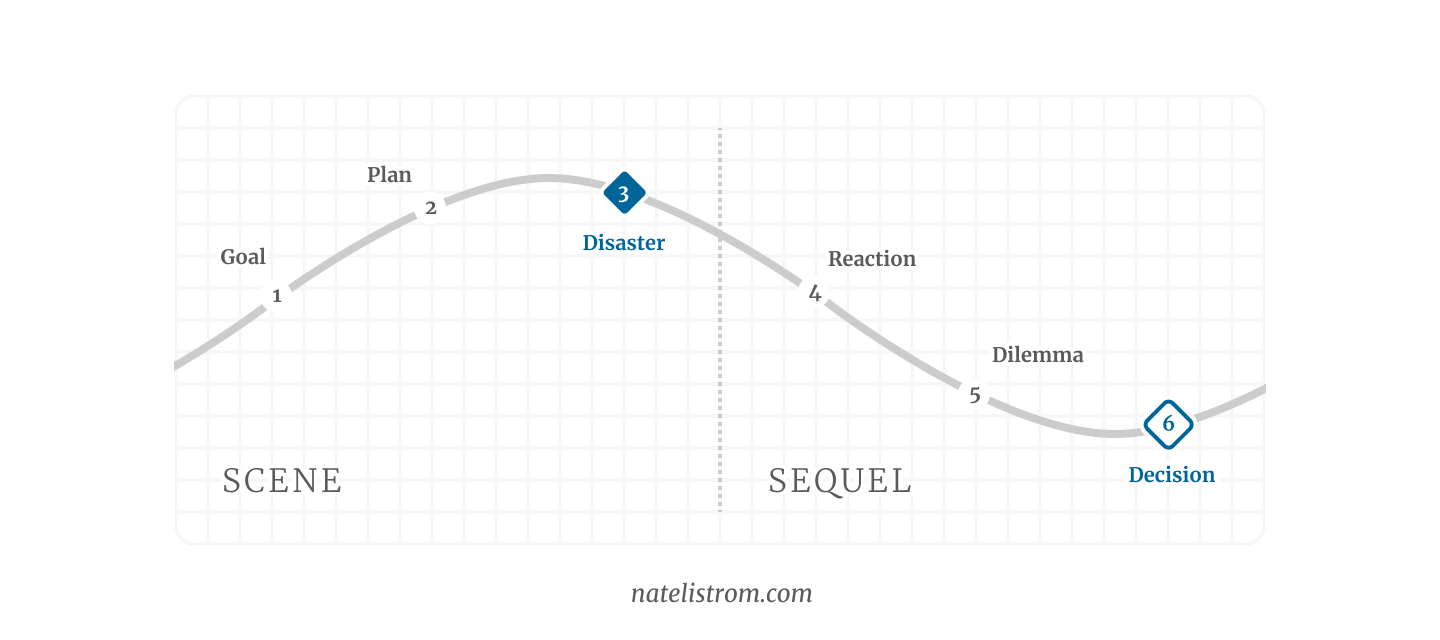
3. Case Study: Deconstructing Toy Story
Now, let's apply this classification system to a complete narrative sequence. The film Toy Story is a masterclass in using "Yes, but" and "No, and" outcomes to continuously escalate stakes and drive the plot.
Write GREAT SCENES by NEVER saying YES or NO
We'll return to Jane Kalmes's video. She provides a scene-by-scene analysis of 'Toy Story,' demonstrating how each scene's outcome propels Woody deeper into conflict.
Watch from 02:01 to 10:15. As you watch the analysis of each scene, pause and identify the POV character's goal and categorize the outcome using our four-part system. Notice how rarely a simple 'Yes' or 'No' is used.
Let's break down a few of the examples from the video to solidify the method:
-
Scene 4:
- Goal (Woody): Be the toy Andy chooses to take to Pizza Planet.
- Outcome: Yes, but... He succeeds in being chosen, but only by knocking Buzz out the window, which makes him a pariah among the other toys. The immediate goal is met, but it creates a much larger social and ethical problem.
-
Scene 6:
- Goal (Woody): Get himself and Buzz back into Andy's possession at Pizza Planet.
- Outcome: No, and furthermore... He fails to get to Andy, and Buzz's delusion gets them both "won" by the destructive Sid. The situation has gone from being lost to being captured by the enemy.
-
Scene 9:
- Goal (Buzz): Prove he is a real Space Ranger by flying.
- Outcome: No. He fails and crashes, breaking his arm. The video points out that adding an "and furthermore..." here would be emotionally redundant. The devastating psychological blow of the failure is the entire point of the scene. This is a strategic use of a "hard No" to mark a major turning point in a character's internal journey.
Test your understanding!
A young coder, Anya, is in a hackathon. Her team's app is moments from the submission deadline, but a critical bug is causing it to crash.
Scene Goal: Anya must find and fix the bug before the timer runs out.
Below are four possible outcomes for the scene. Categorize each one as "Yes," "No," "Yes, but...," or "No, and...".
- Anya isolates the faulty line of code and fixes it with seconds to spare. The app compiles perfectly, and they submit it.
- Anya finds the bug. It's in a third-party library she can't alter. The timer hits zero. They cannot submit.
- Anya cleverly writes a workaround for the bug and submits the app on time. As the confirmation screen appears, she sees a news alert that the competition's main sponsor (a company she dreamed of working for) has just been exposed for a massive data privacy scandal.
- Anya's attempt to fix the bug corrupts their entire database. Not only do they miss the deadline, but they've also lost all their user data.
Show answer
- Yes: A clean win. The goal is achieved without any negative consequences.
- No: A hard stop. The goal is completely and definitively blocked.
- Yes, but...: The goal (fixing the app and submitting) is achieved, but the victory is soured and a new moral/career complication is introduced.
- No, and...: The goal (fixing the bug) is not achieved, and the situation is made catastrophically worse (data is lost).
Conclusion
You have now analyzed the final component in the scene's core mechanical chain: Goal → Conflict → Turning Point → Outcome. By mastering the classification of scene outcomes, you can diagnose why a story might feel flat or, conversely, why it feels relentlessly compelling. The strategic deployment of "Yes, but..." and "No, and..." is the primary engine that generates narrative momentum.
Key Takeaways:
- A scene's outcome is the direct result of the POV character's attempt to achieve their goal in the face of conflict.
- Simple "Yes" (clean win) and "No" (hard stop) outcomes should be used with specific intent, as they risk stalling tension or momentum.
- "Yes, but..." (win with a complication) allows for forward progress while simultaneously raising the stakes.
- "No, and..." (failure with a new or worsened problem) is a powerful tool for escalating conflict and putting the protagonist under greater pressure.
- The choice of outcome for one scene directly sets up the goal and conflict for the next.
Preview of the Next Lesson
We have now completed our analysis of the high-level components of a scene. In the next lesson, we will zoom in further to examine the "atoms" of which scenes are built: the beats. We will start by learning to differentiate between action beats (physical movements) and emotional beats (internal reactions), the fundamental units of character behavior and expression within a scene.