Introduction
In our last lesson, we analyzed a scene's conclusion, or outcome, categorizing it as "Yes," "No," "Yes, but...," or "No, and...". This provided a high-level, mechanical view of how scenes generate narrative momentum. We established that a scene is a unit of change.
Today, we zoom in from the scene's overall architecture to its fundamental building blocks. If a scene is a molecule, we are now going to study its atoms: beats. Your learning outcome for this lesson is to differentiate between action beats (physical movements) and emotional beats (internal reactions).
Understanding this distinction is crucial. It’s the difference between showing a character slam a door and describing the anger tightening in their chest. Both convey fury, but they operate on different channels—external action versus internal experience. Mastering this allows you to precisely control the texture of a scene and the reader's connection to the character.
1. The Core Engine: Motivation-Reaction Units
Before we can differentiate beat types, we need a robust, mechanical model for how beats function. The most effective model treats every moment in a scene as a two-part sequence: a Motivation and a Reaction.
- Motivation: An external, objective event that the point-of-view (POV) character sees, hears, or otherwise senses. Think of it as a stimulus from the outside world.
- Reaction: The POV character's response to that motivation. This is where beats live. The reaction is internal and subjective.
This alternating pattern of Motivation -> Reaction -> Motivation -> Reaction forms the causal chain that drives a scene forward.
To understand this powerful framework, let's turn to an article that treats it with the systematic rigor it deserves.
The article 'Writing The Perfect Scene' by Randy Ingermanson introduces what he calls 'Motivation-Reaction Units' or MRUs. This provides the technical foundation for our analysis of beats.
Read the sections 'Small-Scale Structure of a Scene' and 'The Motivation is external and objective'. Focus on the core definitions of a Motivation (external stimulus) and a Reaction (internal response) and why they must be kept separate.
The key insight here is that you are creating a cause-and-effect chain for the reader. The Motivation is the cause; the Reaction is the effect. Our focus for the rest of this lesson is on deconstructing the Reaction into its component beats.
2. The Anatomy of a Reaction: Action vs. Emotion
Now that we have our framework, we can dissect the Reaction. A character's reaction to a stimulus isn't a single, monolithic event. It unfolds in a specific, neurologically-grounded sequence. The same article breaks this down with analytical precision.
Let's continue reading to see this sequence.
We'll continue with 'Writing The Perfect Scene.' This next section is the core of today's lesson, as it provides a clear, sequential model for a character's reaction.
Read the section 'The Reaction is internal and subjective'. Pay extremely close attention to the three-part analysis of the Reaction: (1) Feeling, (2) Reflex, and (3) Rational Action and Speech. This is the system we will use to differentiate beat types.
This sequence—Feeling, then Reflex, then Rational Action—gives us our specific, technical definitions for emotional and action beats.
Emotional Beats (Internal Reactions)
An emotional beat corresponds to the Feeling part of the reaction. It is the immediate, involuntary, and internal experience of the character. It is often a physiological sensation that is invisible to outside observers.
- Definition: An internal thought, feeling, or visceral sensation experienced by the POV character.
- Examples:
- "A bolt of raw adrenaline shot through Jack’s veins." (from the article)
- A knot of dread forming in the stomach.
- A sudden surge of hope.
- A memory flashing through the character's mind.
To see a masterful example of an emotional beat in a dialogue scene, watch this short clip.
How to Write Engaging Dialogue | Reedsy Live
In this clip from a Reedsy Live event, editor Savannah Gilbo analyzes a scene about grief. It perfectly illustrates how an emotional beat can be more powerful than dialogue.
Watch from 00:37:25 to 00:38:25. Notice the specific phrase 'Iris couldn't speak, her throat was too tight.' This is a pure emotional beat—an internal, physical sensation conveying a complex emotion.
Action Beats (Physical Movements)
Action beats correspond to the Reflex and Rational Action parts of the reaction. They are external, physical movements that an observer could see.
- Definition: An external physical action performed by a character.
- Reflexive Action Examples (Instinctive):
- Flinching from a loud noise.
- Jerking a hand back from a hot surface.
- A gasp of surprise.
- Deliberate Action Examples (Considered):
- Slamming a fist on a table.
- Turning and walking out of a room.
- A slow, deliberate smile.
Action beats are essential for grounding dialogue and showing what characters are doing while they speak, preventing the "dialogue in a white void" problem.
Brand Sanderson Lecture 10: Dialogue Mechanics (2/8)
Let's hear author Brandon Sanderson's take. He provides a concise, practical definition of a beat and its function in a dialogue exchange.
Watch from 00:03:46 to 00:05:07. Sanderson defines a beat as 'showing what someone does alongside their dialogue' and explains the technical formatting rule of keeping the beat and dialogue in the same paragraph.
3. A Visual Breakdown
The distinction can be subtle, as physical actions often reveal emotion. The key is internal vs. external. Is it something happening inside the character's body/mind, or is it an action their body is performing in the scene?
This annotated image provides an excellent visual summary.
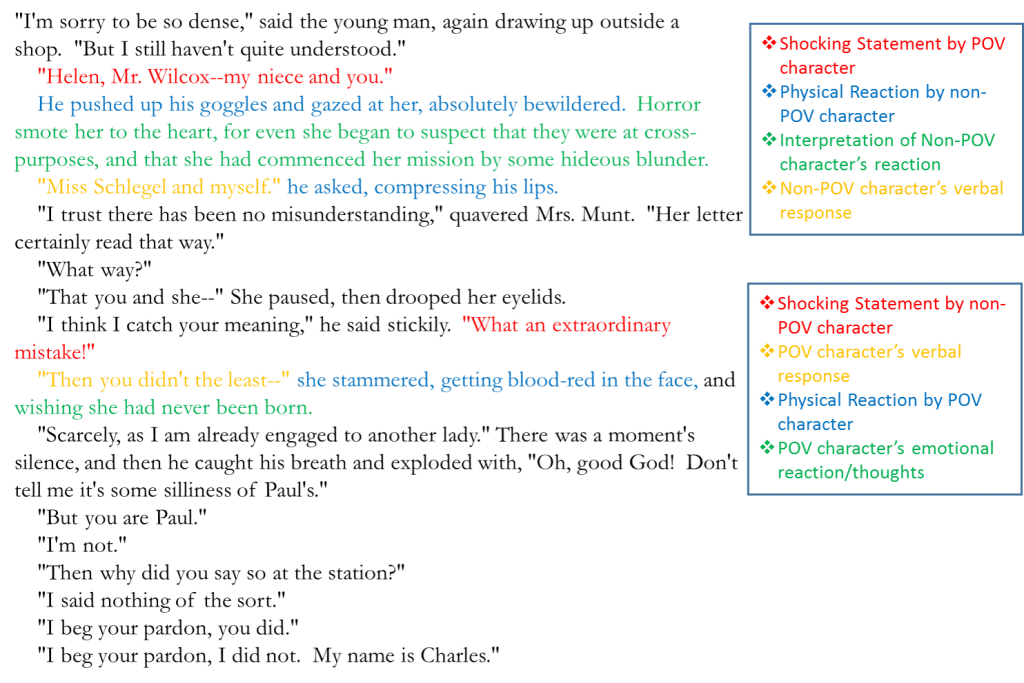
Notice the clear distinction:
- Emotional Beat: "...Margaret's voice was of solid pleasure. So she had struggled with the stranger and won." This is an internal interpretation and feeling.
- Action Beat: "She raised her hand to her lips..." This is a visible, physical movement.
Test your understanding!
Read the following passage. Identify and categorize each of the three numbered beats as either an Action Beat or an Emotional Beat.
The rejection email appeared on the screen. (1) A cold fist clenched in Leo's stomach. He stood up from his desk so quickly that (2) his chair scraped backward against the floorboards. He walked to the window, staring out at the rain-slicked street. All that work for nothing, he thought. (3) He pressed his forehead against the cool glass.
Show answer
- Emotional Beat: "A cold fist clenched in Leo's stomach" is an internal, physiological sensation representing disappointment and anxiety. It's not a literal, external action.
- Action Beat: "his chair scraped backward" is an external, physical event. It's an observable action that reveals the abruptness of his movement.
- Action Beat: "He pressed his forehead against the cool glass" is a deliberate, external, physical action. It's an observable gesture that communicates his despair.
Conclusion
You have now analyzed the atomic units of a scene and can differentiate between their two primary forms. This distinction is not merely academic; it is a fundamental tool for controlling the reader's experience.
Key Takeaways:
- Scenes are built from a chain of Motivation-Reaction Units (MRUs).
- Beats are the components that make up the Reaction to a Motivation.
- Emotional Beats are the character's internal reactions: thoughts, feelings, and visceral sensations (the "Feeling" stage). They allow the reader inside the character's head.
- Action Beats are the character's external physical movements, both instinctive ("Reflex") and deliberate ("Rational Action"). They ground the scene in physical reality and show what the character is doing.
- A strong scene uses a combination of both beat types to create a rich, layered experience for the reader.
Preview of the Next Lesson
Now that you can identify and differentiate these two types of beats, our next step is to apply this knowledge. In the next lesson, we will focus specifically on action beats in the context of dialogue. You will learn how to incorporate physical beats during dialogue to ground the conversation and reveal subtext, turning simple conversations into dynamic, multi-layered interactions.