Introduction
In our previous lesson, we established a clear, mechanical distinction between the two fundamental types of beats in a scene: emotional beats (a character's internal, subjective reactions) and action beats (their external, physical movements). We used the Motivation-Reaction Unit (MRU) framework to understand how these beats fit into the causal chain of a scene.
Today, we will focus exclusively on the practical application of action beats within dialogue. Your learning outcome is to incorporate physical beats during dialogue to ground the conversation and reveal subtext.
This is a critical skill. On a basic level, it's about preventing the "talking heads" problem, where characters seem to float in a void, disembodied from their environment. On a more advanced level, it's a primary mechanism for conveying information and meaning that characters cannot or will not say aloud. You'll learn how to make a character's body language and physical interactions do the heavy lifting in a scene.
1. Grounding the Conversation: Preventing "Talking Heads Syndrome"
The most fundamental purpose of a physical beat during dialogue is to anchor the characters and their conversation in a specific time and place. Without these beats, readers can become dislocated, losing the sense of immersion as the scene devolves into pure dialogue.
A physical beat serves as a piece of scene "choreography." It shows the character interacting with their environment, reminding the reader of their physical presence.
Let's examine a technical breakdown of this function.
What are action beats and how can you use them in fiction ...
The article 'What are action beats and how can you use them in fiction writing?' by Louise Harnby offers a concise explanation of how physical beats solve the 'talking heads' problem.
Please read the section titled '3. The physical voice'. Focus on how the examples use simple actions—fiddling with a dial, placing a finger on a chin, walking to a window—to root the dialogue in a physical setting and context.
As the article demonstrates, these actions don't have to be dramatic. A character glancing at their watch, picking up a coffee mug, or leaning against a doorframe can be enough to maintain the physical reality of the scene.
This video provides a very clear demonstration of this principle in action.
Mastering DIALOGUE TAGS in Writing (With Examples!) | Fiction Writing Advice
In this clip from his channel 'Writer Brandon McNulty', the host shows how a single, simple physical beat can instantly transform a line of dialogue.
Watch from 00:04:41 to 00:05:25. Pay attention to the example 'Brandon approached the chalkboard'. Notice how this one action beat instantly establishes a setting (a classroom), a role (teacher), and a physical movement, all without explicitly stating them.
This is a matter of efficiency. A well-chosen physical beat can simultaneously:
- Attribute dialogue (we know who is speaking).
- Describe the setting.
- Show a character's movement or state.
- Pace the conversation.
2. Revealing Subtext: When Actions Contradict Words
Now we move to the more sophisticated function of physical beats: generating subtext. Subtext is the unspoken layer of meaning—the true intentions, emotions, and power dynamics simmering beneath the surface of a conversation.
A powerful way to create subtext is to establish a contradiction between what a character says and what they do. Their words might say one thing, but their body language reveals the truth.
First, let's establish a precise, technical definition of subtext.
Writing Subtext — The Secret to Writing What's Under the Surface
The team at StudioBinder provides an excellent, almost mathematical formula for understanding subtext: Subtext = Text + Context.
Watch from 00:02:19 to 00:04:20. Absorb this core formula and how context (the situation) changes the meaning of a text (words or actions).
With this formula in mind, a character's physical action becomes part of the context that modifies the meaning of their dialogue (the text). Let's see how this works in practice.
Writing Subtext — The Secret to Writing What's Under the Surface
Continuing with the StudioBinder video, we'll now see how specific physical actions are used to generate subtext and reveal the true power dynamics in a scene.
Watch from 00:11:19 to 00:15:20. Focus on the examples: Jules eating the burger in Pulp Fiction (an act of dominance), Hans Landa's polite tone combined with a homicidal action in Inglourious Basterds (threat), and Meg stopping her daughter from pouring soda in Panic Room (support/unity). Notice how these actions reveal the true power dynamics and emotional states which the dialogue alone does not.
The key mechanism is often a mismatch. When a character's actions and words are not in alignment, the reader instinctively trusts the action more.
Let's return to the article by Louise Harnby for a textual breakdown of this technique.
What are action beats and how can you use them in fiction ...
The same article we looked at earlier also has a section on using action beats to create an 'alternative voice' that reveals a character's true intentions.
Read section '4. The alternative voice'. Analyze the examples where the action directly contradicts the dialogue (e.g., feeling for a wire while promising not to tell; sizing up a window while promising to stay). This is the mechanical basis for creating subtext through contradiction.
Test your understanding!
Consider the following scenario: A manager, Alex, is telling a direct report, Ben, that his year-long project is being canceled due to budget cuts.
- Grounding: Write a line of dialogue for Alex, along with a physical beat that grounds the conversation in a typical office setting.
- Subtext: Ben replies, "No, it's fine. I understand." Write a physical beat for Ben that contradicts his words and reveals his true feelings.
Show answer
Here are some possible answers.
-
Grounding: Alex closed the laptop on the conference table. "Ben, we need to talk about Project Chimera." (The action grounds the scene in a specific office location and object interaction.) Another example: Alex gestured to the empty chair across from his desk. "Have a seat."
-
Subtext: "No, it's fine. I understand." Ben's knuckles went white where he gripped the edge of the desk. (The action reveals suppressed anger/tension.) Another example: "No, it's fine. I understand," Ben said, his gaze fixed on a point on the wall just past Alex's shoulder. (The action reveals shock, disbelief, or emotional disconnection.)
3. Case Study: The Power of a Single Beat
To see how these two functions—grounding and subtext—can be powerfully combined, let's look at one final case study. A single, recurring physical beat can become laden with meaning, serving as both a concrete physical detail and a profound symbol of a character's internal state.
Writing Subtext — The Secret to Writing What's Under the Surface
Let's conclude with a masterclass case study from the film 'Sound of Metal', analyzed by StudioBinder. It shows how a single, recurring physical beat can carry the emotional and thematic weight of an entire scene.
Watch from 00:17:37 to 00:20:10. Pay close attention to the action of Lou scratching her arm. Track how this simple physical beat reveals her regression, informs Reuben's devastating realization, and gives his line 'It's okay' its profound subtextual meaning.
This example shows the highest level of this technique, where a simple physical beat is so well-established that it can tell a whole story without a word.
4. A Visual Application
To see how these elements look on the page in a purely functional format, consider this marked-up script excerpt. In screenwriting, this integration of action and dialogue is non-negotiable.
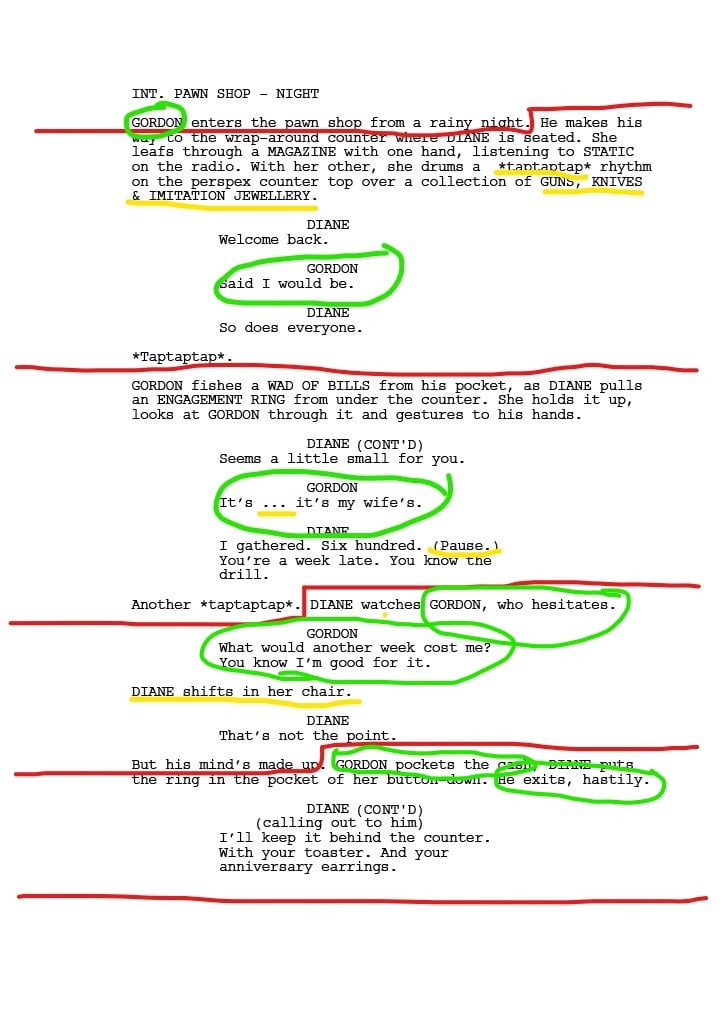
Notice how the physical beats are not afterthoughts; they are integral parts of the exchange, placed precisely to inform the pacing and subtext. While prose offers more flexibility than a screenplay, adopting this mindset—visualizing the scene and weaving action and dialogue together—is a highly effective mechanical approach.
Conclusion
Today, we've broken down the two primary functions of incorporating physical beats into dialogue. This is a technique that operates on both a practical and an artistic level.
Key Takeaways:
- Physical beats serve two main functions during dialogue: grounding the conversation and revealing subtext.
- Grounding prevents "talking heads syndrome" by having characters interact with their environment. These simple actions maintain reader immersion and provide a sense of place.
- Subtext is created by leveraging the contrast between what is said (dialogue) and what is done (physical beat). When words and actions contradict, the action often reveals the truth.
- Think like a screenwriter: visualize your scene and treat physical actions as an inseparable part of the dialogue exchange, not as decoration added later.
Preview of the Next Lesson
We have now examined emotional and action beats in isolation. In our next lesson, we will synthesize these concepts. We will analyze scene rhythm by examining the interplay of action, dialogue, and thought beats, learning how to control a scene's pace and texture by deliberately modulating the density and sequence of these core components.