Introduction
In our last lesson, we focused on sentence-level engineering by varying sentence openings with prepositional and participial phrases. We treated the sentence as a structure that could be reconfigured for rhythm and emphasis. Today, we move from the architectural level down to the component level: word choice.
This lesson targets a specific point of inefficiency in prose. Our learning outcome is to replace weak verb-adverb combinations with a single, stronger, more precise verb. Think of this as code optimization. A verb + adverb pair is often a sign of a generic, all-purpose verb (like walked, said, looked) being propped up by a modifier. This is functional, but not efficient or powerful. By replacing the two-word combination with a single, high-impact verb, we make our prose more concise, vivid, and precise.
1. Diagnosing the Inefficiency
The core issue with many adverbs—especially those ending in "-ly" that modify a verb—is that they are a patch for a weak verb. The adverb tells the reader how an action was done because the verb itself isn't descriptive enough.
Consider the sentence:
He walked slowly across the room.
- Verb:
walked(general action) - Adverb:
slowly(modifier specifying the manner of the action)
The sentence works, but it uses two words to convey an idea that a single, more precise word could handle. This adds clutter and weakens the impact.
Let's watch a short video that frames this problem and introduces the solution.
Should You Use Adverbs in Your Writing?
The video 'Should You Use Adverbs in Your Writing?' from the Reedsy channel provides a concise overview of why verb-adverb combinations can be inefficient. It introduces the core principle of this lesson.
Please watch from 00:40 to 01:59. Pay close attention to: The argument that extra words make writing 'mushy' and 'convoluted'. The direct examples of replacing verb-adverb pairs (e.g., 'ran slowly' -> 'trudged'). The concept of 'implied' meaning, where the adverb is redundant because the context or verb already provides the information.
As the video explains, the goal is to find a verb that contains both the action and the manner of that action.
2. The Strong Verb Replacement: A Mechanical Upgrade
The solution is to replace the generic verb and its modifying adverb with a single, strong verb. This is not about finding a "prettier" word; it's about finding a more accurate one.
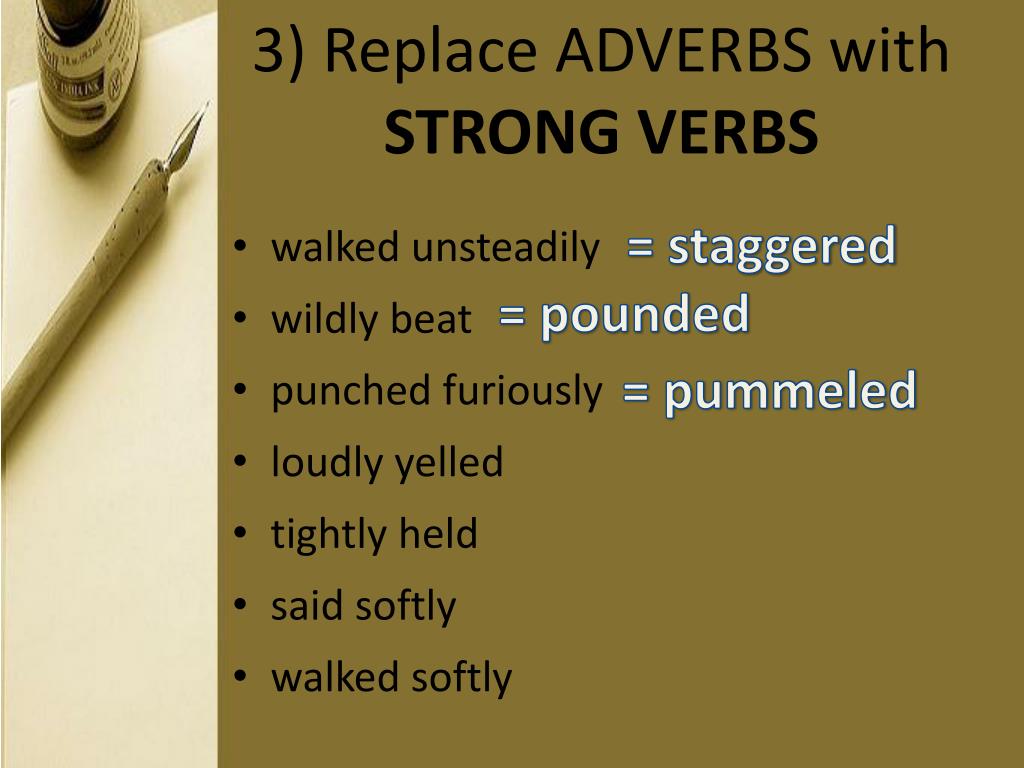
Let's look at our original example: "He walked slowly across the room."
We can replace "walked slowly" with a variety of stronger verbs, each carrying a different, more specific meaning:
- He ambled across the room. (Implies a relaxed, leisurely pace)
- He trudged across the room. (Implies weariness or difficulty)
- He shuffled across the room. (Implies lifting the feet very little, perhaps due to age or injury)
- He sauntered across the room. (Implies a confident, unhurried stroll)
Each replacement is more concise and paints a much clearer picture than the original.
Write Better Prose – The Power of the Verb | Writing Tips
This next clip from the video 'Write Better Prose – The Power of the Verb' offers another concrete example of this technique in action.
Please watch from 04:27 to 05:41. The presenter gives the clear example of replacing 'she walked slowly' with 'she lagged', demonstrating how a single verb tightens the prose and makes it more concise.
3. A Systematic Guide to Verb-Adverb Replacement
This process can be approached systematically, especially during the revision phase. The key is to first identify the potential for improvement and then to find the right replacement.
The following resource provides an extensive list of weak verb-adverb combinations and their stronger, one-word equivalents. It functions like a reference table for upgrading your prose.
6 Ways to Reduce “-ly” Adverb Abuse: A Word List for Writers
The article '6 Ways to Reduce “-ly” Adverb Abuse' by Kathy Steinemann is a highly practical guide. We will focus on its first guideline, which is a comprehensive list of strong verb replacements.
Please read the sections titled 'Guideline #1: Choose Stronger Verbs', 'Strong Verbs: A to R', and 'Strong Verbs: S to W'. Study the lists. You don't need to memorize them, but analyze the pattern: a generic action plus a modifier becomes a single, specific action. Notice how 'move cautiously' becomes 'prowl' or 'slink', and 'speak loudly' becomes 'bellow' or 'roar'.
Test your understanding!
Using the principle of this lesson, replace the following weak verb-adverb combinations with a single, stronger verb. Try to come up with at least two options for each, noting the difference in nuance.
- eat hurriedly
- look steadfastly
- walk gracefully
Show answer
Here are some possible answers, though others may also be correct:
-
eat hurriedly:
- bolt: Suggests swallowing food with little to no chewing, often due to extreme haste.
- gobble: Suggests eating quickly and noisily.
- inhale: A hyperbolic term suggesting the food disappears almost instantly.
-
look steadfastly:
- gaze: Implies a long, steady, often thoughtful or admiring look.
- stare: A more intense, direct, and sometimes unsettling look.
- goggle: Suggests looking with wide-eyed, often naive, wonder.
-
walk gracefully:
- glide: Implies smooth, effortless, continuous movement.
- float: Suggests a light, airy movement, as if not touching the ground.
- slink: Implies a sinuous, stealthy, and often seductive movement.
4. Advanced Application: Eliminating Redundant and Clutter Adverbs
Beyond propping up weak verbs, adverbs can be inefficient in other ways.
1. Redundancy: The adverb is redundant if the verb already contains its meaning.
* He shouted loudly. ("Shout" already implies loudness). The adverb is superfluous.
* The car accelerated quickly. ("Accelerate" means to increase in speed). The adverb adds no new information.
2. Clutter: Some adverbs, like "suddenly," are often used as a crutch to create surprise. Stronger writing creates this effect through action and description, not by announcing it.
* Weak: Suddenly, the door flew open.
* Strong: The door flew open. (The surprise is inherent in the action itself).
Let's return to our textual resource to see a systematic approach to cleaning up these types of adverbs.
6 Ways to Reduce “-ly” Adverb Abuse: A Word List for Writers
The same article provides clear guidelines for these specific cases. They will help you identify and remove even more sources of inefficiency in your prose.
Now, please read two more sections from the article: 'Guideline #4: Remove Redundant Adverbs That Modify Verbs': This section lists verbs where the adverb is almost always superfluous (e.g., 'caress lovingly'). 'Guideline #6: Delete Suddenly': This provides a clear before-and-after example of how removing 'suddenly' and using stronger verbs tightens the writing.
5. Practical Application Exercise
Let's put this all together. The following exercise from the resource we just read is a perfect test case.
Test your understanding!
Here is a short paragraph overloaded with weak verb-adverb combinations and redundancies. Your task is to rewrite it, applying the principles from this lesson. Eliminate the adverbs by choosing stronger verbs and removing redundancies.
The softly burbling stream wound slowly through the forest, gently lapping at brightly glistening rocks. Kelly waded carefully into the water and sighed contentedly.
Show answer
Here is the suggested solution from the article, followed by an analysis.
Suggested Solution:
The burbling stream meandered through the forest, lapping at glistening rocks. Kelly slipped into the water. “Ahhhhh,” she murmured.
Analysis:
wound slowlybecomesmeandered. The single verbmeanderedperfectly captures the slow, twisting movement.softly burblingbecomes justburbling. The verbburblealready implies a soft, gentle sound. The adverb was redundant.gently lappingbecomes justlapping. The verblap(in the context of water) implies a gentle motion.brightly glisteningbecomes justglistening.Glistenmeans to shine or sparkle, sobrightlyis redundant.waded carefullybecomesslipped.Slippedis a more vivid and precise verb that implies careful, smooth entry into the water.sighed contentedlyis replaced by the action and dialogue:“Ahhhhh,” she murmured.This is an example of "showing, not telling." Instead of telling us she was content, the author shows it through her utterance.
Conclusion
Today, we've drilled down into the mechanics of word choice, focusing on optimizing the relationship between verbs and adverbs. By treating prose as a system to be engineered for clarity and impact, you can make significant improvements through a methodical process of revision.
Key Takeaways:
- Identify the Pattern: A
generic verb + -ly adverbis a flag for potential optimization. - Replace, Don't Just Modify: Search for a single, strong verb that encapsulates both the action and its manner. This makes your prose more concise and impactful.
- Eliminate Redundancy: Remove adverbs that state what the verb already implies (e.g.,
shouted loudly). - Trust the Action: Avoid crutch words like "suddenly." Let the events themselves provide the surprise.
This practice of choosing precise, powerful words is a cornerstone of effective prose.
Preview of the Next Lesson
We have focused today on making actions more precise by strengthening our verbs. In the next lesson, we will apply the same principle of precision to things and concepts. The learning outcome will be to replace abstract nouns with concrete sensory details that evoke the emotion. Just as we replaced walked slowly with trudged, we will learn to replace a word like sadness with the concrete details that create the feeling of sadness in the reader: a quavering voice, a cold draft, the smell of rain on pavement.