Introduction
Welcome back. In our previous lesson, we examined the architecture of the periodic sentence, a structure that builds tension by delaying the main clause and placing the most critical information in the sentence's final "stress position." We established why you might place introductory elements before your main clause—to control emphasis and reader anticipation.
Today, we will build on that foundation by focusing on what those introductory elements can be. Our learning outcome is to vary sentence structure by beginning with prepositional or participial phrases.
Monotonous sentence structure, typically a repetitive Subject-Verb-Object pattern, is a common failure mode in prose. It reads as robotic and lacks rhythm. By learning to strategically vary your sentence openings, you add two powerful and flexible tools to your sentence engineering toolkit. This allows you to build more complex, flowing, and rhythmically engaging prose.
1. The Problem: Structural Monotony
Before we add new tools, let's diagnose the problem they solve. Consider the following paragraph:
The knight drew his sword. He faced the dragon. The dragon roared, and smoke billowed from its nostrils. The knight stood his ground. He was not afraid.
Each sentence begins with the subject. The structure is simple and, after a few repetitions, predictable and dull. While clear, it lacks any sense of artistry or flow. Our goal is to break this pattern without sacrificing clarity.
2. Tool #1: The Prepositional Phrase Opener
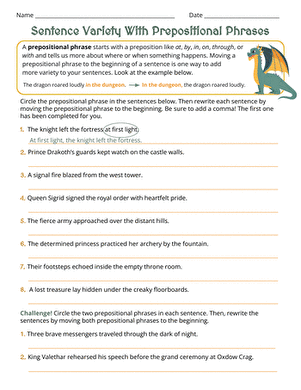
A simple and effective way to vary a sentence opening is to begin with a prepositional phrase. From a mechanical standpoint, a prepositional phrase consists of a preposition (a word specifying time, location, or direction like in, at, on, before, under, with) followed by its object (a noun or pronoun).
When moved to the front of a sentence, a prepositional phrase typically functions to set the context—the time, place, or manner—before delivering the main action.
7.1 Sentence Variety | Successful Writing
The article 'Sentence Variety' from Successful Writing provides a clear breakdown of this technique. It explains the components of a prepositional phrase and demonstrates how moving it changes the sentence's rhythm and emphasis.
Please read the section titled 'Starting a Sentence with a Prepositional Phrase.' Focus on the definition, the table of common prepositions, and the 'before and after' examples. Note the point that moving the phrase shifts emphasis and helps the writing 'flow.'
As you read, you'll see that fronting a prepositional phrase is a simple transformation:
- Standard: The terrified child hid underneath the heavy wooden table.
- Varied: Underneath the heavy wooden table, the terrified child hid.
Notice the comma after the introductory phrase. This is standard punctuation when a prepositional phrase starts a sentence.
Test your understanding!
The following sentence uses a standard Subject-Verb-Object structure.
The old detective found the final clue inside the victim's locket.
Rewrite this sentence to begin with a prepositional phrase.
Show answer
Inside the victim's locket, the old detective found the final clue.
Analysis: This revision places the location of the discovery first, creating a small moment of suspense before revealing what was found and by whom. It breaks the S-V-O pattern and creates a more engaging rhythm.
3. Tool #2: The Participial Phrase Opener
A more dynamic method for varying sentence openings involves the participial phrase. This is a more complex tool, but it offers greater flexibility.
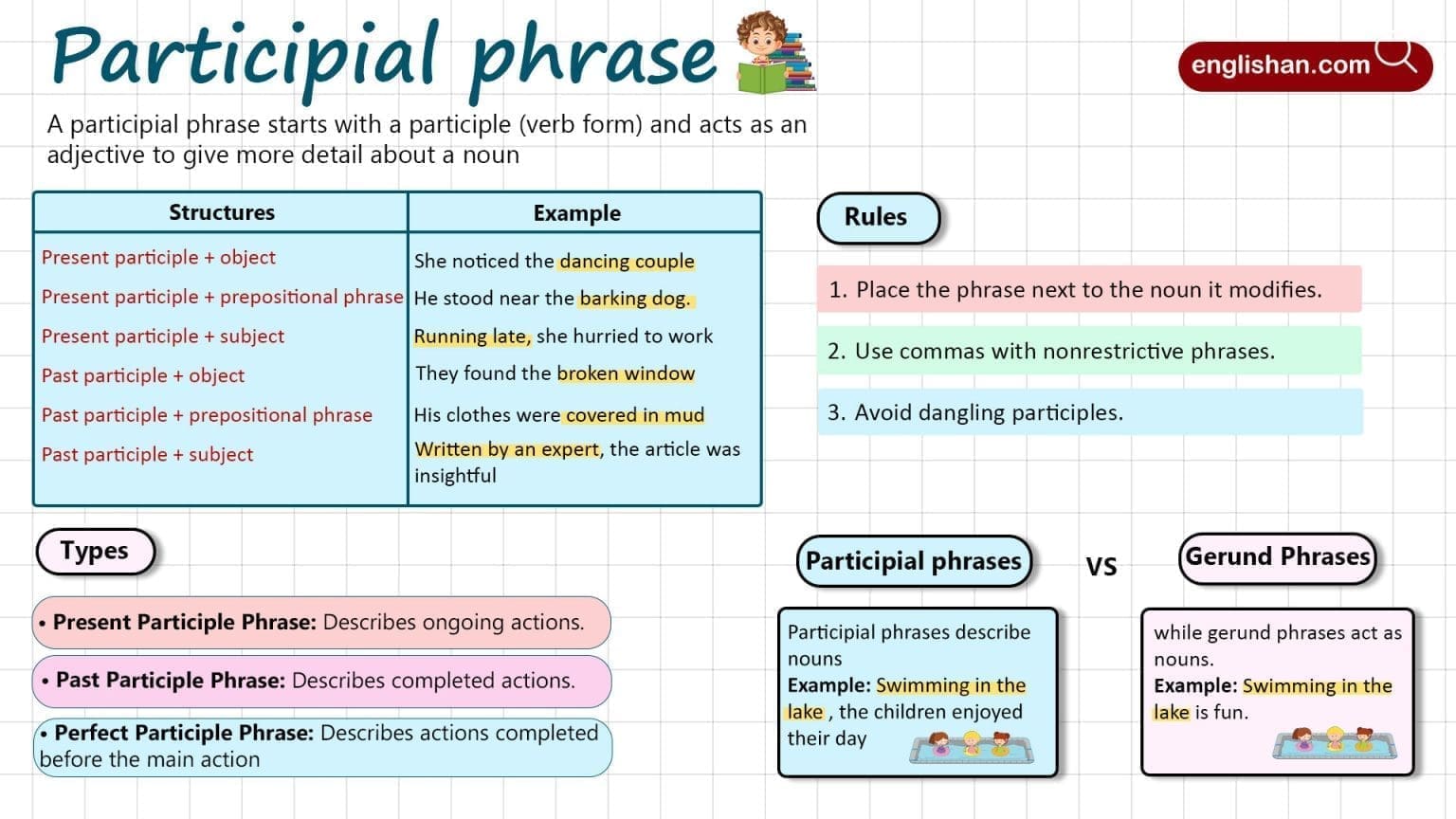
First, let's define the core component. A participle is a verb form that functions as an adjective.
- Present participles end in
-ing(e.g., running, thinking, seeing). - Past participles typically end in
-ed,-en, or have an irregular form (e.g., broken, driven, found).
A participial phrase consists of the participle plus any objects or modifiers connected to it. When placed at the beginning of a sentence, it describes the subject of the main clause, often showing a cause, a result, or a simultaneous action.
Participle Clauses | Participial Phrases(& How to Use Them)
The video 'Participle Clauses' by Writing Better offers a systematic walkthrough of how these phrases are constructed and used. It's an excellent technical introduction.
Please watch the following segments: 00:47 - 02:38: Focus on the definition of a participle and a participial phrase. Internalize the structure: participle + objects/modifiers. 04:40 - 05:43: Observe the examples of present participle clauses used at the beginning of a sentence to give a reason or describe a simultaneous action. 05:43 - 07:08: Now, watch the examples of past participle clauses used to give a reason or add information.
Let's look at the logic:
- Two sentences: The programmer reviewed the code. She found a critical bug.
- Combined with participial phrase: Reviewing the code, the programmer found a critical bug.
Here, "Reviewing the code" is a participial phrase that modifies "the programmer." It efficiently combines two ideas into a single, more fluid sentence.
4. Critical Error Handling: The Dangling Modifier
Using introductory phrases introduces a specific logical risk: the dangling modifier. This is a common error where the introductory phrase does not correctly modify the subject of the main clause that follows it.
From a systems perspective, this is like a function call with the wrong pointer; the connection is made to an incorrect referent, leading to a logical breakdown.
- Incorrect (Dangling): Carrying a heavy load of dishes, his foot caught on the rug.
- Logical error: This sentence implies that "his foot" was carrying the dishes.
The rule is absolute: The noun or pronoun immediately following the introductory phrase must be what the phrase describes.
- Correct: Carrying a heavy load of dishes, he caught his foot on the rug.
Participle Clauses | Participial Phrases(& How to Use Them)
Let's return to the 'Participle Clauses' video, which has an excellent segment on identifying and fixing this specific error.
Please watch the segment from 08:26 to 09:31. The explanation of the 'dangling modifier' is very clear. Notice how rewriting the sentence to place the correct subject ('he') immediately after the comma resolves the logical error.
Test your understanding!
The following sentence contains a dangling modifier.
Exhausted from the long journey, the warm bed was a welcome sight.
Identify the logical error and rewrite the sentence to correct it.
Show answer
The Error: The sentence incorrectly implies that "the warm bed" was exhausted from the long journey.
Correction: You must insert a logical subject for the modifier "Exhausted...". There are a few ways to do this:
- Correct: Exhausted from the long journey, I found the warm bed to be a welcome sight.
- Correct: Exhausted from the long journey, the traveler thought the warm bed was a welcome sight.
In both corrections, the subject that was "exhausted" is now placed immediately after the introductory phrase.
Conclusion
You have now added two fundamental techniques to your toolkit for constructing prose with better rhythm and flow. By consciously breaking the monotonous Subject-Verb-Object pattern, your writing will become more sophisticated and engaging.
Key Takeaways:
- Vary Sentence Openings: Repetitive sentence structures make for dull reading. Varying your sentence beginnings is essential for creating prose rhythm.
- Prepositional Phrase Openers: Use phrases beginning with words like in, at, under, after to set the scene or context before the main clause.
- Participial Phrase Openers: Use phrases beginning with
-ingor-edverb forms to describe the subject of the main clause, showing simultaneous action or causality. - The Cardinal Rule: Avoid dangling modifiers. The subject of your main clause must be the agent described by the introductory phrase.
Preview of the Next Lesson
We have now explored techniques for controlling the beginning (participial/prepositional openers) and the end (periodic sentences/stress position) of your sentences. However, variety comes not just from structure, but also from length.
In the next lesson, we will focus on using short, medium, and long sentences for specific effects. You will learn how to use short sentences for impact, medium sentences for clarity, and long sentences for detail, allowing you to control the pacing of your writing at the most granular level.