Introduction
Welcome to the first lesson in our module on Prose Engineering. In the previous module, we analyzed dialogue as a complete system, deconstructing conversations to reveal their subtextual machinery. We now shift our focus from the macro-level of scenes to the micro-level of the sentences that build them. Your preference for treating writing as a technical discipline will be particularly useful here, as we will break down prose into its fundamental components.
This lesson addresses the learning outcome: Use short sentences (<10 words) to create impact, convey rapid action, or deliver a revelation. We will define the function of short sentences, analyze their mechanics, and establish rules for their effective deployment.
1. The Sentence as the Fundamental Unit
Before we can use a tool, we must understand its importance. In writing, the sentence is the fundamental unit of meaning. Individual words are just data; a sentence is an operation, an expression that performs an action or delivers a piece of information. The structure of that sentence—its length, rhythm, and syntax—is not decorative. It is a critical part of the information being delivered.
To see this principle in action, let's examine two opposing philosophies of sentence construction.
HOW TO WRITE A GREAT SENTENCE | The Art of Writing | Hemingway | Faulkner | Amis | Provost
The video 'HOW TO WRITE A GREAT SENTENCE' introduces the classic contrast between the long, complex sentences of William Faulkner and the short, direct sentences of Ernest Hemingway. This will help frame sentence length not as a default, but as a deliberate stylistic choice.
Watch from the beginning of the discussion on Faulkner and Hemingway (00:53) until the end of the examples from their work (04:48). Notice how the structure of their sentences reflects the content and mood of their stories.
As the video illustrates, Hemingway's short, laconic sentences create a sense of immediacy and factual reportage. Faulkner's long, winding sentences create a sense of contemplation, history, and density. Neither is inherently "better"; they are different tools for different jobs. Our goal is to master the entire toolkit, starting with the short sentence.
2. The Power of Contrast: Establishing Rhythm
A short sentence rarely works in isolation. Its power is almost always generated by its relationship to the sentences around it. A string of identically structured sentences becomes monotonous, regardless of their length. The key to effective prose is variation.
The most famous demonstration of this principle comes from Gary Provost.
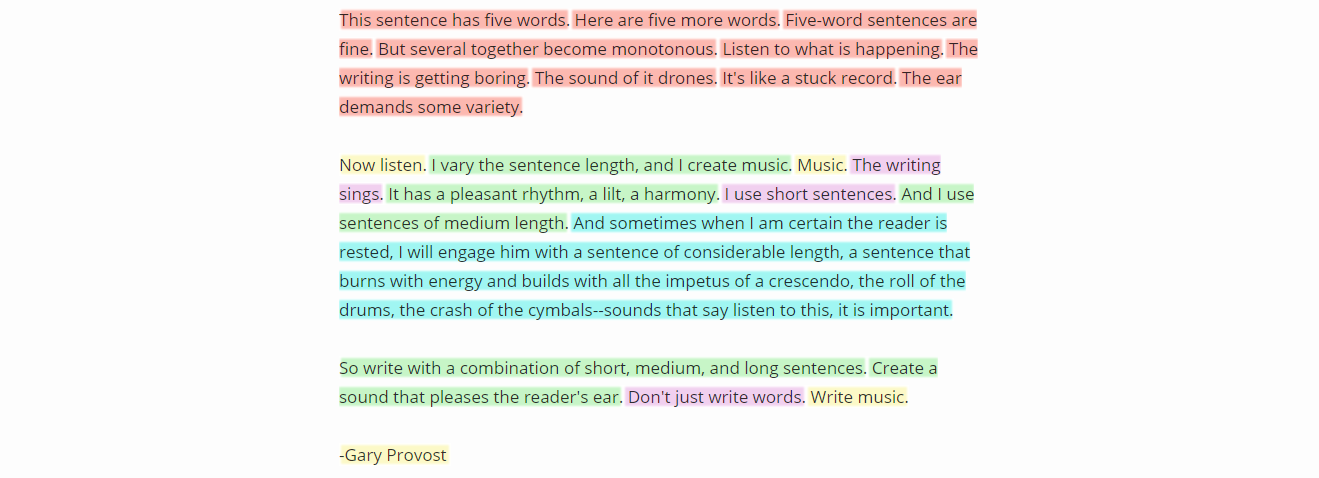
Now, listen to this passage read aloud to get a feel for its rhythm.
HOW TO WRITE A GREAT SENTENCE | The Art of Writing | Hemingway | Faulkner | Amis | Provost
This segment from 'HOW TO WRITE A GREAT SENTENCE' presents Gary Provost's classic advice. Listening to it spoken aloud makes the mechanical effect of sentence length on rhythm immediately obvious.
Watch the section from 05:38 to 07:25. Pay attention to how the narrator's voice changes, reflecting the text. The short sentences are choppy and dull; the varied sentences have a musical flow. This is the core principle of sentence rhythm.
Provost's demonstration gives us our first rule: The effectiveness of a short sentence is proportional to the contrast it creates. It acts as a full stop, a jolt, or a punch precisely because it breaks an established pattern.
3. The Mechanical Functions of a Short Sentence
With the principle of contrast established, let's analyze the specific functions of a short sentence (<10 words). You can deploy them with precision to achieve one of three primary effects. The following resource provides a concise, systematic overview.
3.2 Sentence Length and Rhythm
The study guide 'Sentence Length and Rhythm' provides a clear, structured list of how sentence length affects prose. We will use it as our technical manual for this section.
Read the sections 'Impact on Prose Rhythm and Flow,' 'Emphasis and Pacing Techniques,' and 'Strategic Application of Length.' Focus on the explicit connections made between short sentences and their effects, such as emphasis, urgency, and action.
Based on this guide and our other resources, we can define the three functions:
Function 1: To Create Impact and Emphasis
A short sentence after one or more longer sentences forces the reader to pause. This pause creates emphasis. The isolated statement lands with the force of a "punch line" or a stark declaration.
Consider this example from Mary Karr's memoir The Liars' Club, analyzed in the article "15 Tips for Crafting More Interesting and Elegant Sentences".
My sharpest memory is of a single instant surrounded by dark. I was seven, and our family doctor knelt before me where I sat on a stool in the kitchen, his glasses glinting in the hooded light. Behind him, Mother kept to the shadows, shaking, whether with anger or tears I couldn’t tell. I remember his two fists on my knees, the comforting smell of his wool suit, and his face close enough for me to see each gray pore. Stop crying. It’s just a belt buckle.
The long sentences build a detailed, tense, and somewhat confusing memory. The final two short sentences cut through the haze with brutal clarity and force. Their brevity gives them immense weight.
Function 2: To Convey Rapid Action and Urgency
Long sentences contain multiple clauses and ideas, requiring more cognitive processing. They slow the reader down. Short sentences, by contrast, are processed almost instantly. This makes them the ideal tool for conveying speed, panic, or urgency.
- Long sentence: The frightened man quickly ran across the street, desperately trying to get away from the sound of the approaching footsteps that echoed menacingly in the alley behind him.
- Short sentences: He ran. Footsteps echoed. The alley. He had to escape.
The second version has a staccato, breathless rhythm. Each sentence is a single, distinct action or perception. The reader processes them as a rapid sequence of events, mirroring the character's panicked state. As the study guide noted, you should use "Short sentences for action sequences."
Function 3: To Deliver a Revelation
This is a specific, powerful sub-category of creating impact. A revelation is a piece of information that reframes everything the reader knew up to that point. Placing this information in a short, stark sentence forces the reader to stop and re-evaluate the context.
Look again at the Mary Karr example: It's just a belt buckle. This isn't just an impactful line; it's a horrifying revelation that re-contextualizes the entire scene. The doctor's presence, the mother in the shadows—everything is cast in a new, sinister light. The short sentence functions as a spotlight, isolating the terrible truth.
4. A Rule of Thumb
The learning outcome specifies a length of fewer than ten words. This is a practical, effective guideline. It forces you to be concise and impactful. Don't be afraid to go even shorter.
I Tried a 6-Step Formula for Writing Better Sentences
In this final clip from 'I Tried a 6-Step Formula for Writing Better Sentences,' the presenter makes a strong case for using extremely short sentences.
Watch the final minute of the video, from 14:18 to 15:18. Note the advice about cutting unnecessary words and the explicit directive not to fear short sentences.
The advice is clear: "If you don't have a three-word sentence in your book, there's a problem with your book." Treat this as a system diagnostic. If your prose feels sluggish or lacks punch, scan it for opportunities to inject a very short sentence.
Test your understanding!
The following paragraph describes a character's realization during a chase. It is functional but lacks urgency and impact.
The detective sprinted through the crowded market, shoving past vendors as he tried to keep his eyes on the suspect's red coat, which was a flash of color in the distance. He checked his watch and saw that there were only two minutes left before the train departed from the station, a fact which filled him with a growing sense of dread. As he rounded a corner, he finally saw the suspect clearly, who was turning to look back, and the detective realized with a shock that it was his own partner.
Your task: Rewrite this paragraph to improve its pacing and to deliver the final revelation with more force. You must use at least three short sentences (<10 words).
Show answer
Here is one possible revision:
He sprinted through the market. A flash of red. He shoved past vendors. He checked his watch. Two minutes left. The train would be gone. He rounded the corner and saw the suspect's face. It was his partner.
Analysis of the changes:
- "He sprinted through the market." / "Two minutes left." / "The train would be gone.": These short sentences break up the longer descriptions, creating a staccato rhythm that mimics the urgency of the chase and the ticking clock.
- "It was his partner.": This short, stark sentence delivers the revelation. It is isolated from the descriptive setup, giving it maximum impact and forcing the reader to pause and absorb the shock, just as the detective does.
Conclusion
In this lesson, we established the first mechanical rule of prose engineering: the strategic use of the short sentence. By treating sentence length as a control variable, you can precisely manipulate rhythm, pacing, and emphasis.
Key Takeaways:
- The power of a short sentence comes from contrast. It works best when juxtaposed with longer sentences.
- Short sentences (<10 words) have three primary functions: creating impact/emphasis, conveying rapid action/urgency, and delivering a revelation.
- When writing an action scene, use short sentences to increase the pace. When delivering a critical piece of information, isolate it in a short sentence to give it weight.
Preview of the Next Lesson
We have mastered the function of the shortest sentence type. Now we will move to the workhorse of prose. In the next lesson, we will analyze how to use medium sentences (10-20 words) for clear, efficient delivery of information and narrative progression.