Introduction
Welcome back. In our previous lesson, we established that a character's attempt to control a conversation reveals their underlying goals and fears. We saw that the key to unlocking these hidden motivations is subtext—the meaning simmering beneath the surface—often exposed when a character's words contradict their actions.
This lesson is the final and most granular step in our analysis of dialogue. We will move from simply identifying subtext to systematically dissecting it. Our goal is to fulfill the learning outcome: Deconstruct a dialogue exchange to map the surface conversation versus the subtextual negotiation. You will learn a formal method for taking a scene apart, separating the literal text from the unspoken emotional and strategic power plays, much like parsing code to understand its function versus its literal syntax.
1. A Three-Level Framework for Deconstruction
To deconstruct a dialogue exchange effectively, we need a consistent framework. Think of it as an architecture with distinct layers of communication. A simple text-versus-subtext model is useful, but a more detailed, three-level system provides a more robust analytical tool.
The Fall Guy: 3 Levels of Subtext
The article 'The Fall Guy: 3 Levels of Subtext' from Write Your Screenplay offers an excellent, structured model for this kind of analysis. It treats subtext not as a single hidden layer, but as a dynamic, multi-level system.
Read the section that begins with 'There are three levels on which subtext happens in dialogue.' and ends just before 'Let’s explore more deeply...' This will introduce you to the three-level framework.
Let's formalize this three-level framework:
-
Level 1: Transmission (What is SAID vs. MEANT)
- This is the speaker's layer. It involves the gap between their literal words (the text) and their intended meaning (the subtext).
- Question to ask: What is the character saying, and what are they really trying to communicate? Is the subtext pushed far down (e.g., talking about the weather to mean "I'm nervous") or is it close to the surface (e.g., "You must be very busy" to mean "You're ignoring me")?
-
Level 2: Reception (What is SENT vs. HEARD)
- This is the listener's layer. It's about how the message, including its subtext, is received and interpreted. Misinterpretation is a powerful engine for conflict.
- Question to ask: Does the listener hear the literal text, the intended subtext, or do they project their own meaning onto it? How does their response reflect their interpretation?
-
Level 3: Context (The GIVEN CIRCUMSTANCES)
- This layer is the foundation for the other two. It encompasses everything each character brings into the conversation: their history, recent events, internal fears, desires, and the stories they tell themselves about the situation and the other person.
- Question to ask: What personal history or emotional state is coloring how each character speaks and listens?
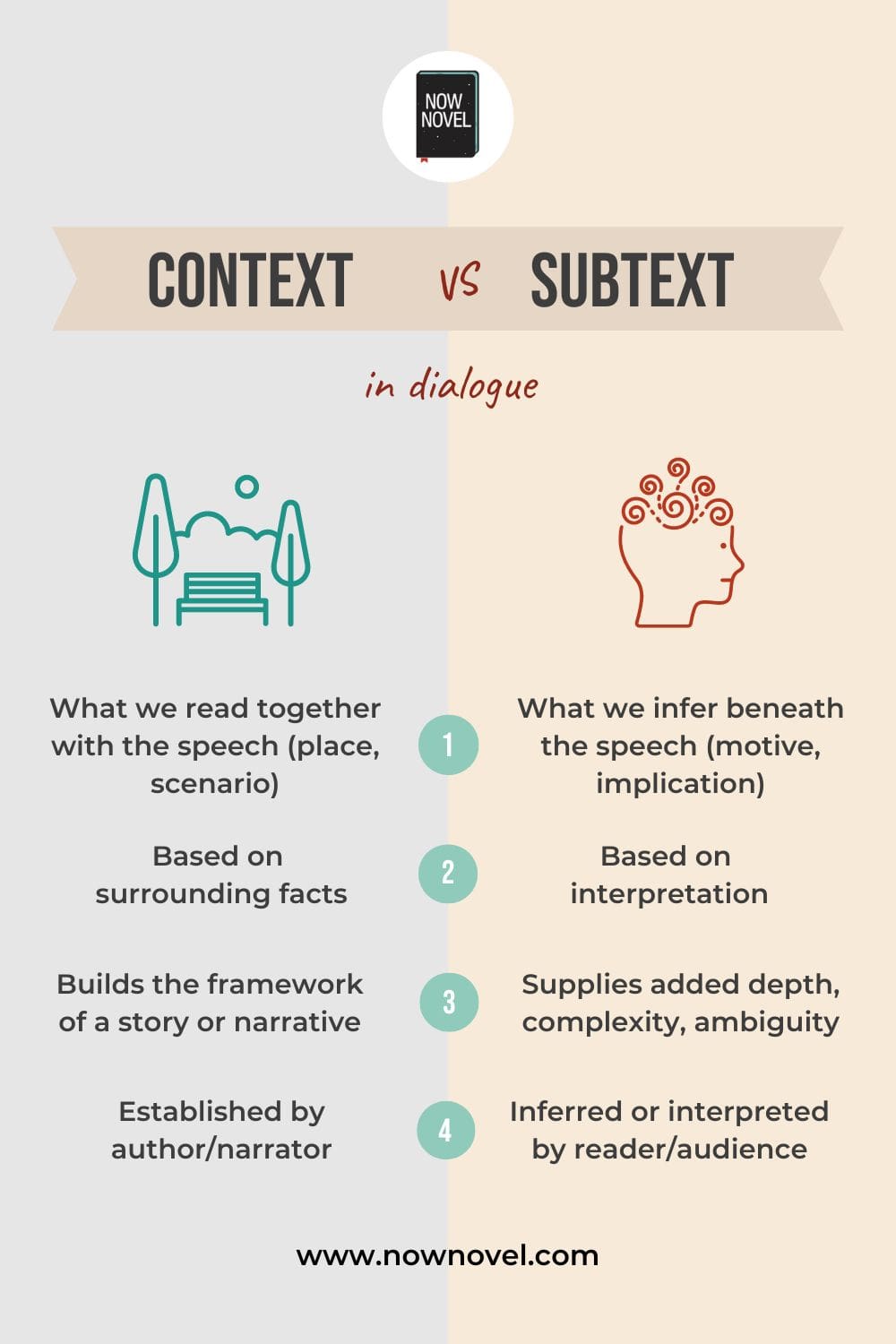
This infographic provides a clean visual distinction between the surface text, the context driving it (Level 3), and the subtext it generates (Levels 1 & 2).
2. Deconstruction in Action: A Case Study
Now, let's apply this three-level framework to a complete scene. The same article provides a meticulous, beat-by-beat analysis of a scene from the film The Fall Guy.
The Fall Guy: 3 Levels of Subtext
We will now see how the three-level framework is used to deconstruct an entire scene. This analysis maps the surface conversation (making a movie) to the subtextual negotiation (processing a painful breakup).
Read from 'Let’s explore more deeply...' to the end of the article. As you read, pay close attention to how every line of dialogue and every action serves two purposes simultaneously: a surface purpose related to the film set, and a subtextual purpose related to the characters' romantic history.
To systematize what you just read, we can map the exchange in a table. This isolates the surface "plot" from the subtextual "story."
| Beat / Line | Surface Conversation (The Movie Plot) | Subtextual Negotiation (The Relationship) |
|---|---|---|
| Jody: "Technical issue, little bump on the dolly." | Director needs another take for technical reasons. | Jody's Opening Move: "We're not done. You don't get off that easy. I'm in control now." |
| Jody: "They shared what’s called a moon season. In real life, you might call it a fling." | Director gives an actor backstory for the character. | Accusation: "What we had... was it just a fling to you?" |
| Colt: "I can hit the rock better now." | Actor signals he understands the direction. | Plea: "I get it. Please stop. You're making your point." |
| Jody: "How do you justify this year she spent spinning out over this? What could you say?" | Director asks the actor for dialogue improvisation. | Demand for Accountability: "Explain yourself. Apologize for ghosting me and breaking my heart." |
| Colt: "In this movie, do the aliens and humans ever talk… in private?" | Actor asks a logistical question about the script. | Request for De-escalation: "Can we please not do this in public? You're humiliating me." |
| Colt: "...he’d probably say… he’s been living in total regret since then." | Actor improvises a line for his character. | Confession: Colt finally answers her demand, admitting his true feelings of regret and vulnerability. |
| Colt: "I'd love another chance." | Actor agrees to do another take of the stunt. | The Real Goal: "Can we try again? I want you back." |
This mapping process is the core of deconstruction. You are reverse-engineering the dialogue to expose its dual machinery.
3. A Pattern Library for Subtextual Negotiation
To get proficient at mapping, you need to recognize the tell-tale signs of subtextual negotiation. These are recurring patterns in how people talk around an issue.
How to Write Better Dialogue: Subtext, Conflict & Rhythm
The article 'How to Write Better Dialogue' provides a concise set of 'mini rules' and patterns that act as excellent diagnostics for subtext.
Focus on three key areas in this resource: 1) Read the 'Before/after example (subtext)' to see a direct comparison. 2) Study the 'Quick subtext patterns you can reuse'. 3) Study the 'Mini rules that reliably produce better dialogue', specifically the rules 'Make answers slightly misaligned' and 'Let characters talk past each other strategically'.
Let's compile these into a quick diagnostic toolkit:
- Misaligned Answers: Does a character answer the emotional question instead of the factual one, or vice versa? (e.g., "Did you finish the report?" → "It's been a very long week.") This signals avoidance.
- Frame Switching: Does a character refuse the premise of a question and challenge the questioner's right to ask it? (e.g., "Where were you?" → "Why are you keeping tabs on me?") This is a power play to shift the topic from the information to the relationship.
- Strategic Literalism: Does a character use technically true but emotionally evasive language? (e.g., "I said I'd handle it. I didn't say when.") This is a form of passive aggression.
- Over-specificity: Does a character provide an unnecessary amount of detail? This often signals defensiveness, as if they are pre-emptively building a case for themselves.
When you spot these patterns, it's a strong indicator that a subtextual negotiation is underway.
Test your understanding!
Consider this exchange between two business partners, A and B, after losing a major client. Partner A was responsible for the account.
Partner B: "I just got off the phone with them. They're pulling the contract."
Partner A: (Stares at their computer screen) "I've already drafted a new marketing proposal for the Sterling account. I've broken down the Q3 projections by vertical. We can pivot to focus on enterprise leads."
Partner B: "Did you hear me?"
Partner A: "I heard you. The Sterling proposal uses a completely different engagement metric."
Deconstruct Partner A's dialogue. Which subtextual pattern are they using, and what are they negotiating for subtextually?
Show answer
- Pattern: Partner A is using a combination of Misaligned Answers and Over-specificity. Partner B makes a direct, emotionally heavy statement about a failure. Partner A completely ignores the emotional and factual content of that statement and instead provides an overly detailed, unrelated monologue about a different account.
- Subtextual Negotiation: Partner A is refusing to engage with the failure. On the surface, they are talking about work. Subtextually, they are saying, "I am not going to talk about this failure. I will not accept blame. I am already moving on and demonstrating my competence, so you cannot attack my performance." They are negotiating to avoid accountability and shame.
4. Final Deconstruction Exercise
Let's conclude with one final case study, this time from the film Sound of Metal. In the previous lesson, we saw the outcome of this scene. Now, let's analyze the pivotal exchange that leads to it.
Writing Subtext — The Secret to Writing What's Under the Surface
The video 'Writing Subtext' provides an excellent analysis of the climactic reunion in 'Sound of Metal'. We'll focus on this specific scene to practice our deconstruction skills.
Watch the segment analyzing the 'Sound of Metal' scene (17:23 - 20:33). Pay close attention to the context (Lou's history of self-harm, Reuben's recovery) and how it informs the final, simple line of dialogue.
Now, map the most important exchange:
Surface Conversation: Reuben wants to get the band back together. Lou seems to agree but is hesitant. Reuben sees her scratching her arm, a sign of her old trauma returning. He says: "It's okay, Lou."
Your Task: Deconstruct the line "It's okay, Lou." What is the surface meaning, and what is the profound subtextual negotiation being resolved in that single phrase?
Show Answer
-
Surface Meaning: "It's okay, you don't have to get the band back together. Don't worry about it." It's a simple reassurance.
-
Subtextual Negotiation: This line is the final move in a deep, unspoken negotiation.
- Reuben's Opening Position: "I want us to go back to how things were. Let's fix this."
- Lou's Counter-Position (via action): The scratching of her arm says, "Going back will destroy me. I can't."
- Reuben's Final Move ("It's okay, Lou."): Reuben is conceding the negotiation. He is receiving her subtextual message and responding to it. The line's subtext is: "I understand. I see that going back would hurt you, and I love you too much to do that. I release you from your obligation to me. I will be okay, and more importantly, you need to be okay. We have to let each other go."
He isn't just saying the situation is okay; he's communicating a complex act of love, sacrifice, and release, resolving the entire emotional conflict of the story in three words.
Conclusion
In this lesson, you learned a systematic method to deconstruct dialogue. By separating the surface conversation from the underlying subtextual negotiation, you can map the true mechanics of a scene.
Key Takeaways:
- Dialogue has Layers: Effective dialogue operates on at least three levels: what is said and meant (Transmission), what is heard and interpreted (Reception), and the history each character brings to the table (Context).
- Deconstruction is Mapping: The goal of analysis is to create a clear map between the literal words on the page and the unspoken negotiation for power, safety, love, or status happening beneath.
- Patterns Signal Subtext: You can diagnose subtext by looking for recurring patterns like misaligned answers, frame switching, and strategic literalism.
Preview of the Next Lesson
We have now concluded our module on dialogue. We've gone from power dynamics to subtextual deconstruction. We are now prepared to transition from the macro-level of conversation to the micro-level of the prose itself.
Our next module is Prose Engineering: Sentence and Paragraph. In the first lesson, we will focus on the smallest unit of impact and learn how to use short sentences (<10 words) to create impact, convey rapid action, or deliver a revelation.