Introduction
In our last lesson, we deconstructed the short sentence, defining it as a specialized tool for creating impact, conveying speed, and delivering revelations. We established that its power comes from contrast—breaking the pattern of longer, more descriptive prose.
This lesson focuses on the prose that creates that pattern: the medium sentence. Our learning outcome is to use medium sentences (10-20 words) for clear, efficient delivery of information and narrative progression. You can think of the medium sentence as the default gear for your narrative engine. It's not designed for high-impact jolts or for slow, scenic crawls; it's designed for reliably moving the story forward. We will define its function, analyze its role in pacing, and examine its use as a corrective tool for common prose problems.
1. The Narrative Workhorse
While short sentences create emphasis and long sentences create atmosphere, medium sentences do the bulk of the narrative work. They are the foundation of clear, readable prose. Their primary function is to deliver information and advance the plot without drawing attention to themselves.
To establish a clear, technical definition, we'll consult a guide on prose rhythm.
How to Vary Sentence Structure to Control Reading Rhythm
The article 'How to Vary Sentence Structure to Control Reading Rhythm' provides an excellent mechanical breakdown of sentence types. We will use it to define the medium sentence and its core function.
Read the three paragraphs within the 'Mastering Sentence Length Variation' section that define short, medium, and long sentences. Focus on the description of medium sentences as the 'foundation' for your narrative.
As the guide states, medium sentences (10-20 words) are your "foundation." They are clear, readable, and functional. Most of your writing will operate in this range. Because they don't demand the immediate attention of a short sentence or the sustained focus of a long one, they allow the reader to become immersed in the story itself, rather than the prose.
2. Establishing Neutral Pacing and Flow
In our previous lesson, you saw how Gary Provost's famous example demonstrated the need for sentence variety. The monotonous rhythm of repeated short sentences was corrected by introducing medium and long sentences to create "music." The medium sentence is the key to establishing a neutral, flowing pace that feels natural to the reader.
- Short Sentences (<10 words): Accelerate pacing.
- Medium Sentences (10-20 words): Establish a neutral, steady pace.
- Long Sentences (>20 words): Decelerate pacing.
Most effective prose is built on a base of medium sentences, with short and long sentences used strategically to deviate from that baseline for specific effects. A visual representation of sentence length in a typical text often resembles a statistical distribution, with the majority of sentences falling in the middle range.
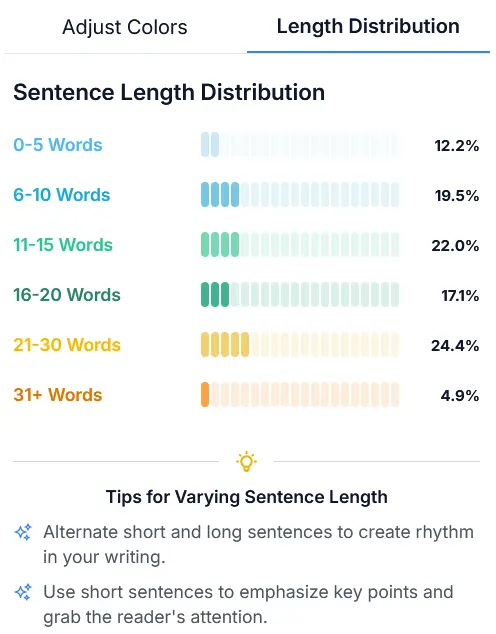
A steady flow of medium sentences moves the narrative forward efficiently, achieving what the River Editor guide refers to as a "flowing narrative" with "neutral pacing." It's the rhythm that allows readers to forget they are reading.
3. A Data-Driven Case for Clarity
Your background in computer science and statistics gives you an appreciation for efficiency and empirically-backed claims. The effectiveness of the 10-20 word sentence isn't just a stylistic preference; it's supported by data on reader comprehension.
What is the perfect sentence length?
The article 'What is the perfect sentence length?' by James Scott cites research from the American Press Institute that directly correlates sentence length with reader understanding. This provides a quantitative basis for our 10-20 word guideline.
Read the section 'An argument for shorter sentences.' Pay close attention to the specific comprehension percentages tied to different word counts.
The research is clear:
- 8 words or less: 100% comprehension
- 14 words: 90% comprehension
- 43+ words: <10% comprehension
This data provides a strong, logical argument for why the medium sentence is the workhorse of prose. The 10-20 word range represents a sweet spot—long enough to contain a complete thought with some detail, but short enough to ensure near-perfect comprehension. It is maximally efficient for information transfer.
4. The Medium Sentence as a Corrective Tool
Because medium sentences represent a stable middle ground, they are the primary tool for diagnosing and fixing two common prose failures: choppiness and convolution.
A. Fixing Choppy Prose
Choppy prose occurs when too many short sentences are strung together. It feels abrupt, simplistic, and disconnected.
Diagnosis: Read a paragraph aloud. If it sounds like a drum solo with no variation (e.g., "He walked in. He saw the body. He called the police. The line was dead."), the prose is choppy.
Correction: Combine related short sentences into a single, clearer medium sentence.
Let's return to the River Editor guide for the specific technique.
How to Vary Sentence Structure to Control Reading Rhythm
We will now look at a practical application. This section of the guide demonstrates how to fix choppy prose by combining sentences.
Read the section titled 'Identifying and Fixing Choppy Prose.' Analyze the 'before' and 'after' examples to see the mechanical process of using conjunctions and clauses to combine short sentences into more fluid medium ones.
Example from the guide:
- Choppy: "The door opened. A man walked in. He was tall. He wore a dark suit." (4 sentences, 14 words total)
- Corrected: "The door opened and a tall man in a dark suit walked in." (1 sentence, 13 words)
The corrected version is more efficient and reads more smoothly. It packages a set of related facts into a single, easily digestible unit.
B. Fixing Convoluted Prose
Convoluted or exhausting prose is the opposite problem: a paragraph dominated by overly long, complex sentences with no "breathing room."
Diagnosis: If you have to reread a sentence to understand its meaning, or if you lose track of the subject by the time you reach the period, it's likely too long or poorly constructed.
Correction: Break the long sentence down into two or more shorter, clearer sentences (often a mix of medium and short).
How to Vary Sentence Structure to Control Reading Rhythm
Now for the opposite problem. This section of the same guide shows how to fix overly long sentences.
Read the section titled 'Avoiding Run-On and Exhausting Prose.' Again, focus on the 'before' and 'after' example to understand how to deconstruct a long sentence into more manageable, readable parts.
Example from the guide:
- Convoluted: "She walked down the street thinking about what he'd said and wondering if he'd meant it the way it sounded or if she was reading too much into his words the way she always did when she was anxious about a relationship." (1 sentence, 42 words)
- Corrected: "She walked down the street thinking about what he'd said. Had he meant it the way it sounded? Or was she reading too much into his words, the way she always did when she was anxious about a relationship?" (3 sentences, 41 words total)
By breaking the single long thought into a statement, a question, and a follow-up observation, the prose becomes clearer and more engaging. The core ideas are now delivered in more efficient packets of information, largely falling within the medium-sentence range.
Test your understanding!
The following paragraph suffers from choppy prose, making it feel disjointed and elementary.
The ship rocked on the waves. The sky was dark. Clouds gathered on the horizon. A storm was coming. The captain stood on the deck. He gripped the railing. He stared into the wind. He was not afraid.
Your task: Rewrite this paragraph to create a smoother narrative flow. Your goal is to combine the short sentences into more effective medium-length sentences. You are not required to use all the original words, but you must preserve all the key information.
Show answer
Here is one possible revision:
The ship rocked on the dark waves as clouds gathered on the horizon. A storm was coming. Standing on the deck, the captain gripped the railing and stared into the wind. He was not afraid.
Analysis of the changes:
- The first three sentences are combined into one 14-word medium sentence that sets the scene efficiently.
- "A storm was coming" is kept as a short sentence for emphasis. This demonstrates the principle of variety we've discussed.
- The next three sentences about the captain are combined into a fluid 16-word medium sentence.
- "He was not afraid" remains a short, impactful sentence that reveals character.
The revised paragraph now has a base of medium sentences, creating a solid narrative flow, while still using short sentences for punctuation and impact.
Conclusion
In this lesson, we defined the medium sentence as the functional core of clear narrative prose. By mastering its use, you build the foundation upon which more dramatic stylistic effects can be built.
Key Takeaways:
- Function: Medium sentences (10-20 words) are the workhorses of prose, used for the clear and efficient delivery of information and plot progression.
- Pacing: They establish a neutral, steady narrative pace, creating a smooth reading experience.
- Clarity: The 10-20 word range is a proven "sweet spot" for reader comprehension.
- Correction: Medium sentences are the primary tool for fixing both choppy prose (by combining short sentences) and convoluted prose (by breaking down long sentences).
Preview of the Next Lesson
We have now analyzed the mechanics of short and medium sentences. The final tool in our sentence-length toolkit is the long sentence. In the next lesson, we will explore how to use long, complex sentences (>20 words) to build contemplative moods or detailed descriptions, while also analyzing the risks and structural control required to use them effectively.