Introduction
Welcome to the final lesson in our module on sentence length. In our previous lessons, we established a functional framework for sentence control. We defined the short sentence (<10 words) as a tool for impact and acceleration, and the medium sentence (10-20 words) as the narrative workhorse, ensuring clarity and steady progression. You learned that medium sentences are the most efficient for information transfer, a conclusion supported by reader comprehension data.
Today, we address the third and final tool in this set: the long sentence. Our learning outcome is to use long, complex sentences (>20 words) to build contemplative moods or detailed descriptions.
While the data from our last lesson showed that comprehension drops with very long sentences, this doesn't mean they are a flaw. It means they serve a different primary purpose. Instead of prioritizing rapid, efficient information transfer, the long sentence prioritizes immersion, atmosphere, and detail. It intentionally slows the reader down, trading comprehension speed for a richer sensory or psychological experience. We will deconstruct the mechanics of building these sentences so they are artful and controlled, not just long and confusing.
1. The Function of the Long Sentence: Mood and Description
A long sentence forces the reader to hold a continuous thought, preventing the mental "reset" that a period provides. This sustained attention is ideal for two specific effects:
- Building a Contemplative Mood: By stringing together clauses of reflection, observation, or internal thought, you can draw the reader into a character's mind, creating a slow, introspective rhythm.
- Painting a Detailed Description: By accumulating sensory details within a single sentence, you can build a comprehensive and immersive picture of a person, object, or place, forcing the reader to see it as a whole.
Let's examine a practical example of this principle. The image below is an excerpt from Charlotte Brontë's Jane Eyre, with sentences color-coded by the mood they create.
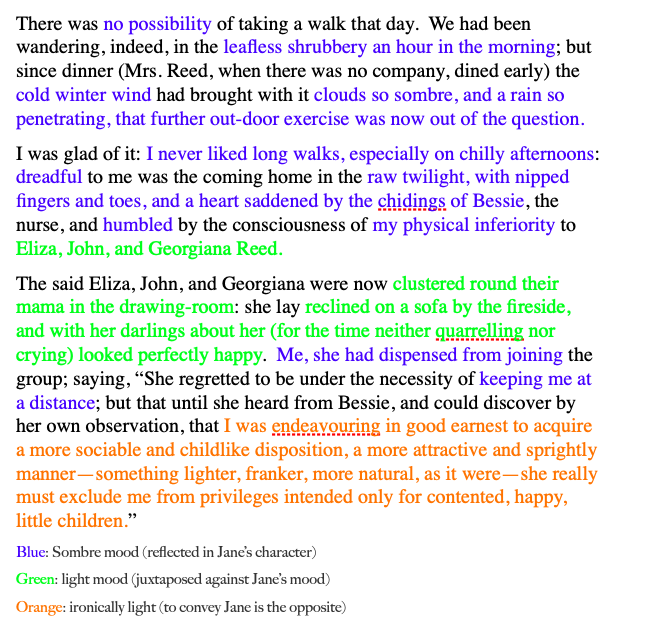
Notice the sentences highlighted in blue, which describe Jane's "sombre mood." They are significantly longer than the others. For example: "I was a discord in Gateshead Hall; I was like nobody there; I had nothing in harmony with Mrs. Reed or her children, or her chosen vassalage." This sentence doesn't just state a fact; it accumulates clauses to build a feeling of pervasive alienation. It slows the reader down to the pace of Jane's own gloomy thoughts. This is the power of a well-constructed long sentence: it makes the reader feel the mood through the very structure of the prose.
2. The Core System: Cumulative (Right-Branching) Sentences
The primary risk of a long sentence is confusion. If the reader gets lost tracking subjects, verbs, and clauses, the intended effect is ruined. The most reliable system for building a long sentence that remains clear is the cumulative sentence, also known as a right-branching sentence.
The system is simple and mechanical:
- Start with a clear, simple main clause (also called a "kernel" or "base clause"). This clause contains the core subject and verb of the sentence.
- Place this main clause at or near the beginning of the sentence.
- "Branch" to the right by adding a series of modifying phrases and clauses that add detail, description, or qualification to the main clause.
This structure is effective because it gives the reader the core information upfront. They know who did what. Everything that follows is supplementary detail, which they can process without having to hold the main grammatical structure in memory.
Let's read about this core principle.
How to Write a Brilliant Long Sentence
The following article, 'How to Write a Brilliant Long Sentence,' explains this technique clearly. We will focus on the final, most important principle it presents.
Read section 7, 'Branch to the right.' This section contains the central rule for our purposes: state the subject and verb early, then add details. Pay attention to the example about 'Gasper Hicks' and the explanation of cognitive load.
The key insight is that this method "spread[s] the cognitive load over time." Your reader is never left waiting for the main point.
This idea of building from a "kernel" is a powerful way to think about sentence construction as a process of generative addition, not just fitting words into a pre-planned structure.
Now, let's explore this concept of 'branching' in more grammatical detail. The guide 'How to Write Better Sentences' provides a fantastic mechanical breakdown of this.
Read 'Essay Six: Phrases and branching sentences' (starts around page 38). Focus on the explanation and examples of right-branching, left-branching, and mid-branching. Then, continue reading about Francis Christensen's 'cumulative sentence' (starts around page 44), which formalizes this idea of writing as a process of addition.
3. The Mechanics of Addition: Using Modifiers
So, what are these "additions" that we branch off from the main clause? They are typically modifying phrases—groups of words that act like adjectives or adverbs, adding layers of detail.
The most common and useful types are:
- Participial Phrases: Phrases built around a verb ending in
-ingor-edthat acts as an adjective (e.g., "grinning with madness," "angered by the CEO's laughter"). - Prepositional Phrases: Phrases beginning with a preposition like in, on, at, with, under (e.g., "in the dark courtyard").
- Absolute Phrases: A noun followed by a participle that modifies the entire main clause (e.g., "his arms aching from the rusty axe's weight").
Watching these being assembled is the best way to understand the process. The following video provides a clear, practical demonstration of building an extremely long cumulative sentence from a simple base.
Improve Your Life with Cumulative Sentences
In 'Improve Your Life with Cumulative Sentences,' the channel Writing with Andrew demonstrates how to construct a long, detailed sentence by layering modifiers onto a simple base clause. This is the cumulative method in action.
Watch from 03:34 to 09:37. Pay close attention to these parts: 03:34 - 04:38: The critical distinction between a long sentence and a run-on sentence. 05:40 - 07:15: The main demonstration. Notice how the sentence starts with 'Today is a beautiful day' and then accumulates an enormous amount of descriptive detail. 07:15 - 09:37: The analysis of why this works, including the river analogy, which contrasts the 'stepping stone' effect of short sentences with the continuous flow of a cumulative one.
The video shows how you can transform short, choppy sentences into a single, flowing complex sentence by turning those independent clauses into modifying phrases. This is a generative technique you can apply directly.
This next video demonstrates that transformation process explicitly.
Make Your Writing Flow | Sentences: Transitions, Subordination, and Modification
In this clip from 'Make Your Writing Flow,' the same creator shows how to convert a series of short, independent clauses into modifiers to create a single, smoother sentence.
Watch the segment from 06:47 to 09:10. Focus on the 'before' and 'after' example about Tim cracking eggs. Analyze how clauses like 'He had gathered his ingredients' are converted into a participial phrase like 'having gathered the ingredients' to become part of a larger sentence.
Test your understanding!
Here is a simple kernel sentence:
The ship sailed into the fog.
Your task: Using the cumulative (right-branching) method, expand this kernel into a single long sentence (>20 words) that creates a mood of mystery and dread. Add at least three distinct modifying phrases.
Show answer
Here is one possible solution:
The ship sailed into the fog, its wooden hull groaning under the strain, the dim shapes of the crew vanishing one by one from the deck, leaving only the rhythmic toll of a single bell to mark its passage into the unknown.
Analysis of the additions:
- Kernel Clause:
The ship sailed into the fog(main point delivered upfront). - Modifier 1 (Absolute Phrase):
its wooden hull groaning under the strain(adds an auditory detail, building tension). - Modifier 2 (Participial Phrase):
the dim shapes of the crew vanishing one by one from the deck(adds a visual detail, enhancing mystery). - Modifier 3 (Participial Phrase):
leaving only the rhythmic toll of a single bell to mark its passage into the unknown(adds a final, ominous auditory detail and reinforces the theme of dread).
Each phrase adds another layer of description, building a specific mood, while the core action remains clear.
4. A Note on Strategic Use
Mastering the long sentence does not mean using it constantly. As with short and medium sentences, its power comes from variety and contrast. A long, descriptive sentence has the most impact when it follows a series of shorter, more direct sentences. Overusing any single structure leads to monotonous prose.
The final video clip offers an important warning about this.
Make Your Writing Flow | Sentences: Transitions, Subordination, and Modification
Finally, a crucial point about moderation. While these techniques create flow, they can be overdone.
Watch the short concluding segment from 09:10 to 10:25. The core idea here is that contrast (like 'crackers on their soup') is vital. You don't want to eliminate every short sentence.
The goal is to have a full toolkit—short, medium, and long—and to deploy each tool for its specific, intended purpose.
Conclusion
Today we completed our analysis of sentence length as a mechanical tool for controlling narrative pace and effect. We dissected the long sentence, reframing it from a potential error into a powerful device for immersion.
Key Takeaways:
- Function: Long sentences (>20 words) are used to slow the reader down, building contemplative moods and detailed, immersive descriptions.
- Core System: The most reliable structure is the cumulative (right-branching) sentence, which places the main clause at the beginning and adds modifying phrases afterward.
- Mechanics: This "addition" is achieved by converting ideas into modifying phrases (participial, prepositional, absolute), which layer detail onto the base clause.
- Strategic Use: Long sentences are most effective when used in contrast with shorter sentences to create rhythmic variety.
Preview of the Next Lesson
We have focused on how sentence length affects rhythm. Next, we will turn to how the arrangement of information within a sentence creates emphasis. Our next lesson is: Control emphasis by placing the most important word or phrase at the end of a sentence. This will introduce a complementary structure to the cumulative sentence—the periodic sentence—where the main clause is deliberately delayed for dramatic effect, giving you another layer of control over your prose.