Welcome back. In our last lesson, we established a crucial principle for building scalable systems: stateless architecture. We saw how decoupling user state from individual servers allows a system to grow horizontally and withstand failures. Now, we'll delve into a powerful pattern that operates within these servers to process requests in a structured and reusable way.
This lesson focuses on middleware and its role in request processing pipelines. Your goal is to describe how middleware functions as an ordered chain of components that intercepts and handles HTTP requests and responses. Understanding this concept is essential for dissecting how backend applications manage common tasks—like security, logging, and validation—before a request ever reaches the core business logic. This insight is directly aligned with your goal of gaining a deep technical understanding of how backend systems work from the inside out.
What is Middleware?
At its heart, middleware is software that sits between an application's core logic and the underlying system, handling communication and coordination. In the context of a web server, it's a series of functions that execute in a specific order for every incoming HTTP request.
A great way to think about this is the "waiter" analogy.
What Is Middleware? How It Works, Types, Benefits, Examples and When to Use It - Intechfy
This article from Intechfy provides a clear, high-level definition and analogy for middleware.
Please read the introduction and the first three short sections: Start from the beginning and read through the Simple Definition, Where Middleware Sits, and Quick Real-World Analogy. This will establish a strong mental model of middleware as a coordinator.
As the article explains, you don't walk into a restaurant kitchen to give your order to the chef. You interact with a waiter, who validates your request, passes it to the kitchen, and brings the response (your food) back to you. Middleware plays a similar role for software requests. It intercepts the request, performs some checks or tasks, passes it along to the next stage (which could be another middleware or the final application logic), and can even process the response on its way back to the client.
These "waiters" are chained together to form a pipeline. Each request travels through this pipeline, with each middleware component having a chance to act on it.
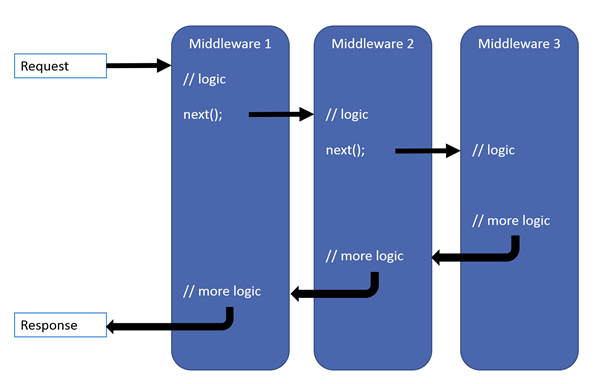
This visual shows the core idea:
- The request enters Middleware 1.
- Middleware 1 performs some logic and then calls
next(), passing control to Middleware 2. - Middleware 2 does its job and calls
next(), passing control to Middleware 3. - Middleware 3, the final component in this example, generates a response.
- The response then travels backwards through Middleware 2 and Middleware 1, each of which can inspect or modify the response before it's sent to the client.
How the Pipeline Works: Order, Control, and Bidirectionality
The concept of a pipeline seems simple, but its power lies in a few key mechanics that are critical to understand. The article "Middlewares in ASP.NET Core" provides an excellent, technically detailed breakdown of these mechanics. While it uses ASP.NET Core for its examples, the principles apply broadly to most modern backend frameworks like Express.js, Django, and others.
Understanding Middlewares in ASP.NET Core
This article from the blog 'Code with Mukesh' explains the mechanics of the middleware pipeline in great detail.
Focus on these two sections: How Middlewares Work: This section clearly explains the bidirectional nature of middleware—how code before await next() runs on the request path and code after it runs on the response path. Middleware Execution Order: Pay close attention to this section. It uses a code example and a real-world debugging story to demonstrate why the order of middleware is not just a suggestion, but a strict rule with major consequences.
Let's unpack the two most important ideas from that reading.
-
Middleware is Bidirectional: This is a profound concept. A single middleware function can execute logic on both the incoming request and the outgoing response. The
next()call is the pivot point. Any code beforenext()is part of the request's journey toward the application logic. Any code afternext()is part of the response's journey back to the client. This is how, for example, a logging middleware can record the incoming request details and then, afternext()completes, record the final status code of the response. -
Order is Critical: As the article's debugging story highlights, registering middleware in the wrong order can lead to subtle, hard-to-trace bugs. The example of placing authorization before authentication is a classic. The system tries to check what a user can do before it even knows who the user is. From your perspective as a QA professional, this is a crucial insight. When you see inconsistent or illogical behavior, especially around security or request processing, an incorrectly ordered middleware pipeline is a prime suspect.
Another key capability of middleware is the ability to short-circuit the pipeline. A middleware component can decide not to call next() and instead generate a response immediately. All subsequent middleware components are skipped.
This is extremely useful for:
- Authentication: If a request has an invalid or missing authentication token, an authentication middleware can immediately return a
401 Unauthorizedresponse. There's no need to proceed further down the pipeline. - Rate Limiting: If a client exceeds their request limit, a rate-limiting middleware can return a
429 Too Many Requestsresponse. - Caching: If a request is for a resource that is already in a cache, a caching middleware can return the cached response directly, avoiding a potentially expensive database query.
Common Use Cases for Middleware
Middleware is used to handle cross-cutting concerns—tasks that are common across many different parts of an application and are not part of the core business logic of a specific feature. Separating these concerns into middleware makes the application code cleaner, more modular, and easier to maintain.
The following video from the Syntax podcast provides a great overview of the many practical applications of middleware.
The video "Middleware Explained" from the Syntax channel offers a practical, developer-focused tour of common middleware use cases.
Watch the first two main segments: The introduction, which defines middleware as code that runs in between the request and the final handler. The section on real-world examples, which covers authentication, logging, performance timing, A/B testing, error handling, caching, and more.
Based on the video and our other resources, here are some of the most common categories of middleware functionality:
- Authentication & Authorization: Checks for valid credentials (e.g., JWTs, API keys) and verifies that the user has permission to access the requested resource.
- Logging & Metrics: Records details about each request and response. It can also time how long requests take to process, which is invaluable for performance monitoring.
- Error Handling: A special type of middleware, often placed at the very beginning of the pipeline, designed to catch any errors that occur in downstream middleware or in the application logic. It ensures that users receive a clean, structured error response instead of a raw server crash.
- Request Parsing: Transforms the raw request body into a usable format, for example, by parsing a JSON string into a programmable object.
- Response Formatting: Ensures responses are consistent, for example, by compressing response bodies to save bandwidth or adding standard headers like CORS (Cross-Origin Resource Sharing) headers.
- Routing: Directs the incoming request to the correct piece of application code that should handle it.

A Deeper Look: Global Error Handling
Let's examine one specific use case—global error handling—to see how these concepts come together. In many frameworks, you can define a special middleware that only runs when an error occurs.
The procademy video below provides a fantastic walkthrough of creating a global error handler in Express.js. It demonstrates how passing an error object to the next() function signals to the framework to skip all other regular middleware and jump directly to the designated error-handling middleware.
#91 Global Error Handling Middleware | Error Handling in Express | A Complete NODE JS Course
This video, "Global Error Handling Middleware," explains the pattern of using a centralized middleware to manage all application errors.
Focus on these key parts: The explanation of how a global error handler provides separation of concern. How to create the error handler by defining a function with four specific arguments, which the framework automatically recognizes. The crucial mechanism for triggering it: calling the next function with an error object.
This pattern is incredibly powerful. It means your main application logic doesn't need to be cluttered with repetitive try...catch blocks for every possible failure. Instead, it can simply throw an error, and trust that the global error-handling middleware will catch it and format a consistent, user-friendly response.
Conclusion
In this lesson, we've unpacked the concept of middleware and its central role in modern backend applications. It's the mechanism that brings order and reusability to the process of handling HTTP requests.
Here are your key takeaways:
- Middleware is a pipeline: It's a chain of functions that a request flows through sequentially on its way to your application logic, and that the response flows back through in reverse.
- Order is critical: The sequence in which middleware is registered dictates the flow of control and can be a source of subtle bugs if incorrect (e.g., authorization before authentication).
- It handles cross-cutting concerns: Middleware is ideal for separating generic tasks like logging, authentication, error handling, and data parsing from your core business logic.
- Middleware can control the flow: A middleware component can either pass control to the next component via
next()or short-circuit the pipeline by sending a response directly.
For you as a QA engineer, understanding the middleware pipeline is like having a schematic of the factory assembly line. It allows you to reason about potential points of failure, design more targeted tests (e.g., "what happens if the auth middleware receives a bad token?"), and more effectively diagnose bugs by identifying which stage of the request-response lifecycle the failure occurred in.
In our next lesson, we'll look at a topic that's closely related to how middleware is configured: environment configuration and secrets management. We'll explore how backend applications manage different settings for development, testing, and production environments, and how they securely handle sensitive information like API keys and database passwords that middleware and other parts of the system rely on.