Welcome to your next lesson in the Core Backend Components module. In our previous session, we traced a request's journey inside a single application server, dissecting the layered architecture of controllers, services, and repositories. Now, we'll zoom back out to consider how multiple application servers work together. This leads us to a pivotal design decision that profoundly impacts a system's ability to handle growth and failure.
Your goal in this lesson is to differentiate between stateful and stateless server design and understand their significant implications for scalability. Mastering this concept is fundamental for anyone involved in architectural discussions, as it's one of the first and most critical choices that determines how a system will behave under load—a topic central to your goal of understanding how complex systems manage high concurrency.
Building an Intuitive Understanding
Before we dive into technical definitions, let's build a strong mental model. The concepts of stateful and stateless can be understood through simple, real-world analogies.
Stateful vs Stateless Architectures Explained
The video "Stateful vs Stateless Architectures Explained" by Hayk Simonyan provides excellent analogies that make these abstract concepts tangible.
Please watch the entire video. It's short and effective. Pay close attention to: The restaurant analogy for stateful architecture, where a specific waiter must serve you. The contrast with stateless, where any waiter can help because the order is written down. The online shopping cart example, which clearly illustrates the practical consequences of each approach. The explanation of why this matters for scalability, especially for large platforms.
This video provides the core intuition: does the server remember you, or does it treat every interaction as if it's the first time?
What is "State"?
In this context, "state" refers to any data related to a user's interaction history that the server needs to remember across multiple requests. This could include:
- Session Data: Is the user logged in? What is their user ID?
- User Preferences: Language, theme, or other settings.
- In-Progress Transactions: Items in a shopping cart, data entered into a multi-step form.
The fundamental question is not if an application has state—nearly all non-trivial applications do—but where that state is stored.
Stateful Architecture: The Server Remembers
In a stateful architecture, the application server itself stores the client's session state, typically in its own memory. As the video's analogy suggested, each user is "tied" to the specific server that holds their state.
Stateful vs. stateless architecture for scalable systems ...
The article from Aerospike provides a clear, formal definition of a stateful application.
Read the section What is a stateful application?. Focus on how it retains context between requests, using the shopping cart and login examples.
This design has one primary advantage: performance for subsequent requests can be very fast. Since the data is already in the server's memory, there's no need to fetch it from an external database.
However, this approach comes with severe disadvantages, especially concerning scalability.

As illustrated in the "Stateful Application" part of the diagram, if User A and User B's sessions are on Server A, all their future requests must go to Server A. This leads to several problems:
-
Difficult Horizontal Scaling: You can't simply add more servers to distribute the load evenly. A load balancer must use "sticky sessions" (or session affinity) to ensure a user is always sent back to the same server. If Server A is overloaded, adding a new Server C does nothing to help the users already stuck on Server A.
-
Poor Fault Tolerance: If Server A crashes, all the session data stored in its memory is lost. User A and User B would be abruptly logged out, their shopping carts emptied. From a user's perspective, the system is broken.
-
Maintenance Complexity: Taking a server down for updates is disruptive. You must either accept that all users on that server will lose their sessions or implement complex session migration logic.
Stateless Architecture: The Server Forgets
In a stateless architecture, the application server does not store any client session state between requests. Every request from a client is treated as an independent, self-contained transaction.
If the server needs state, it must be provided with the request or fetched from an external, shared storage system.
Scalability Simply Explained in 10 Minutes
The video "Scalability Simply Explained" from ByteByteGo frames statelessness as a core principle for building scalable systems.
Watch the segment on statelessness. It explains how externalizing state is the key to enabling horizontal scaling and fault tolerance.
The state is typically stored in one of two places:
- On the Client: The state is passed back to the client after the first request, and the client sends it back with every subsequent request. A common implementation is using JSON Web Tokens (JWTs), which we will cover in detail in the Security module. The "Stateless Authentication with JWT" part of the infographic above illustrates this flow.
- In a Shared External Store: The state is saved in a location accessible to all application servers, such as a distributed cache (like Redis) or a database.
This design completely changes the scalability equation.
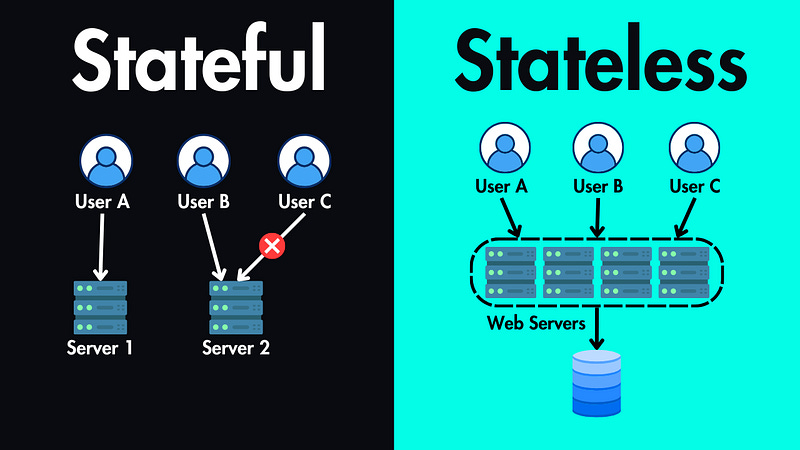
As shown in the image, because no server holds unique user data, any server can process a request from any user. This has massive benefits:
-
Effortless Horizontal Scaling: If traffic increases, you simply add more identical servers. The load balancer can use a simple algorithm like round-robin to distribute requests freely, as any server can handle any request.
-
High Fault Tolerance: If a server crashes, it's no big deal. The load balancer simply stops sending traffic to it. Since no session state was lost (it's stored externally), the user's next request goes to a healthy server, which retrieves the state from the shared store and continues as if nothing happened.
-
Simplified Design and Maintenance: The application servers are simpler and interchangeable. Deploying updates is easy: you can replace servers one by one without affecting user sessions.
A Direct Comparison
The "Stateful vs Stateless" table in the "A Guide to Stateless Architecture" infographic provides an excellent summary. Let's explore those points in more detail, drawing from our resources.
Stateful vs. stateless architecture for scalable systems ...
This article provides an excellent, detailed comparison of the two architectures and their trade-offs.
Please read the following sections carefully: "Differences between stateful and stateless systems" for a comprehensive breakdown across multiple dimensions like load balancing, fault tolerance, and performance. "Benefits of stateless architecture" to solidify your understanding of why this is the preferred model for scalable systems. "Drawbacks of stateful architecture" to understand the constraints that make stateful designs challenging at scale.
To summarize the key differences:
| Aspect | Stateful Architecture | Stateless Architecture |
|---|---|---|
| State Storage | On the application server (in-memory) | External (shared database, cache, or client token) |
| Scalability | Hard. Requires "sticky sessions". Limited by the capacity of a single node. | Easy. Allows for simple horizontal scaling by adding more servers. |
| Fault Tolerance | Low. A server failure results in the loss of all session data on that server. | High. Server failures have no impact on session data. Requests are rerouted. |
| Load Balancing | Complex. Requires session affinity to route users to the correct server. | Simple. Can use round-robin or least-connections to distribute load evenly. |
| Server Design | More complex. Must manage session lifecycle (creation, expiration, etc.). | Simpler. Servers are interchangeable and don't manage long-lived session data. |
The "Cost" of Statelessness
While stateless architecture is the standard for building scalable web services, it's not a free lunch. The "Stateless Services are Wasteful" section of the following article introduces a critical perspective. It describes the "Data Shipping Paradigm": for every request, the service might need to fetch data from an external store, do some work, and then throw the data away, only to fetch it all again on the next request. This can increase latency and database load.
By contrast, stateful services can embody a "Function Shipping Paradigm": data is loaded into the service once, and subsequent requests (functions) are shipped to the server where the data already lives.
Making the Case for Building Scalable Stateful Services in the ...
This article from High Scalability provides an advanced, nuanced look at the trade-offs, arguing that well-designed stateful services can offer significant benefits. This is a valuable perspective for deeper architectural discussions.
Read the first three sections: The introduction, which frames the debate. "Stateless Services are Wasteful", which defines the "Data Shipping Paradigm." "Stateful Services are Easier to Program", which explains the benefits of "Data Locality" and the "Function Shipping Paradigm."
Understanding this trade-off is crucial. Most modern systems accept the "cost" of data shipping because the benefit of horizontal scalability and fault tolerance is so immense. They mitigate the cost by using very fast, scalable external stores like in-memory caches (e.g., Redis) and well-designed databases.
Conclusion
In this lesson, we've contrasted two fundamental approaches to server design. This distinction is at the heart of building systems that can grow and withstand failure.
Your key takeaways are:
- Stateful Architecture: The server stores user session data in its memory. This makes horizontal scaling difficult and the system fragile, as a server failure leads to data loss.
- Stateless Architecture: The server stores no session data. State is externalized to a shared data store or carried by the client. This is the cornerstone of modern, scalable systems.
- Implications for Scalability: Statelessness is a prerequisite for easy horizontal scaling. It allows you to add and remove servers freely and makes the system resilient to individual server failures.
- The Trade-off: The primary benefit of stateless design (scalability, resilience) comes at the cost of potentially higher latency and load on external data stores for each request.
As a QA professional, identifying whether a service is stateful or stateless gives you immediate insight into its potential scaling bottlenecks and failure modes. If you're testing a stateful service, you should focus on scenarios involving session persistence and server failure. For a stateless service, you'd focus more on the external dependencies and the mechanisms for state transfer (like tokens).
In our next lesson, we will take a deeper look at a concept we touched on previously: middleware. While our last lesson introduced it as part of the request pipeline, we will now explore its role in more detail, examining common middleware patterns and how they help manage cross-cutting concerns in a clean, reusable way.