Hello! Welcome to our third lesson in this module.
In our last session, we built a crucial bridge from astronomy to Ayurveda by seeing how the Sun's declination (Kranti) dictates the environmental Gunas (qualities) and, in turn, the predominant Rasas (tastes) of the Adana and Visarga Kalas.
Today, we will bring this understanding inside the body. Our goal is to map the cycle of Dosha Sanchaya (accumulation), Prakopa (aggravation), and Prashama (pacification) to the Sun's transit through specific Rashi pairs. By the end of this lesson, you'll be able to predict how the Doshas will behave in each season based on the Sun's specific position in the zodiac. This is the very heart of preventative medicine in Ayurveda—anticipating imbalance before it manifests as disease.
The Foundation: From Rashi Transit to Dosha Response
As we've established, the Suryasiddhanta provides us with a celestial clock. The Sun's 360-degree journey through the 12 Rashis of the ecliptic is the primary driver of the seasons. Each of the six Ritus lasts for the duration it takes the Sun to transit through a pair of Rashis.

The qualities of each Ritu—which we now know are driven by the Sun's position—do not cause random effects. They trigger a predictable, three-stage process in the Doshas:
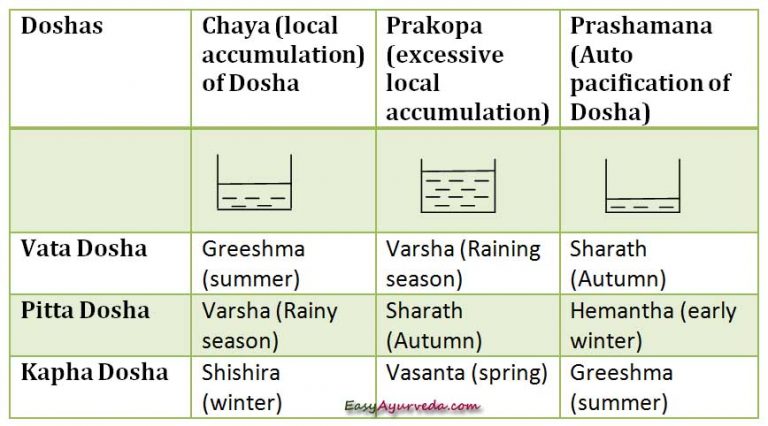
- Sanchaya (Accumulation / चय): This is the initial, mild stage. Due to the influence of a season with similar qualities (Gunas), a Dosha begins to increase in its primary seat (Sthana). It's like a reservoir slowly filling with water.
- Prakopa (Aggravation / प्रकोप): As the seasonal qualities continue or intensify, the accumulated Dosha "overflows" its seat and begins to circulate in the body, producing symptoms. The reservoir is now overflowing, causing problems downstream.
- Prashama (Pacification / प्रशम): As the season changes, a new set of environmental qualities—opposite to the aggravated Dosha—naturally brings it back to a state of balance. The inflow to the reservoir stops, and the overflow subsides.
This natural cycle is the basis of health. Disease often arises when our diet (Ahara) and lifestyle (Vihara) interfere with the Prashama stage or worsen the Prakopa stage.
Let's look at a resource that explains this core idea.
Rtucharya: The 6 seasons and lifestyle, diet, and your Yoga ...
The article 'Rtucharya: The 6 seasons and lifestyle...' provides an excellent conceptual overview of how this natural rhythm of the Doshas works.
Please read the first three paragraphs of the article. Focus on how the author describes the disturbance in Mahabhutas and Gunas leading to Sanchaya and Prakopa, and how nature's mercy brings about balance in the next season. This establishes the theoretical groundwork for our lesson.
The image below provides a simple but powerful visual metaphor for this three-stage process.
Mapping the Complete Dosha-Rashi Cycle
Now, let's put it all together. We will trace the annual journey of each Dosha through its cycle of Sanchaya, Prakopa, and Prashama, linking each stage directly to the Sun's transit through specific Rashis.
A comprehensive table in the paper "Ritucharya as Preventive Medicine" lays this out perfectly. We will use it as our primary guide.
Ritucharya as Preventive Medicine
The following resource contains a detailed table that is the cornerstone of our lesson today. It directly maps each Ritu to its corresponding Rashis and the state of the Doshas.
Please locate the table under the 'RESULTS' section. Take a few minutes to study it carefully. For each Ritu, identify the corresponding Rashis and then look at the 'Dosha' column to see which Dosha is accumulating, aggravating, or pacifying.
Based on the information in that table and classical principles, let's analyze the cycle for each Dosha.
The Kapha Dosha Cycle (Earth & Water)
The Kapha cycle is driven by the interplay of cold and heat.
-
Sanchaya (Accumulation) in Shishira Ritu
- Sun's Transit: Makara (Capricorn) & Kumbha (Aquarius)
- Reason: This is the peak of Dakshinayana's cold. The Sheeta (cold) and Guru (heavy) qualities of this season cause the fluids of Kapha Dosha to congeal and accumulate in their sites, primarily the chest. It's like water turning to ice.
-
Prakopa (Aggravation) in Vasanta Ritu
- Sun's Transit: Meena (Pisces) & Mesha (Aries)
- Reason: As Adana Kala begins and the Sun's declination becomes positive, the increasing environmental heat (Ushna) starts to melt the solidified Kapha from winter. This liquefied Kapha overflows its sites, leading to the classic symptoms of spring allergies, colds, and congestion.
-
Prashama (Pacification) in Grishma Ritu
- Sun's Transit: Vrisha (Taurus) & Mithuna (Gemini)
- Reason: The intense heat and dryness (Ruksha Guna) of summer effectively evaporates and dries up the excess liquid Kapha, bringing it back to a normal state.
The Vata Dosha Cycle (Air & Ether)
The Vata cycle is primarily governed by dryness and cold.
-
Sanchaya (Accumulation) in Grishma Ritu
- Sun's Transit: Vrisha (Taurus) & Mithuna (Gemini)
- Reason: This is the peak of Adana Kala. The intense heat depletes the body of its unctuous and fluid elements (Sneha and Jala), leading to an increase in dryness (Ruksha) and lightness (Laghu). These are the primary qualities of Vata, so it naturally accumulates.
-
Prakopa (Aggravation) in Varsha Ritu
- Sun's Transit: Karka (Cancer) & Simha (Leo)
- Reason: The body, already dry from summer, is now exposed to the cold, windy, and unstable atmosphere of the rainy season. This combination of pre-existing dryness with new coldness is a potent trigger for Vata Prakopa, leading to joint pains, gas, and bloating. The general weakness of the body (Bala Kshaya) during this time also contributes.
-
Prashama (Pacification) in Sharad Ritu
- Sun's Transit: Kanya (Virgo) & Tula (Libra)
- Reason: After the rains, the atmosphere still retains some moisture, and the Sun's heat is not yet scorching. This mild, slightly unctuous (Snigdha) quality of early autumn helps to counteract the dryness of Vata, leading to its natural pacification.
The Pitta Dosha Cycle (Fire & Water)
The Pitta cycle is driven by heat and acidity.
-
Sanchaya (Accumulation) in Varsha Ritu
- Sun's Transit: Karka (Cancer) & Simha (Leo)
- Reason: During the rainy season, digestive strength (Agni) is naturally weak. Food is not digested properly, and the water sources become acidic (Amla) due to atmospheric changes. This combination of impaired digestion and environmental acidity causes the acidic, hot Pitta Dosha to accumulate.
-
Prakopa (Aggravation) in Sharad Ritu
- Sun's Transit: Kanya (Virgo) & Tula (Libra)
- Reason: The Pitta that accumulated during the cloudy rainy season is suddenly "cooked" by the re-emergence of the hot sun in autumn. This phenomenon is classically known as Sharad Tapa (the heat of autumn). This aggravated Pitta overflows, leading to skin rashes, acidity, fever, and inflammatory conditions. This is why Sharad Ritu is considered the classic season for Virechana (therapeutic purgation) to remove excess Pitta.
-
Prashama (Pacification) in Hemanta Ritu
- Sun's Transit: Vrischika (Scorpio) & Dhanu (Sagittarius)
- Reason: The onset of the cold and heavy qualities of early winter provides the perfect antidote to the hot, sharp, and liquid qualities of Pitta. The environmental coldness naturally pacifies the aggravated Pitta.
Test your understanding!
A patient explains that they feel remarkably well during early winter (Hemanta), with strong digestion and high energy, but every year as winter deepens into Shishira (late January/February), they begin to feel heavy, lethargic, and notice a sweet taste in their mouth upon waking.
Based on the Dosha-Rashi cycle, explain what is happening physiologically. Which Dosha is involved, what stage is it in, and which Rashi transits correspond to this period?
Show answer
This is a classic presentation of Kapha Sanchaya (accumulation).
- In Hemanta (Sun in Vrischika, Dhanu), the patient feels well because Pitta has been pacified and Agni is strong.
- As the season progresses into Shishira (Sun in Makara, Kumbha), the increasing cold causes Kapha Dosha to start accumulating in its sites. The symptoms of heaviness, lethargy, and a sweet taste in the mouth are hallmark signs of this accumulation phase. The patient is experiencing the first stage of the Kapha cycle for the year.
Conclusion
Today, we have unlocked a profound layer of Ritucharya. You can now see that the cycle of Sanchaya, Prakopa, and Prashama is not a random occurrence but a predictable physiological response to the Sun's majestic and unwavering journey through the 12 Rashis. By knowing where the Sun is, you can anticipate which Dosha is accumulating and which is at risk of aggravation, allowing for truly proactive and preventative clinical interventions.
Key Takeaways:
- The Sun's transit through pairs of Rashis defines the six Ritus and their inherent qualities.
- These qualities drive a predictable three-stage cycle for each Dosha throughout the year:
- Kapha: Accumulates in Shishira, aggravates in Vasanta, pacifies in Grishma.
- Vata: Accumulates in Grishma, aggravates in Varsha, pacifies in Sharad.
- Pitta: Accumulates in Varsha, aggravates in Sharad, pacifies in Hemanta.
- Understanding this astronomical and physiological map is the foundation for prescribing seasonal diet and lifestyle regimens to maintain health.
In our next lesson, we will delve deeper into one of the most important consequences of the Sun's changing position: the variation in Agni. We will explore how our digestive strength fluctuates dramatically throughout the year as a direct result of solar intensity, providing the rationale for why our diet must change with the seasons.