Hello! Welcome to our next lesson.
In our previous session, we established the fundamental link between the Sun's annual journey and its broad physiological impact, correlating Uttarayana with Adana Kala (the period of taking away strength) and Dakshinayana with Visarga Kala (the period of giving back strength).
Today, we will refine this understanding significantly. We will move from the broad strokes of the Ayanas to the finer details of the seasons, or Ritus. Our learning outcome is to analyze how the Sun's changing longitude and declination directly influence the predominant Rasa (taste) and Guna (quality) of each Ritu. By the end of this lesson, you will be able to explain why certain tastes are naturally abundant in specific seasons, grounding this classical Ayurvedic knowledge in astronomical mechanics.
The Astronomical Drivers: Longitude and Declination
To understand how the Sun's movement creates seasonal qualities, we must look at two key astronomical coordinates: longitude and declination.
1. Solar Longitude (Rekhamsha)
Imagine the Sun's apparent path through the sky over a year. This path is a 360-degree circle called the ecliptic, which is divided into the 12 Rashis. Solar Longitude is simply the Sun's position along this circular path, measured in degrees from a fixed starting point. As the Sun's longitude increases, it transits from one Rashi to the next, marking the passage of time and the progression of the Ritus. Each of the six Ritus corresponds to the Sun's transit through a pair of Rashis, covering a 60-degree arc of the ecliptic.
2. Solar Declination (Kranti)
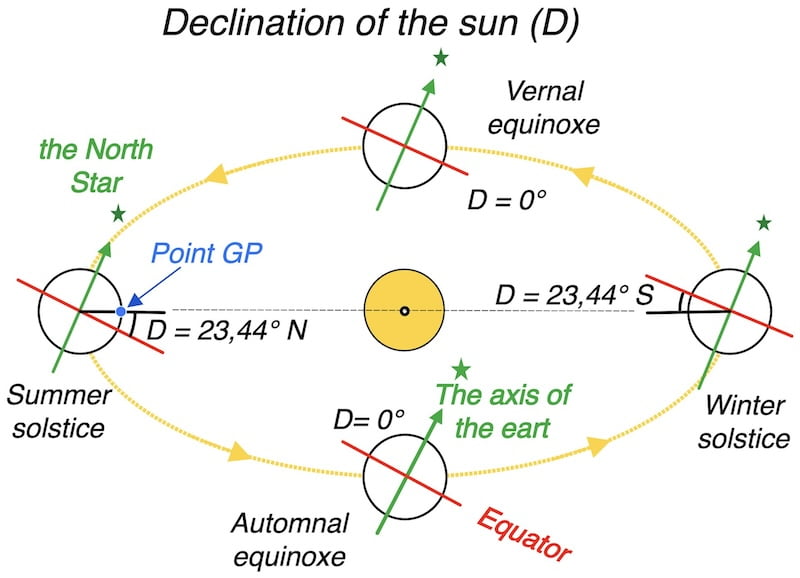
While longitude tells us where the Sun is along its path, declination tells us how "high" or "low" the Sun is in the sky relative to the Earth's equator. It is the Sun's angular distance north or south of the celestial equator.
This single astronomical variable is the primary driver of solar intensity on Earth.
- Positive (Northern) Declination: The Sun is north of the celestial equator. This results in more direct sunlight and longer days for the Northern Hemisphere, leading to increased heat. The maximum positive declination (+23.44°) occurs at the Summer Solstice.
- Negative (Southern) Declination: The Sun is south of the celestial equator. This results in more oblique (angled) sunlight and shorter days for the Northern Hemisphere, leading to decreased heat. The maximum negative declination (-23.44°) occurs at the Winter Solstice.
- Zero Declination: The Sun is directly over the equator. This occurs at the Vernal and Autumnal Equinoxes, resulting in balanced day and night.
The image below provides a clear visual of this concept.
From Solar Declination to Environmental Gunas
The changing solar intensity, driven by declination, directly shapes the dominant qualities (Gunas) of the environment.
-
During Uttarayana / Adana Kala: The Sun's declination moves from its most negative point towards its most positive. This progressive increase in solar energy makes the atmosphere hotter (Ushna), the sunlight more intense (Tikshna), and evaporates moisture from the land and air, leading to dryness (Ruksha).
-
During Dakshinayana / Visarga Kala: The Sun's declination moves from its most positive point back towards its most negative. The decreasing solar energy allows the atmosphere to cool (Sheeta). This reduction in heat, along with factors like cloud cover and rain, allows moisture to remain in the environment, imparting a nourishing, unctuous quality (Snigdha).
Let's examine how classical principles describe this process.
RITU (SEASON), RITUCHARYA AND PRAKRITI
The following article, 'RITU (SEASON), RITUCHARYA AND PRAKRITI', clearly describes how the qualities of the sun and air change during the two Ayanas.
Please read the sections titled 'Uttarayana or Adana Kala' and 'Dakshinayana or Visargakala'. As you read, focus on the specific Gunas mentioned for each period. For Uttarayana, note the emphasis on 'Tikshna, Ushna and Ruksha'. For Dakshinayana, note the rise of 'Snigdha guna (oilyness)' and the nourishing effect.
From Environmental Gunas to Predominant Rasas
Now we connect the final link in the chain. In Ayurveda, the predominant Gunas in the environment directly influence the Mahabhautik composition of substances, which in turn determines the taste (Rasa) that becomes prevalent.
-
Adana Kala (The Period of Absorption):
- Dominant Gunas: Ushna (Hot), Tikshna (Sharp), Ruksha (Dry).
- These qualities are composed primarily of Agni, Vayu, and Akasha Mahabhutas.
- Resulting Rasas: The environment naturally promotes the development of tastes with similar qualities:
- Tikta (Bitter): Composed of Vayu + Akasha. It is light, cold, and dry.
- Kashaya (Astringent): Composed of Vayu + Prithvi. It is dry, cold, and heavy.
- Katu (Pungent): Composed of Vayu + Agni. It is light, hot, and dry.
- The increasing solar intensity and dryness of Adana Kala naturally give rise to these three tastes.
-
Visarga Kala (The Period of Liberation):
- Dominant Gunas: Sheeta (Cold), Snigdha (Unctuous), Manda (Dull), Guru (Heavy).
- These qualities are composed primarily of Prithvi and Jala Mahabhutas.
- Resulting Rasas: The nourishing, moist, and cool environment promotes the development of tastes with similar qualities:
- Madhura (Sweet): Composed of Prithvi + Jala. It is heavy, cooling, and unctuous.
- Amla (Sour): Composed of Prithvi + Agni. It is light, hot, and unctuous.
- Lavana (Salty): Composed of Jala + Agni. It is heavy, hot, and unctuous.
- The decreasing solar intensity and increased moisture of Visarga Kala naturally give rise to these three tastes.
Synthesis: The Annual Cycle of Tastes
We can now see a complete, logical progression from the Sun's position to the tastes we find in our food and environment. The article we consulted earlier provides a superb table that summarizes this entire relationship.
RITU (SEASON), RITUCHARYA AND PRAKRITI
Let's return to the same article and focus on a table that beautifully synthesizes these connections.
Please find the section titled 'Relation between Rasa Ritu (season) Dosha' and carefully study the table named 'Ritus with their relation with Mahabhutas, Doshas and Rasas'. This table is the culmination of our lesson. Observe how it directly links each Ritu to its predominant elements and, consequently, its prominent Rasa.
The table you just studied shows this flow clearly. For example:
- In Shishira (Vayu & Akasha dominant), the prominent Rasa is Tikta (Bitter).
- In Hemanta (Prithvi & Apa dominant), the prominent Rasa is Madhura (Sweet).
This isn't an arbitrary list; it's a direct consequence of the Sun's declination influencing the environmental Gunas and Mahabhutas throughout the year.
Test your understanding!
A patient observes that vegetables available in early spring (Vasanta) are often bitter or astringent (e.g., leafy greens, sprouts), while fruits harvested in late autumn (Hemanta) are very sweet (e.g., pumpkins, root vegetables). Based on today's lesson, explain the astronomical and Ayurvedic reason for this.
Show answer
You would explain that Vasanta Ritu falls within Adana Kala, a time when the Sun is moving north (increasing declination) and its energy is becoming stronger. This creates an environment that is progressively drier (Ruksha) and more intense. These qualities favor the manifestation of Tikta (bitter) and Kashaya (astringent) tastes.
Conversely, Hemanta Ritu is in the middle of Visarga Kala, when the Sun is in its southern course (negative declination) and its energy is weak. This creates a cool (Sheeta), moist (Snigdha), and heavy (Guru) environment, dominated by Prithvi and Jala Mahabhutas. These conditions are ideal for the natural development of the Madhura (sweet) taste, leading to sweet, dense, and nourishing produce.
Conclusion
Today we have built a critical bridge connecting the cosmos to the kitchen. We have seen that the seasonal availability of different tastes is not random but is governed by the predictable, cyclical changes in the Sun's position.
Key Takeaways:
- Solar declination (Kranti) is the key astronomical factor determining solar intensity, which in turn dictates the dominant environmental Gunas (Ushna, Sheeta, Ruksha, Snigdha).
- The dominant Gunas of a season determine which Mahabhutas are prevalent, and therefore which Rasas will naturally manifest in plants and the environment.
- Adana Kala (Uttarayana), with its increasing solar intensity, is characterized by the predominance of Tikta, Kashaya, and Katu Rasas.
- Visarga Kala (Dakshinayana), with its decreasing solar intensity and nourishing qualities, is characterized by the predominance of Madhura, Amla, and Lavana Rasas.
This understanding of Rasa manifestation is a cornerstone of Ritucharya. In our next lesson, we will take this one step further. We will map the cycle of Dosha Sanchaya (accumulation), Prakopa (aggravation), and Prashama (pacification) to the Sun's transit through specific Rashi pairs, showing how these seasonal tastes directly influence the state of the Doshas in the body.