Hello! Welcome to the fourth lesson in our module on bridging astronomy with Ayurvedic principles.
In our last session, we mapped the predictable cycle of Dosha Sanchaya, Prakopa, and Prashama to the Sun's transit through the zodiac. We established that by knowing the Sun's position, we can anticipate how the Doshas will behave throughout the year.
Today, we will focus on one of the most direct and clinically vital consequences of the Sun's annual journey. Our objective is to explain the variation in Agni (digestive strength) as a direct consequence of solar intensity changes across the year. This concept is central to Ritucharya, as Agni is considered the root of health (Sarve roga api mandagnau - all diseases begin with a weakened fire). Understanding this solar-digestive link will empower you to deduce dietary prescriptions logically, rather than simply memorizing them.
The Sun Within: The Principle of Bahya and Antaragni
At the heart of today's lesson is a fundamental Ayurvedic principle: the external universe and the internal human body are microcosms of each other. The external sun, Bahya Surya, which dictates the seasons and life on Earth, has its direct counterpart within us as Antaragni, the internal fire. This internal fire, primarily represented by Pachaka Pitta in the digestive tract, governs all metabolic and transformative processes.
The body's primary goal is to maintain thermal homeostasis. The strength of your Antaragni is not constant; it dynamically adjusts to the external temperature, which is a direct function of the Sun's intensity. The mechanism is simple and elegant:
- When the external environment is cold, the body conserves heat. Peripheral channels (srotas) constrict, pulling heat inward and concentrating the Agni in the core (Koshtha).
- When the external environment is hot, the body needs to dissipate heat. Peripheral channels dilate, drawing heat away from the core and dispersing it.
Let's explore how this principle plays out across the seasons, directly linking solar mechanics to the state of our digestive fire.
Agni's Annual Cycle: An Inverse Relationship with the Sun
The key takeaway is that the strength of our internal Agni has an inverse relationship with the intensity of the external sun.
Peak Agni in Dakshinayana (Hemanta & Shishira Ritu)
- Astronomical Context: During Hemanta (early winter) and Shishira (late winter), the Sun is in Dakshinayana, its southern course. Its declination is low or negative, resulting in less intense rays, shorter days, and a cold, dry external environment.
- Physiological Response: As we discussed, the external cold causes the body's superficial tissues and peripheral channels to constrict (Sankocha). This physiological response effectively "traps" the body's heat internally, preventing it from escaping.
- Resulting State of Agni: This concentration of heat powerfully stokes the digestive fire. Agni becomes Tikshna (sharp and powerful), capable of digesting heavy (Guru), unctuous (Snigdha), and large quantities of food.
To understand this in more detail, let's turn to a resource that describes the classical view.
Seasonal Regimen In Ayurveda (Ritucharya)
The article 'Seasonal Regimen In Ayurveda (Ritucharya)' provides a clear explanation from the Charaka Samhita on why Agni is strongest in the winter.
Please read the subsection '3.3.3. Hemanta Ritu'. Focus on the initial Sanskrit verse and its translation, which states that due to cold, the Agni of healthy individuals gets trapped and becomes strong and powerful. This is the core principle for this season.
This powerful Agni is why winter is the season for nourishing, building foods. However, if this strong fire is not supplied with adequate "fuel" (food), it can begin to consume the body's own tissues (Dhatus), leading to Dhatu Kshaya and subsequent Vata aggravation.
Weakest Agni in Adana Kala (Grishma & Varsha Ritu)
- Astronomical Context: In Grishma (summer), the Sun is at its peak strength in Uttarayana. Solar rays are at their most intense and direct, leading to extreme heat and dryness in the environment. This is the height of Adana Kala, the period of depletion.
- Physiological Response: To combat the intense external heat, the body initiates cooling mechanisms. The peripheral channels dilate to release heat from the core to the skin, facilitating sweating and evaporation.
- Resulting State of Agni: This dispersal of heat from the core to the periphery leaves the digestive fire weak (Manda Agni). The body's overall strength (Bala) is also at its lowest, as the sun's harsh qualities deplete the cooling, nutritive (Saumya) aspects of the body.
The following resources provide both Ayurvedic and modern scientific perspectives on this phenomenon.
Heat Adaptability mechanisms & measures of Greeshma Ritu
First, let's examine the Ayurvedic explanation for weakness in summer. The article 'Heat Adaptability mechanisms & measures of Greeshma Ritu' explains how the sun's qualities lead to poor strength.
Please read the section 'Shareera Bala or strength during Greeshma ritu'. Note how it explains that the 'ushna, laghu and ruksha guna' of the season cause 'vilayana of kapha dosa, which is considered to be the bala'. This directly links solar intensity to a loss of strength, which is inseparable from Agni.
Seasonal Regimen In Ayurveda (Ritucharya)
Now, let's look at the regimen for summer. The resource 'Seasonal Regimen In Ayurveda (Ritucharya)' confirms this state of weakened Agni.
Read the subsection '3.2.3. Grishma Ritu'. Observe the dietary recommendations: food should be sweet, cold, liquid, and unctuous. Heavy, spicy, and sour foods are to be avoided. This is a direct clinical response to a weakened Agni.
This state of weak Agni continues into Varsha Ritu (monsoon). The body is already debilitated from summer, and the atmosphere becomes damp, cloudy, and the water acidic. These factors further suppress the digestive fire, making Agnimandya a hallmark of this season.
Variable Agni in Transitional Seasons (Vasanta & Sharad Ritu)
The transitional seasons present unique challenges to Agni.
- Vasanta (Spring): As the Sun's strength increases after winter, the accumulated Kapha melts. This liquefied Kapha, with its heavy and moist qualities, flows into the digestive tract and can "douse" or smother the digestive fire, leading to Agnimandya.
- Sharad (Autumn): In the autumn, after the clouds of monsoon clear, the body is suddenly exposed to the Sun's heat again (Sharad Tapa). This provokes the Pitta that accumulated during the rains. While Agni itself is moderate, it is often disturbed by this aggravated Pitta, leading to conditions like hyperacidity and inflammation. The classical texts advise eating only when a true appetite is felt.
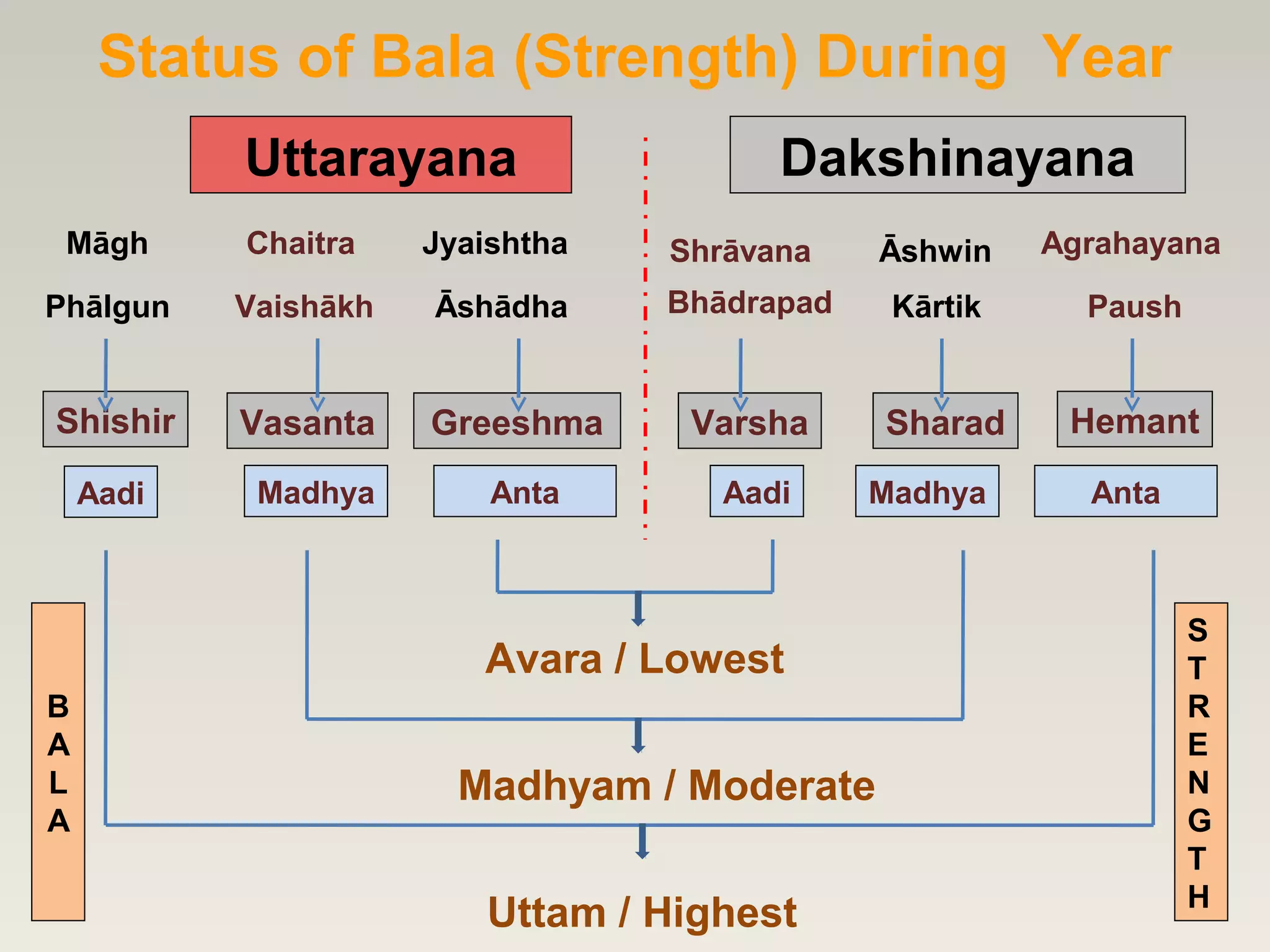
The image below shows the fluctuation of Bala (strength) throughout the year. As you know, Bala and Agni are intimately connected. Notice how the highest strength (Uttam) aligns with the season of highest Agni (Hemanta/Shishira), and the lowest strength (Avara) aligns with the seasons of lowest Agni (Grishma/Varsha).
Test your understanding!
A patient who recently moved from the tropical climate of Kerala to the cold, high-altitude region of Ladakh complains that they are constantly hungry and can eat much larger meals than before without feeling heavy. Using the principles of Bahya and Antaragni, explain this physiological change.
Show answer
This is a perfect example of the body adapting to a new environment based on solar and thermal intensity.
- In the tropical climate of Kerala (hot and humid), the external environment is warm. The patient's body was habituated to keeping its peripheral channels open to dissipate heat, leading to a naturally weaker or moderate Agni.
- Upon moving to Ladakh (cold and dry), the external environment is intensely cold. The patient's body responded by constricting its peripheral channels to conserve heat.
- This act of "trapping" the heat internally concentrated the Antaragni in their Koshtha, making it Tikshna (sharp and powerful).
- The constant hunger and ability to digest larger meals is a direct manifestation of this strengthened digestive fire, which now requires more "fuel" to stay balanced.
Modern Scientific Corroboration
This ancient Ayurvedic concept finds strong parallels in modern physiology. The body's process of maintaining a stable internal temperature is called thermoregulation.
- Winter (Strong Agni): Modern research confirms that in response to cold, the body increases its Basal Metabolic Rate (BMR) to generate more internal heat. This increased metabolism is the modern equivalent of a stronger Agni.
- Summer (Weak Agni): Conversely, in hot weather, metabolic processes slow down to reduce internal heat production. Digestion is an energy-intensive process, so slowing it down helps cool the body.
The resource below provides an excellent summary of this correlation.
Seasonal Regimen In Ayurveda (Ritucharya)
The article 'Seasonal Regimen In Ayurveda (Ritucharya)' includes a section on modern scientific validation that directly supports our discussion.
Please read the paragraph under 'Metabolism'. Notice how it explicitly states that lower ambient temperatures in winter elevate the BMR, aligning with strong Agni, while warmer climates slow digestion, aligning with diminished Agni.
This demonstrates that the principles of Ritucharya are not arbitrary rules but are based on a profound and observable understanding of human physiology's response to its environment, driven by the Sun.
Conclusion
Today, we have connected the astronomical reality of changing solar intensity directly to the clinical reality of fluctuating digestive strength. By understanding this relationship, you can now explain why dietary needs change so drastically with the seasons.
Key Takeaways:
- The strength of the internal fire (Antaragni) has an inverse relationship with the intensity of the external sun (Bahya Surya).
- Hemanta/Shishira (Winter): External cold concentrates internal heat, leading to the strongest Agni of the year.
- Grishma/Varsha (Summer/Monsoon): External heat disperses internal heat, leading to the weakest Agni.
- Vasanta/Sharad (Spring/Autumn): Agni is variable and easily disturbed, by melting Kapha in spring and aggravated Pitta in autumn.
- This ancient observation is corroborated by modern concepts of thermoregulation and seasonal changes in Basal Metabolic Rate (BMR).
In our next lesson, we will focus on the critical transition periods between these seasons. We will define Ritu Sandhi (seasonal junction) from an astronomical perspective—the Sun's transit between Rashis—and explore its immense clinical importance for managing this fluctuating Agni and preventing seasonal diseases.