Hello! Welcome to your fifth lesson.
In our last session, we mastered the practical units of time used in the traditional Indian day, learning how to convert between Ghatikas, Palas, and modern hours and minutes. We now have a solid grasp of the "human-scale" clock. Today, we expand our perspective dramatically, moving from the daily cycle to the grand cosmic epochs that form the very fabric of time in Hindu cosmology.
This lesson addresses the learning outcome: Explain the concepts of planetary revolutions (Bhagana) and the Yuga system. We will explore the vast cycles of the Yugas and understand how ancient astronomers used them as a framework to measure the long-term movements of the planets—a concept known as Bhagana. This is a crucial step toward our goal, as the annual journey of the Sun, which dictates the Ritus, is itself one solar Bhagana.
1. The Yuga System: A Cosmic Clock
Just as we divide a day into hours and minutes for practical purposes, ancient Indian astronomers conceived of a much larger clock to track the movements of celestial bodies over immense periods. This cosmic clock is built upon the Yuga system.
The foundational block is the Chaturyuga (or Mahayuga), a cycle of four ages totaling 4,320,000 solar years. To understand its structure and the philosophy behind it, let's turn to an explanation based on the Suryasiddhanta.
Time CREATES Space! Ancient Vedic Mystical Astronomy - SURYA SIDDHANTA
The video 'Time CREATES Space!' by Vic DiCara provides an accessible explanation of these immense time scales. This segment introduces the Chaturyuga and its four component ages.
Please watch the segment from 09:41 to 13:28. Focus on how the total duration of a 'Tetra-age' (Chaturyuga) is divided into the four sub-yugas: Krita, Treta, Dvapara, and Kali.
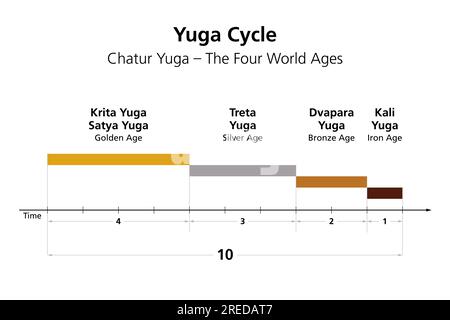
As the video explained, the Chaturyuga is composed of four distinct ages whose durations decrease in a precise ratio of 4:3:2:1. This ratio is said to correspond to the gradual decline of Dharma (righteousness) in the world.
- Krita Yuga (also called Satya Yuga) - The Golden Age
- Treta Yuga - The Silver Age
- Dvapara Yuga - The Bronze Age
- Kali Yuga - The Iron Age
Calculating the Duration of Each Yuga
Let's look at the mathematics, as described in the classical texts.
Translation of the Surya Siddhanta
This translation of the Suryasiddhanta provides the original framework for these calculations. It explains the principle behind dividing the total duration of a Chaturyuga.
Please read verses 15, 16, and 17 on page 11 (PDF page 35). The text refers to the Chaturyuga as a 'great yuga' and explains that the years are divided proportionally based on the 'legs of Dharma'.
Following the principle from the text, we can calculate the duration of each Yuga from the total of 4,320,000 years:
- Determine the total number of parts: 4 (Krita) + 3 (Treta) + 2 (Dvapara) + 1 (Kali) = 10 parts.
- Calculate the value of one part: 4,320,000 years / 10 parts = 432,000 years.
- Determine the duration of each Yuga:
- Kali Yuga = 1 part = 432,000 years
- Dvapara Yuga = 2 parts = 2 × 432,000 = 864,000 years
- Treta Yuga = 3 parts = 3 × 432,000 = 1,296,000 years
- Krita Yuga = 4 parts = 4 × 432,000 = 1,728,000 years
These values represent the core duration of each age. The Suryasiddhanta also adds transitional periods at the beginning (Sandhya or dawn) and end (Sandhyans'a or dusk) of each Yuga, further refining the timeline.

2. Bhagana: The Measure of a Revolution
Now that we have the grand timeline of the Yugas, we need a way to mark progress on it. This is where the concept of Bhagana (भगण) comes in.
A Bhagana is simply one complete revolution of a celestial body through the 360 degrees of the zodiac, returning to its starting point.
REVIEW OF SURYA SIDDHANTA, FOCUSING ON SOME ...
The research paper 'REVIEW OF SURYA SIDDHANTA' gives a concise, modern definition of Bhagana.
Please read the second paragraph in the 'Findings' section on page 31. Focus on the definition provided: 'when a stellar object starts from this point [end of Revati] and returns to the same Rashi Mandala, it completes one Bhagana...'
The genius of using the Chaturyuga as a time scale is that it was designed to be a "great year"—a period over which all major celestial bodies complete a whole, integer number of Bhaganas and realign at their conceptual starting point in the sky. It acts as a universal common denominator for planetary cycles.
Counting Revolutions in a Mahayuga
The Suryasiddhanta provides the precise number of Bhaganas that each planet completes during one Chaturyuga of 4,320,000 years. This data is the foundation for calculating the mean speed and position of any planet.
Translation of the Surya Siddhanta
Let's return to the 'Translation of the Surya Siddhanta' to see the actual numbers of revolutions as recorded in the text.
Read verses 29 through 33 on pages 15-16 (PDF pages 39-40). Pay close attention to the number of revolutions assigned to the Sun.
From the text, we find a crucial piece of information (Verse 29):
- Sun's Revolutions in a Chaturyuga: 4,320,000
This is an elegant and powerful statement. It directly links the duration of the Chaturyuga in solar years to the Sun's own motion. It means:
1 Solar Year = 1 Bhagana of the Sun
This simple fact is the astronomical key to Ritucharya. The six Ritus are a direct consequence of the Sun completing its single, annual Bhagana. The different seasons correspond to the Sun passing through different segments of this 360-degree journey.
Test your understanding!
The Suryasiddhanta (Verse 30) states the Moon completes 57,753,336 revolutions in a Chaturyuga (4,320,000 years). Approximately how many revolutions does the Moon make for every single revolution of the Sun? What does this number represent in a practical sense?
Show answer
To find the ratio, we divide the Moon's revolutions by the Sun's revolutions:
This means the Moon completes approximately 13.37 revolutions (lunar cycles) in one solar year. This corresponds to the fact that there are roughly 12 to 13 lunar months within a single solar year, forming the basis of lunisolar calendars.
Conclusion
In this lesson, we have explored the vast cosmic time scales that form the backdrop of Vedic astronomy and connected them to the concrete, observable motion of the planets.
Key Takeaways:
- The Yuga system is a hierarchical cosmic clock, with the Chaturyuga (4,320,000 solar years) being the fundamental cycle for planetary calculations.
- The four ages—Krita, Treta, Dvapara, and Kali—have durations in a decreasing ratio of 4:3:2:1.
- A Bhagana is one complete 360° revolution of a celestial body through the zodiac.
- The Chaturyuga is the grand period over which the planets are thought to complete a whole number of Bhaganas and realign.
- Most importantly for our course, the Sun completes exactly one Bhagana per solar year, and it is this annual journey that creates the seasons.
We now understand the timeline (Yuga) and the event we are tracking (Bhagana). To precisely follow the Sun's yearly journey, ancient astronomers needed to divide its path into marked segments. In our next lesson, we will learn how they did this by exploring the learning outcome: Describe the division of the ecliptic (Zodiac) into 12 Rashis and 27 Nakshatras. These divisions are the celestial signposts that allow us to pinpoint the Sun's position and, therefore, the exact state of the Ritu.