Hello! Welcome to your sixth and final lesson in this introductory module.
In our last lesson, we journeyed through the vast cosmic timescales of the Yuga system and defined a Bhagana as a complete 360-degree revolution of a planet. We established that the Sun's single annual Bhagana is the astronomical engine driving the seasons, or Ritus.
Now that we know we need to track the Sun's yearly journey, our task is to learn about the "map" that ancient astronomers used to chart this path. This lesson directly addresses the learning outcome: Describe the division of the ecliptic (Zodiac) into 12 Rashis and 27 Nakshatras. These divisions are the celestial signposts that allow us to precisely locate the Sun and understand its influence at any given time, forming the foundation for the astronomical approach to Ritucharya.
1. The Celestial Highway: The Ecliptic and the Zodiac
From our perspective on Earth—the geocentric view adopted by the Suryasiddhanta for observational purposes—the Sun appears to travel along a fixed, circular path in the sky over the course of a year. This 360-degree path is called the ecliptic.
The Zodiac is a belt or band of the sky, extending about 8 degrees on either side of the ecliptic, within which the Sun, Moon, and planets appear to move. Think of the ecliptic as the centreline of this celestial highway.
To understand these concepts visually, let's turn to a helpful article.
What is Zodiac ? Tropical & Sidereal Zodiacs - Dharma Station
The article 'What is Zodiac ? Tropical & Sidereal Zodiacs' from Dharma Station provides clear definitions and diagrams for these foundational concepts.
Please read the section 'The Use of Geocentric System'. Focus on the definitions of the Ecliptic and the Zodiac. Pay attention to the two diagrams titled 'Zodiac - Ecliptic' and 'Eliptic & Zodiac' that illustrate these concepts.
Now that we have defined the path, we need to divide it into measurable segments. Ancient Indian astronomy, as codified in texts like Suryasiddhanta, uses two primary, interlocking systems for this: the 12 Rashis and the 27 Nakshatras.
2. The Solar Division: 12 Rashis
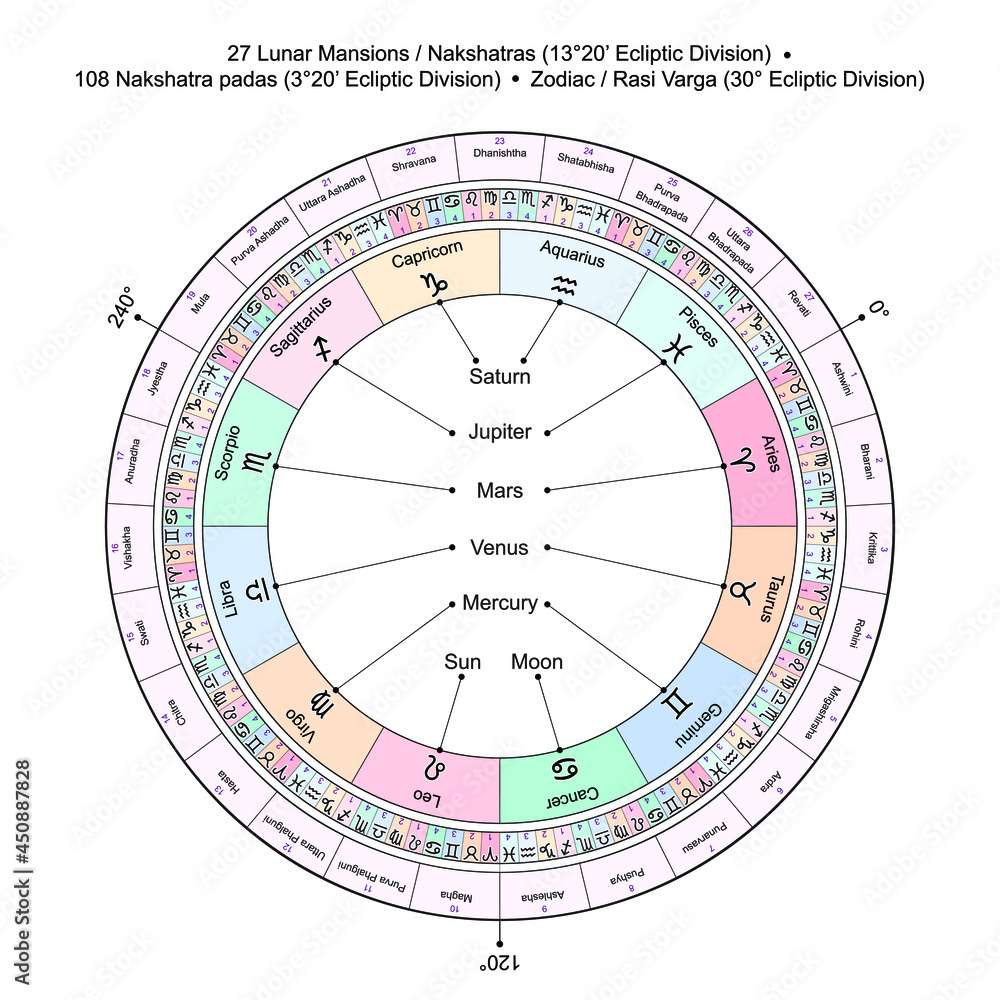
The most fundamental division of the ecliptic for determining seasons is the system of 12 Rashis (zodiac signs). The 360-degree ecliptic is divided into 12 equal segments, each spanning 30 degrees.
Since the Sun takes a full year (approximately 365 days) to complete its 360-degree journey, it spends about one month in each Rashi. This is the direct astronomical basis for the Ayurvedic concept of Ritu, where each of the six seasons is defined by the Sun's transit through a pair of Rashis. For instance, Vasanta Ritu corresponds to the Sun's passage through Meena (Pisces) and Mesha (Aries).
It is crucial to note that the zodiac system used in Jyotisha and Suryasiddhanta is the Sidereal (Nirayana) Zodiac. This means its starting point (0° of Mesha) is fixed relative to the background stars, not tied to the Earth's seasons (like the Western Tropical system). This provides a stable, astronomically consistent frame of reference.
3. The Lunar Division: 27 Nakshatras
A much older and finer division of the ecliptic is the system of 27 Nakshatras, often called "lunar mansions." This system is based on the movement of the Moon.
The Moon completes one full revolution around the Earth in approximately 27.3 days (its sidereal period). Ancient observers noted that the Moon spends about one day in each of 27 distinct sectors of the sky. These sectors became the Nakshatras.
To understand this concept more deeply, let's watch a short animated video.
Nakshatras in Detail | Animated |
The video 'Nakshatras in Detail' provides an excellent animated explanation of what Nakshatras are and how they relate to the Moon's orbit.
Please watch the segment from 01:14 to 03:35. Focus on how the Moon's ~27-day orbital period is the basis for dividing the sky into 27 Nakshatras, turning the sky into a 'cosmic clock'.
Mathematically, each Nakshatra represents an equal arc of the ecliptic:
You might have heard of a 28th Nakshatra called Abhijit. While it holds importance in certain contexts (as mentioned in the Mahabharata), the system was standardized to 27 for mathematical elegance and ease of integration with the 12 Rashis.
4. Integrating the Solar and Lunar Maps
We now have two different ways to divide the same 360-degree circle: 12 Rashis of 30° each, and 27 Nakshatras of 13° 20' each. How do they fit together?
The solution is a brilliant subdivision called the Pada (or Charan), which means "foot" or "quarter."
- Each Nakshatra (13° 20') is divided into 4 Padas.
- Therefore, each Pada has an arc of: .
This creates a total of 108 Padas across the entire zodiac (27 Nakshatras × 4 Padas). The number 108 has profound significance in Hindu tradition.
Now, let's see how these 108 Padas relate to the 12 Rashis.
This perfect fit is the key to unifying the solar and lunar zodiacs. Each 30-degree Rashi contains exactly 9 Padas.
To solidify this, let's read a short article that explains this mathematical harmony.
Why are there 27 Nakshatras in Indian Astrology?
The article 'Why are there 27 Nakshatras in Indian Astrology?' explains the mathematical reasoning behind the system.
Read the section that begins 'However, this integration created certain mathematical problems.' Focus on how dividing each of the 27 Nakshatras into 4 'paadas' allows them to fit perfectly into the 12 Rashis, with 9 paadas per Rashi.
This means that a single Rashi contains two full Nakshatras (2 × 13° 20' = 26° 40') plus one Pada of a third Nakshatra (3° 20'), for a total of 30°.
Test your understanding!
A common rule of thumb in Jyotisha is that one Rashi contains "two and a quarter" Nakshatras. Using the angular measurements we've learned (1 Rashi = 30°, 1 Nakshatra = 13° 20'), mathematically prove why this is correct.
Show answer
We want to find out how many Nakshatras fit into one Rashi. We can do this by dividing the angular size of a Rashi by the angular size of a Nakshatra.
It's easiest to work in arcminutes:
- 1 Rashi = 30° = 30 × 60' = 1800'
- 1 Nakshatra = 13° 20' = (13 × 60') + 20' = 780' + 20' = 800'
Now, we divide:
This shows that exactly 2.25, or two and a quarter, Nakshatras fit into one Rashi.
Conclusion
Today, we have assembled the celestial map used in Suryasiddhanta. This map is not just for astrologers; it is a precise tool for tracking the Sun's position, which is the key to understanding the astronomical basis of Ritucharya.
Key Takeaways:
- The ecliptic is the 360° apparent annual path of the Sun.
- This path is divided into 12 Rashis, each spanning 30°. This is the primary framework for defining the six Ritus.
- The same path is also divided into 27 Nakshatras, each spanning 13° 20'. This is a finer, Moon-based division.
- The two systems are harmonized through Padas. Each Nakshatra has 4 Padas, and exactly 9 Padas fit into each Rashi.
- This entire framework is based on the Sidereal (Nirayana) Zodiac, which is fixed to the stars, providing a stable system for astronomical calculation.
We have now completed the first module, building a solid foundation in the core concepts of Suryasiddhanta—from time and cosmic cycles to the map of the heavens. In our next lesson, we will begin Module 2 and take our first step into solar mechanics, addressing the learning outcome: Explain the different types of solar motion (Surya Gati) and the concept of the Sun's mean and true positions. This will teach us how the Sun actually moves across the map we learned about today.