Hello! Welcome to the fourth lesson in our course.
In our last session, we mapped out the vast hierarchy of time in Hindu cosmology, from the infinitesimal Truti to the cosmic Kalpa. We now have the vocabulary of time. Today, we'll learn the grammar—how to use these units in a practical sense.
The learning outcome for this lesson is to calculate conversions between practical time units (e.g., Ghatika, Muhurta, Divasa). This is a fundamental skill. To eventually determine the precise start and end of a Ritu based on the Sun's position, we must first be able to confidently handle the units used to measure that journey. This lesson will equip you with the mathematical tools to translate between the ancient Indian clock and the modern one.
1. The Architecture of the Indian Clock
While modern timekeeping divides the day into 24 hours, the traditional Indian system, as detailed in texts like the Suryasiddhanta, divides the day into 60 primary units. This system is elegantly sexagesimal (based on the number 60), much like our own minutes and seconds.
To begin, let's explore the core components of this system.
Ghati - Designing the Bharat Clock
The article 'Ghati - Designing the Bharat Clock' provides a clear and practical definition of the main units of the Indian clock. It lays out the fundamental hierarchy that we will be working with throughout this lesson.
Please read the section titled 'Solution: To Design the Bharat Clock'. Focus on the definitions of Ghati, Pala, and Vipala, and their relationship to a full day.
As you've just read, the primary structure is:
- 1 Divasa (a full day and night, from one sunrise to the next) = 60 Ghatikas (घटिका)
- 1 Ghatika = 60 Palas (पल)
- 1 Pala = 60 Vipalas (विपल)
It's helpful to know that these units have several synonyms you may encounter in classical texts:
- Ghatika is also known as Nadi or Danda.
- Pala is also known as Vighati or Kala.
- Vipala is also known as Vikala or Lipta.
The primary unit, the Ghatika, gets its name from the Ghatika Yantra, a water clock used for timekeeping.
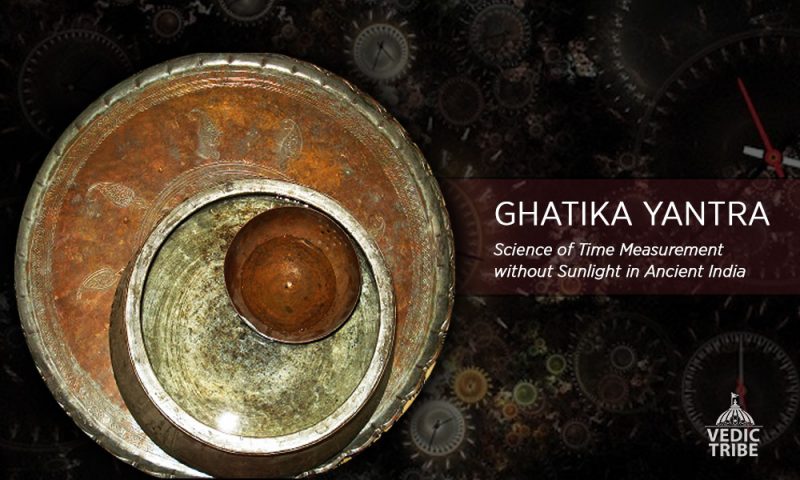
2. Converting Between Indian and Modern Units
Now that we have the structure, we can establish the conversion factors. All conversions stem from one simple fact: 1 Divasa = 24 hours.
From Divasa to Vipala
Let's derive the modern equivalent of each unit step by step.
-
Ghatika:
- Since 1 day = 24 hours and 1 day = 60 Ghatikas:
- 60 Ghatikas = 24 hours
- 1 Ghatika = 24 / 60 hours = 0.4 hours
- Converting to minutes: 0.4 hours × 60 minutes/hour = 24 minutes.
-
Pala:
- We know 1 Ghatika = 24 minutes and 1 Ghatika = 60 Palas:
- 60 Palas = 24 minutes
- 1 Pala = 24 / 60 minutes = 0.4 minutes
- Converting to seconds: 0.4 minutes × 60 seconds/minute = 24 seconds.
-
Vipala:
- We know 1 Pala = 24 seconds and 1 Pala = 60 Vipalas:
- 60 Vipalas = 24 seconds
- 1 Vipala = 24 / 60 seconds = 0.4 seconds.
Here is a summary of these essential conversions:
| Indian Unit | Modern Equivalent |
|---|---|
| 1 Ghatika | 24 minutes |
| 1 Pala | 24 seconds |
| 1 Vipala | 0.4 seconds |
The article you read earlier, "Ghati - Designing the Bharat Clock", also points out a set of very convenient conversion ratios that are easy to remember:
- 5 Ghatis = 2 hours
- 5 Palas = 2 minutes
- 5 Vipalas = 2 seconds
Test your understanding!
A specific Ayurvedic preparation needs to be stirred for exactly 1.5 Ghatikas. How long is this in hours and minutes?
Show answer
We know that 1 Ghatika = 24 minutes.
Therefore, 1.5 Ghatikas = 1.5 × 24 minutes = 36 minutes.
In hours, this is 36 / 60 = 0.6 hours.
3. Practical Calculation Examples
Let's work through some examples to solidify your understanding. The Indian day traditionally begins at sunrise, so all calculations are relative to that point.
Example 1: Converting Modern Time to Indian Time
Problem: An important astronomical event is observed at 4:36 PM. If sunrise on that day was at 6:00 AM, what is the time of the event in Ghatikas and Palas?
Solution:
-
Calculate the time elapsed since sunrise in hours.
- 4:36 PM is 16:36 in 24-hour format.
- Time elapsed = 16.6 hours - 6.0 hours = 10.6 hours. (Note: 36 minutes is 36/60 = 0.6 hours).
-
Convert hours to Ghatikas.
- We know 2 hours = 5 Ghatikas, so the conversion factor is (5 Ghatikas / 2 hours) = 2.5.
- 10.6 hours × 2.5 Ghatikas/hour = 26.5 Ghatikas.
-
Convert the fractional part to Palas.
- The time is 26 full Ghatikas and 0.5 of a Ghatika.
- 0.5 Ghatika × 60 Palas/Ghatika = 30 Palas.
Answer: The event occurred at 26 Ghatikas and 30 Palas after sunrise.
Example 2: Converting Indian Time to Modern Time
Problem: A classical text states that a specific medicinal herb should be collected at 3 Ghatikas and 20 Palas after sunrise. If sunrise is at 5:45 AM, what is the collection time?
Solution:
-
Convert the Indian time units to minutes.
- Convert Ghatikas to minutes: 3 Ghatikas × 24 minutes/Ghatika = 72 minutes.
- Convert Palas to minutes: 20 Palas × (24 seconds/Pala) = 480 seconds.
- 480 seconds / 60 seconds/minute = 8 minutes.
-
Calculate the total time elapsed since sunrise.
- Total time = 72 minutes + 8 minutes = 80 minutes.
- 80 minutes is equal to 1 hour and 20 minutes.
-
Add the elapsed time to the sunrise time.
- 5:45 AM + 1 hour 20 minutes = 7:05 AM.
Answer: The herb should be collected at 7:05 AM.
4. Larger Time Blocks: Muhurta and Prahara
Within a day, there are also larger, very significant units of time that you are likely familiar with from an Ayurvedic context. Let's define them mathematically.
Ghati - Designing the Bharat Clock
Let's return to the 'Ghati - Designing the Bharat Clock' article, which also defines Muhurta and Prahara in relation to Ghatikas.
Please read the short section titled 'Muhurta and Prahara (प्रहर)'. Focus on the conversion factors provided.
From this text, we get the following clear definitions:
-
Muhurta (मुहूर्त):
- 1 Muhurta = 2 Ghatikas
- Since 1 day has 60 Ghatikas, a full day has 60 / 2 = 30 Muhurtas.
- In modern time: 1 Muhurta = 2 Ghatikas × 24 minutes/Ghatika = 48 minutes.
-
Prahara (प्रहर):
- 1 Prahara = 7.5 Ghatikas
- A full day has 60 / 7.5 = 8 Praharas (four for the day, four for the night).
- In modern time: 1 Prahara = 7.5 Ghatikas × 24 minutes/Ghatika = 180 minutes = 3 hours.
The Muhurta is especially critical in Ayurveda and Jyotisha for determining auspicious moments for therapies, rituals, and other important undertakings. The Praharas are famously used in Indian classical music to define the proper time for performing certain Ragas, a practice that has deep connections to balancing the Doshas through sound.
Test your understanding!
A physician advises a patient to perform a specific breathing exercise for the duration of half a Muhurta every morning. How many minutes is this?
Show answer
One Muhurta is 48 minutes.
Half a Muhurta is 48 / 2 = 24 minutes.
Interestingly, this is also the duration of exactly one Ghatika.
5. A Coherent System: The Role of Prana
In our previous lesson, we saw that the Suryasiddhanta often begins its definition of time with Prana (the duration of one breath). Let's see how this physiological measure fits perfectly with the mathematics we've just done.
Time CREATES Space! Ancient Vedic Mystical Astronomy - SURYA SIDDHANTA
To see how these units are built up from a physiological base, let's watch a brief segment from Vic DiCara's video on the Suryasiddhanta. He explains the system starting from the 'Prana'.
Please watch from 2:07 to 4:18. Observe the hierarchy he presents. He uses the term 'beat' for what we are calling a Ghatika/Nadi.
The video states there are 21,600 breaths (Pranas) in a day. Let's verify this with our units:
- We know 1 Pala = 24 seconds.
- The texts define 1 Prana as approximately 4 seconds.
- Therefore, 1 Pala = 24 seconds / 4 seconds/Prana = 6 Pranas.
- Now, let's calculate the number of Pranas in a day:
- 1 Divasa = 60 Ghatikas × 60 Palas/Ghatika = 3600 Palas.
- 3600 Palas × 6 Pranas/Pala = 21,600 Pranas.
The numbers match perfectly. This demonstrates the profound consistency of the system, seamlessly linking a physiological rhythm (breath) to an astronomical one (the day).
Conclusion
In this lesson, we transitioned from knowing the names of time units to being able to use them for practical calculations. This skill is the bedrock for the more complex astronomical work ahead.
Key Takeaways:
- The Indian clock is a sexagesimal system based on the Ghatika, Pala, and Vipala.
- A day is divided into 60 Ghatikas, 30 Muhurtas, or 8 Praharas.
- The key conversion factors to remember are:
- 1 Ghatika = 24 minutes
- 1 Pala = 24 seconds
- 1 Muhurta = 48 minutes
- 1 Prahara = 3 hours
- The entire system can be derived from the fundamental relationship of 1 Divasa = 24 hours.
We have now solidified our understanding of time (Kāla). In our next lesson, we will move on to the learning outcome: Explain the concepts of planetary revolutions (Bhagana) and the Yuga system. We will see how ancient astronomers used these vast Yuga cycles, which we introduced two lessons ago, to track the long-term movements of the Sun and planets, a concept known as Bhagana.