Welcome back. In our previous lessons, we built a three-dimensional map of the atom, visualizing the shapes and orientations of the s, p, and d orbitals. We now have a clear picture of the "spaces" where electrons can exist. The question that naturally follows is: how do electrons actually populate these spaces?
This lesson addresses that very question by introducing the three fundamental rules that govern electron arrangement. Think of these rules as the "laws of physics" for electron configurations. By the end of this lesson, you will be able to state and apply the Aufbau principle, the Pauli exclusion principle, and Hund's rule, which together form the complete toolkit for determining how electrons occupy orbitals in an atom. This moves us from the atom's architecture to its electronic blueprint.
Rule 1: The Aufbau Principle - Building Up from the Ground State
In physics, systems tend to seek their lowest possible energy state, or "ground state." The same is true for atoms. As we add electrons to an atom, they will occupy the lowest energy orbitals available first before moving into higher energy orbitals. This is the essence of the Aufbau principle, from the German word Aufbau meaning "building up."
The energy ranking of orbitals is mostly straightforward, but there are some important details. The image below illustrates the relative energy levels of atomic orbitals.
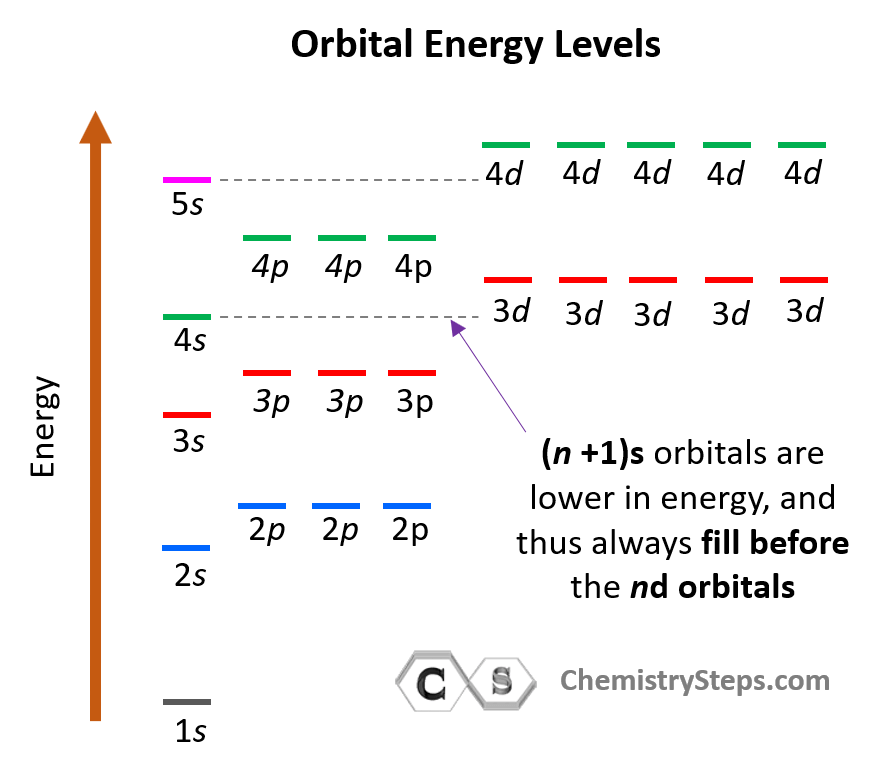
As you can see, the energy generally increases with the principal quantum number (n). However, the subshell energy levels within a shell also increase in the order s < p < d < f. This leads to overlaps, most famously the 4s orbital being lower in energy than the 3d orbitals.
Remembering this precise order is crucial. While you can memorize the diagram, a very effective mnemonic device can help you generate the order quickly. The following video provides an easy-to-learn trick for this.
Complete Electronic Configuration |Aufbau Principle | Hund's Rule | Pauli Exclusion Principle
This video from Najam Academy demonstrates a popular and reliable mnemonic for remembering the correct orbital filling order according to the Aufbau principle.
Watch the segment from 04:36 to 06:48, which demonstrates the "s, ps, dps" trick. This will give you a practical tool to reconstruct the sequence: 1s, 2s, 2p, 3s, 3p, 4s, 3d, 4p, and so on.
Now that you have a practical tool, let's ground this in a formal description.
8.3: Electron Configurations- How Electrons Occupy Orbitals
This article from Chem LibreTexts explains the reasoning behind the orbital energy ordering and formally defines the Aufbau principle.
First, read the section on Orbital Energies. This text explains why the energies of subshells differ, introducing the concept of shielding. Then, read the section defining the Aufbau Principle, which formalizes the "building up" process we've discussed.
With the Aufbau principle, we now know the sequence in which orbitals are filled. Next, we need to know the rules for how electrons behave within those orbitals.
Rule 2: The Pauli Exclusion Principle - No Two Electrons are Identical
In the last lesson, we saw that orbitals are defined by a set of quantum numbers. A fourth quantum number, the spin quantum number (), describes an intrinsic property of an electron called spin. It can have one of two values: +1/2 (spin-up) or -1/2 (spin-down).
The Pauli exclusion principle, formulated by physicist Wolfgang Pauli, states that no two electrons in the same atom can have the same set of four quantum numbers.
The practical consequence of this principle is direct and simple:
- An atomic orbital can hold a maximum of two electrons.
- If an orbital contains two electrons, they must have opposite spins (one spin-up, one spin-down).
We represent this visually using arrows in a box. An orbital is a box, and electrons are arrows. Two electrons in the same box must have arrows pointing in opposite directions (↑↓). The Duell Chemistry video uses this convention perfectly to illustrate the principle with the helium atom.
Electron Configuration: The Full Story
This video provides a clear, concise explanation of the Pauli exclusion principle in action.
Watch the segment explaining the electron configuration for helium from 09:33 to 10:13. Notice how the second electron added to the 1s orbital is drawn with a downward-pointing arrow to represent its opposite spin.
Rule 3: Hund's Rule - The "Bus Seat" Rule
The final rule applies when we have degenerate orbitals—a set of orbitals with the same energy, such as the three 2p orbitals or the five 3d orbitals.
Hund's rule states that for a set of degenerate orbitals, the lowest energy configuration is achieved by placing one electron in each orbital before pairing any electrons. Furthermore, all electrons in the singly occupied orbitals will have the same spin (e.g., all spin-up).
A common and highly effective analogy is the "bus seat rule": when you get on an empty bus, you choose an empty row of seats for yourself before sitting next to a stranger. Electrons behave similarly, preferring to occupy their own orbital before being forced to pair up, which minimizes electron-electron repulsion.
The image below shows the correct and incorrect ways to apply Hund's rule.
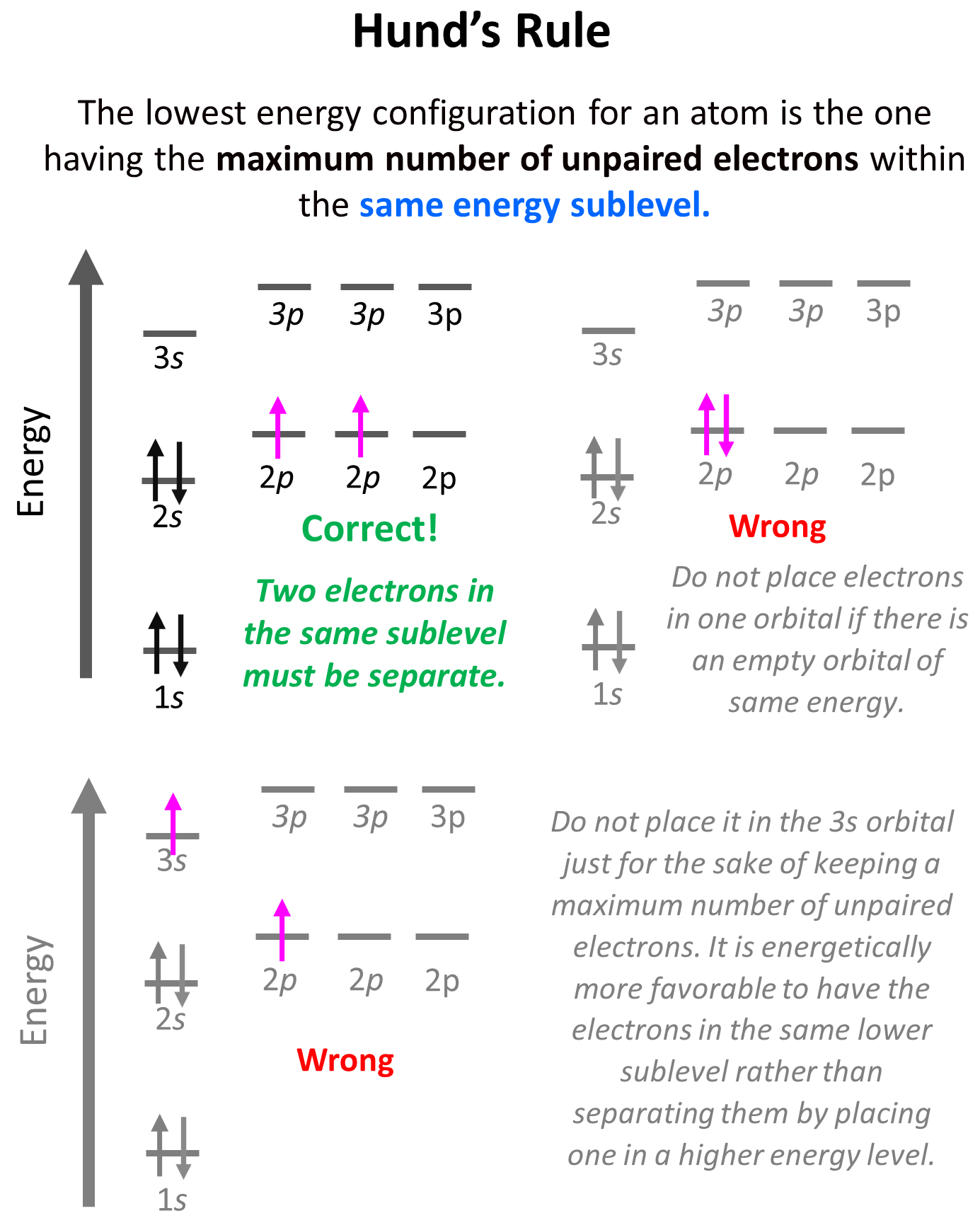
The "bus seat" analogy is wonderfully explained in the same Duell Chemistry video.
Electron Configuration: The Full Story
This video provides the classic "bus seat" analogy for Hund's rule, making it very intuitive.
Watch the explanation of Hund's rule using the carbon atom as an example from 11:24 to 12:23.
Applying the Rules
Let's put all three rules together to see how they work. The following reading walks through the process of building the electron configurations for the first ten elements, from hydrogen to neon. As you read, identify how each rule is being applied at each step.
8.3: Electron Configurations- How Electrons Occupy Orbitals
This section systematically applies all three rules to build the electron configurations for the first ten elements.
Read the text starting from the section on the first and second periods. Pay close attention to: Lithium (Z=3): The third electron goes into the 2s orbital, not 1s (Aufbau & Pauli). Carbon (Z=6): The two 2p electrons occupy separate 2p orbitals (Hund's rule). Nitrogen (Z=7): The three 2p electrons occupy all three 2p orbitals, all with the same spin (Hund's rule). Oxygen (Z=8): The eighth electron is forced to pair up in one of the 2p orbitals (Pauli & Hund's rules).
Conclusion
In this lesson, you have learned the three essential rules that dictate how electrons are arranged in atoms. These principles are not just abstract regulations; they are fundamental to explaining the structure of the periodic table and the chemical behavior of the elements.
The key takeaways are:
- Aufbau Principle: Electrons fill orbitals starting with the lowest energy levels and building up.
- Pauli Exclusion Principle: An orbital can hold a maximum of two electrons, which must have opposite spins.
- Hund's Rule: When filling a subshell with multiple orbitals (like p or d), electrons occupy orbitals singly first before pairing up.
We now have the complete theoretical framework. In our next lesson, we will put this knowledge into practice by learning how to construct orbital box diagrams. This will allow us to create detailed visual representations of the electron distribution for any element, a foundational skill in chemistry.