Welcome back! In our last lesson, we established the three fundamental rules that govern how electrons populate orbitals: the Aufbau principle, the Pauli exclusion principle, and Hund's rule. You now have the theoretical "building code" for atomic structure.
This lesson puts that theory into practice. We will focus on constructing orbital box diagrams, which are detailed visual blueprints of an atom's electron distribution. Your goal for this lesson is to become proficient in drawing these diagrams for any element up to atomic number 30 (Zinc). This is a crucial skill that brings the abstract rules to life and provides a concrete way to represent the electronic structure of atoms, including the transition metals you're interested in.
From Rules to Diagrams
An orbital box diagram is a straightforward way to visualize our three rules:
- Each orbital is represented by a box
[ ]. - An electron is represented by a half-arrow (
↑or↓). - The Pauli exclusion principle means a box can hold at most two arrows, and they must point in opposite directions
[↑↓]. - Hund's rule dictates that for subshells with multiple orbitals (like the three p-orbitals
[ ] [ ] [ ]), you place one↑in each box before you start pairing them up.
To see how this works step-by-step for the first ten elements, let's turn to a clear written guide.
Electron Configurations, Orbital Box Notation (M7Q7)
This text provides a formal introduction to orbital diagrams and systematically constructs them for the elements from hydrogen to neon. It's a great way to solidify the basic conventions.
Please read the section titled Writing Orbital Diagrams. As you go through the examples for each element (H, He, Li, Be, B, C, N, O, F, Ne), pay close attention to how each of the three rules is applied at every step.
A Guided Tour of the Periodic Table
Reading about the process is one thing; seeing it done is another. The following video by The Organic Chemistry Tutor provides an excellent walkthrough, building orbital diagrams for elements all the way up to zinc (Z=30). This will be our main activity for this lesson. We'll watch it in three parts.
Orbital Diagrams and Electron Configuration - Basic Introduction - Chemistry Practice Problems
This comprehensive video demonstrates how to apply the rules you've learned to construct orbital diagrams for a wide range of elements.
First, watch the segment covering the elements from Hydrogen to Neon. This will be a dynamic review of the elements covered in the reading, reinforcing the application of Hund's rule in the p-block. Next, continue with the elements in the third period, from Sodium to Argon. Notice how the pattern of filling the 3s and 3p orbitals is identical to the 2s and 2p orbitals. Finally, watch the remainder of the video, from Potassium to Zinc. This is the most critical section, as it introduces the filling of the d-orbitals and covers the first row of transition metals. Pay special attention to how the 4s orbital is filled before the 3d orbitals (Aufbau principle) and how Hund's rule is applied across the five degenerate d orbitals.
As you may have noticed in the video, the elements Chromium (Cr) and Copper (Cu) don't follow the rules perfectly. This is due to the extra stability of half-filled and fully-filled d-subshells. We will explore these important exceptions in detail in our next lesson. For now, focus on mastering the standard procedure.
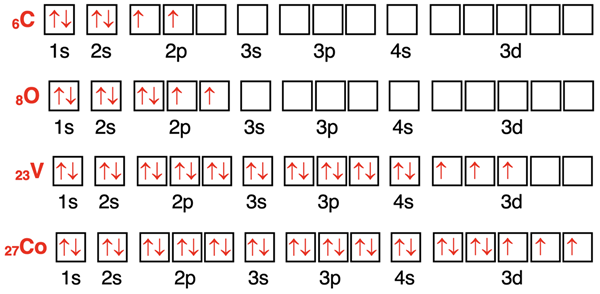
The image below shows the final orbital diagrams for a few example elements, including the transition metals Vanadium (V) and Cobalt (Co). You can use this as a reference to check your understanding of the final structure for these elements.
Practice and Application
Now it's your turn to construct one from scratch.
Problem: Draw the full orbital box diagram for a neutral phosphorus atom. Phosphorus (P) has an atomic number of 15.
Take a few minutes to work this out on paper. Follow these steps:
- Determine the number of electrons: Z = 15, so there are 15 electrons.
- Determine the orbital filling order: 1s, 2s, 2p, 3s, 3p...
- Draw the boxes for these subshells.
- Fill the boxes with 15 electrons, remembering Hund's rule and the Pauli exclusion principle.
Once you have your answer, compare it with the solution provided in the reading below.
Electron Configurations, Orbital Box Notation (M7Q7)
This reading contains a worked example for the phosphorus atom, showing the complete orbital diagram and electron configuration.
Find Example 1 in the text and review the provided solution. Does your diagram match? Pay particular attention to how the three electrons are placed in the 3p orbitals.
Conclusion
In this lesson, you translated the theoretical principles of electron filling into the practical skill of constructing orbital box diagrams. This visual method is a powerful tool for representing the electronic structure of an atom, making it easier to understand and predict chemical properties.
Here are the key takeaways:
- Orbital box diagrams use boxes for orbitals and arrows for electrons to visualize an atom's electron configuration.
- The construction process is a direct application of the Aufbau principle (filling order), Pauli exclusion principle (spin pairing), and Hund's rule (maximizing unpaired electrons in degenerate orbitals).
- You are now equipped to draw these diagrams for elements up to atomic number 30, which includes the first row of transition metals where the
3dorbitals are being filled.
We now have a robust visual model for electron arrangement. In our next lesson, we will learn how to write this information more concisely using spdf notation and noble-gas shorthand. We will also formally examine the electron configuration exceptions for Chromium (Cr) and Copper (Cu) and see how the periodic table itself is a map of electron configurations.