Hallo! In our last lesson, we built a vocabulary of essential places for a student in a German city, like die Universität and die Mensa. Now that you know what these places are called, it's time to learn how to talk about your relationship to them in space. How do you say you are going to the library, versus being in the library?
This distinction is central to navigating and describing your surroundings, and German handles it with a special group of prepositions. Today's lesson focuses on understanding and using these two-way prepositions (Wechselpräpositionen). You will learn the crucial rule that determines whether they are followed by the accusative or the dative case, a fundamental concept for expressing both location and direction.
1. The Golden Rule: Location vs. Direction
In German, certain prepositions can take two different grammatical cases, and the case you choose changes the meaning of the sentence. This is the core idea you need to master.
- When you describe a static location (where something is), you use the dative case. The question to ask is
Wo?(Where?). - When you describe movement toward a destination (where something is going to), you use the accusative case. The question to ask is
Wohin?(Where to?).
Let’s watch a short video that explains this fundamental concept clearly. It uses the example of a library, a place we discussed in our last lesson.
DATIVE or ACCUSATIVE? Does it MATTER? | Two-way prepositions in GERMAN.
The "Bausteine eins" channel provides a very clear explanation of why the case matters with these prepositions.
Please watch the segment from the core concept. The speaker contrasts a sentence in dative with one in accusative, showing how the meaning shifts from being in the library to going to the library.
As the video explained, the choice between dative and accusative is what allows you to differentiate between location and direction.
Let's apply this to the vocabulary from our last lesson. Look at this image of a university entrance.

We can describe two different situations using the preposition in (in/into):
- Location (
Wo?): Ein Student ist in der Universität. (A student is in the university.)- Here,
der Universitätis dative. We are answering the question "Where is the student?". He is at a fixed location.
- Here,
- Direction (
Wohin?): Ein Student geht in die Universität. (A student goes into the university.)- Here,
die Universitätis accusative. We are answering "Where is the student going?". He is moving from outside to inside.
- Here,
Notice how the article changes: der (dative feminine) vs. die (accusative feminine). This case change is how German grammar encodes the difference between being somewhere and going somewhere.
2. The Nine Two-Way Prepositions
There are nine common prepositions that follow this rule. They are called Wechselpräpositionen, which literally means "change prepositions."
This diagram gives a great overview of the different types of prepositions. The ones in the overlapping middle section are our focus today.
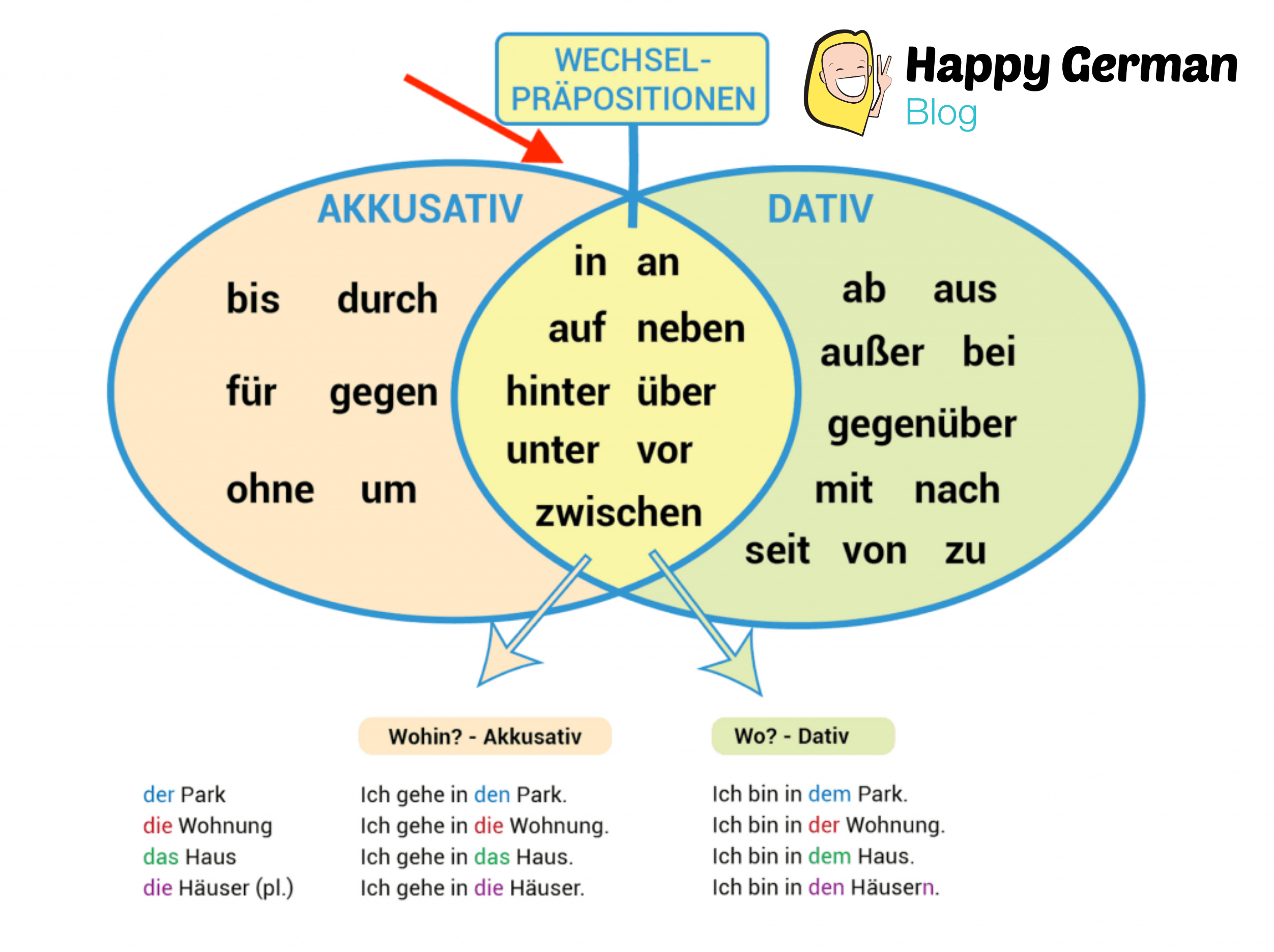
Now, let's read a clear definition and list of these nine prepositions from the "German with Antrim" blog.
Two-Way Prepositions with Accusative & Dative
This article provides a thorough introduction to two-way prepositions.
Read the first two sections, starting from the top. First, focus on the list of the nine prepositions. Then, carefully read the section When to Use Accusative and When to Use Dative, which reinforces the core rule we just discussed.
The nine Wechselpräpositionen are:an (on, at), auf (on, on top of), hinter (behind), in (in, into), neben (next to), über (over, above), unter (under, among), vor (in front of, before), zwischen (between).
3. Seeing the Rule in Action
The best way to understand this concept is to see it applied. The following video demonstrates this principle by showing simple actions, like placing an object somewhere. For each preposition, you'll see one sentence with movement (accusative) and one with a static location (dative).
Wechselpräpositionen Dativ und Akkusativ | German Two-Way Prepositions
"YourGermanTeacher" offers fantastic visual examples that make the accusative/dative distinction very clear.
Watch the following short clips. For each one, notice the action of placing something (movement, accusative) versus the state of it being somewhere (location, dative). auf (on): A mug is placed onto the table, then it is on the table. vor (in front of): A watch is placed in front of a picture, then it is in front of the picture. unter (under): A box is put under the table, then it is under the table. in (in/into): A credit card is put into a wallet, then it is in the wallet.
Here is a summary table with examples you might encounter as a student. Pay close attention to the changing articles (den/dem, die/der, das/dem).
| Preposition | Wohin? + Accusative (Direction) |
Wo? + Dative (Location) |
|---|---|---|
in (in/into) |
Ich gehe in den Hörsaal. (I go into the lecture hall.) | Ich sitze im (in dem) Hörsaal. (I am sitting in the lecture hall.) |
an (at/on a vertical surface) |
Ich hänge das Poster an die Wand. (I hang the poster on the wall.) | Das Poster hängt an der Wand. (The poster is hanging on the wall.) |
auf (on top of a horizontal surface) |
Ich lege das Buch auf den Tisch. (I lay the book onto the table.) | Das Buch liegt auf dem Tisch. (The book is lying on the table.) |
vor (in front of) |
Ich fahre vor die Universität. (I drive in front of the university.) | Ich warte vor der Universität. (I am waiting in front of the university.) |
You might have noticed that some prepositions contract with the article, like in + dem = im. Here are the most common contractions:
an + dem = aman + das = ansin + dem = imin + das = ins
4. A Helpful Trick: Verbs of Position
As you saw in the video auf example, the verb changed from stellen (to place) to stehen (to be standing). Certain pairs of verbs can give you a huge clue about which case to use. One verb in the pair describes the action of moving something, while the other describes the state of being in a position.
This article section explains these helpful verb pairs.
Two-Way Prepositions with Accusative & Dative
This section dives into the verb pairs that signal whether to use accusative or dative.
Find the section titled Indicator Verbs. Read through the explanation of the pairs legen vs. liegen, stellen vs. stehen, and setzen vs. sitzen. Focus on how one verb implies a direct object and a change of location (accusative), while the other describes a static position (dative).
Here's a quick summary of the main pairs:
Action Verb (Wohin? + Accusative) |
State Verb (Wo? + Dative) |
Meaning |
|---|---|---|
stellen |
stehen |
to place (upright) / to stand |
legen |
liegen |
to lay (flat) / to lie |
setzen |
sitzen |
to set, to seat / to sit |
hängen |
hängen |
to hang (something) / to be hanging |
If you use an action verb like legen (I lay the book...), you are describing movement, so you'll use the accusative. If you use a state verb like liegen (The book is lying...), you are describing a location, so you'll use the dative.
5. Quick Practice
Let's test your understanding. Complete the following sentences by choosing the correct article.
- Ich gehe in ______ Mensa. (die / der)
- Das Buch liegt auf ______ Tisch. (den / dem)
- Der Professor stellt den Laptop auf ______ Pult. (das / dem)
- Wir warten vor ______ Bibliothek. (die / der)
- Setz dich bitte an ______ Tisch! (den / dem)
Answers:
- die (
gehenis movement ->wohin?-> accusative) - dem (
liegtis a static location ->wo?-> dative) - das (
stelltis an action of placing ->wohin?-> accusative) - der (
wartenis a static location ->wo?-> dative) - den (
sich setzenis an action of sitting down ->wohin?-> accusative)
Conclusion
In this lesson, you've unlocked one of the most important concepts in German grammar: the logic of two-way prepositions. Mastering this will dramatically improve your ability to describe the world around you, a vital skill for your life as a student in Germany or Austria.
Key Takeaways:
- The
Wo?vs.Wohin?Rule: Use the dative case to answerWo?(Where is something?) and the accusative case to answerWohin?(Where is it going?). - The Nine
Wechselpräpositionen: You learned to identify the nine prepositions that follow this rule:in, an, auf, neben, hinter, über, unter, vor, zwischen. - Indicator Verbs: Verb pairs like
stellen/stehenandlegen/liegenare strong clues that tell you whether to use the accusative (action) or dative (state).
In our next lesson, we will put this new knowledge to practical use. Now that you can talk about location and direction, you'll learn how to ask for and give simple directions to navigate the city, combining today's grammar with the vocabulary from our previous lesson.