Hallo! Welcome to a new module in your German learning journey. In the previous module, we focused on your personal world—your hobbies, opinions, and daily life. Now, we're going to step outside and explore the public sphere. This module, "City & Travel," is designed to give you the language skills you need to navigate a German-speaking city, which is a crucial step toward your goal of studying in Germany or Austria.
Today, we'll begin by building the foundational vocabulary for your future student life. Our goal is to identify the key places you'll encounter on and around a university campus. You'll learn the German words for places like the university itself, the library, and the student cafeteria, setting the stage for learning how to get around in the lessons to come.
1. The German University Campus
Imagine arriving at your university in Germany for the first time. You'll need to know where to go for lectures, where to study, and where to eat. Let's start by familiarizing ourselves with the essential vocabulary for these locations.
The image below shows scenes from student life in Germany: a university building, a lecture hall, and the student cafeteria, known as the Mensa. These are the kinds of places that will become central to your daily routine as a student.
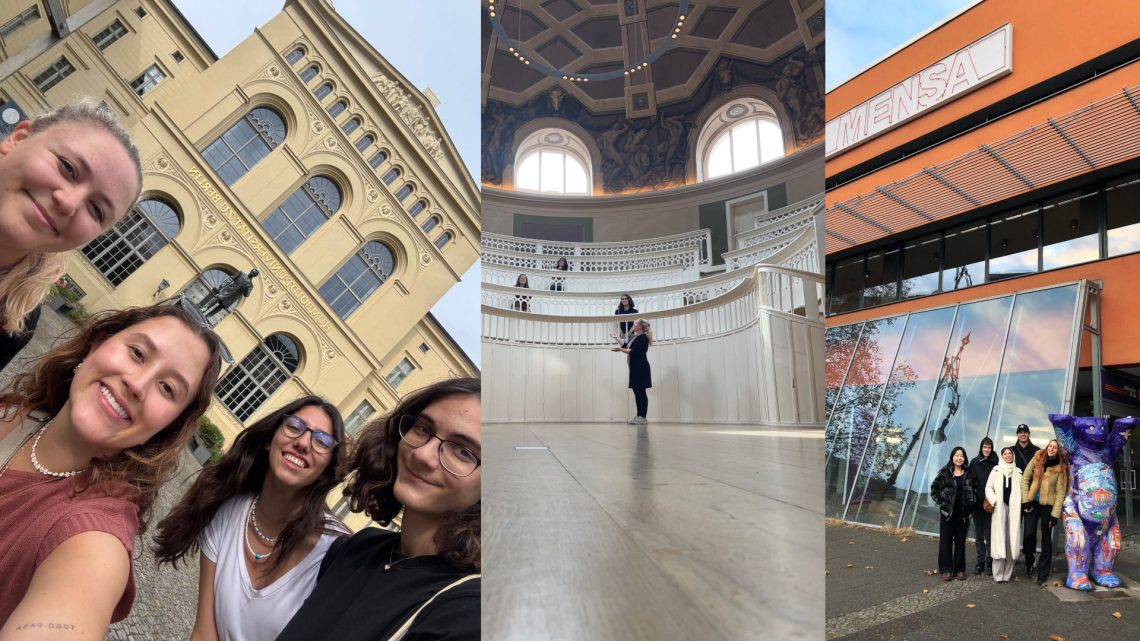
The three most important places to know right away are:
- die Universität (the university)
- die Bibliothek (the library)
- die Mensa (the student cafeteria)
Notice that each noun is preceded by a word: die. This is the definite article, equivalent to "the" in English. In German, every noun has a grammatical gender, indicated by its article: der (masculine), die (feminine), or das (neuter). It is essential to learn the article with every new noun.
The following video is a great introduction to the names of various places in a city. It presents the word, its plural form, and a simple sentence explaining its function.
Places in a city in German | In der Stadt | German Vocabulary | Learn German | A1
This video from the "Learn German" channel will help you build your core city vocabulary.
Please watch the sections that introduce the university (die Universität) and the library (die Bücherei). Notice the article, the plural form, and the example sentence for each. Die Bücherei is a general term for a library; at a university, you'll more commonly hear die Bibliothek.
This vocabulary is not just abstract; it's the language of daily student life. As the GradGermany course guide highlights, their content is specifically built around scenarios you will face, such as navigating "university life... the Mensa, finding housing." This underscores how vital today's topic is for your long-term goal.

2. A Look Inside: The Mensa and Campus Life
While Universität and Bibliothek are straightforward, the concept of the Mensa is a key part of German student culture. It's more than just a cafeteria; it's a central social hub for students.
The "Easy German" team visited the campus in the city of Fulda and asked students about their lives. This video gives you an authentic glimpse into the campus environment.
Student life in Germany | Easy German 99
In this video, you'll see a real German 'Mensa' and hear students talk about their favorite spots on campus.
First, watch the segment where the hosts go to the Mensa (Mensa tour). They explain how it works, from choosing food to paying with a student card. Next, listen to students describe their favorite places on campus (favorite spots). You'll hear them mention the Mensa again, as well as a student café called Café Chaos.
As you saw, the campus is full of different places for studying and socializing. The Mensa is for eating and meeting friends, the Bibliothek is for quiet study, and a Café is for relaxing between classes.
3. Inside the Classroom: Lecture Halls and Seminar Rooms
Beyond the main buildings, your academic life will happen in specific kinds of rooms. The two most common are the Hörsaal for large lectures and the Seminarraum for smaller, more interactive classes. As a future dental student, you will spend a lot of time in both.
The following resource, taken from a German textbook, provides a vocabulary list related to university studies.
[PDF] Schule und Studium - Vista Higher Learning
This PDF excerpt lists key vocabulary for university life.
On the first page, under the heading "Los geht's!", find the vocabulary list on the right. In the sub-section titled Orte (Places), locate the words der Hörsaal (lecture hall) and der Seminarraum (seminar room).
4. Your Student Vocabulary Summary
Let's consolidate the key places you've learned today. Remember to always learn the noun with its article (der, die, or das).
| Article | German Word | Plural Form | English Translation | What do you do there? |
|---|---|---|---|---|
die |
Universität | Universitäten | University | studieren (to study) |
die |
Bibliothek | Bibliotheken | Library | Bücher lesen (to read books) |
die |
Mensa | Mensen | Student cafeteria | Mittagessen (to eat lunch) |
der |
Hörsaal | Hörsäle | Lecture hall | eine Vorlesung hören (to hear a lecture) |
der |
Seminarraum | Seminarräume | Seminar room | diskutieren (to discuss) |
das |
Café | Cafés | Café | Kaffee trinken (to drink coffee) |
Quick Practice: Was macht man wo? (What do you do where?)
Match the activity on the left with the correct place on the right.
- Ich will ein Buch lesen.
- Ich habe eine Vorlesung.
- Ich habe Hunger.
- Ich will Kaffee trinken.
a. Ich gehe in die Mensa.
b. Ich gehe in den Hörsaal.
c. Ich gehe ins Café.
d. Ich gehe in die Bibliothek.
(Answers: 1-d, 2-b, 3-a, 4-c)
This exercise gives you a small glimpse of how we use prepositions to talk about movement, which is exactly what we will be covering in our next lessons.
Conclusion
In this lesson, you've taken the first step into navigating a German city by learning the essential vocabulary for student life. You can now identify the primary locations on a university campus, from the library and cafeteria to the specific rooms where you'll attend classes.
Key Takeaways:
- Core Vocabulary: You learned the names for key student locations:
die Universität,die Bibliothek,die Mensa,der Hörsaal, andder Seminarraum. - The Importance of Articles: You reinforced the rule that every German noun has a gender, marked by its article (
der,die,das), which must be learned with the noun. - Cultural Context: You gained insight into the role of the
Mensaas a central part of German student life.
In our next lesson, we will build directly on this foundation. Now that you know the names of these places, you will learn how to talk about going to them and being at them. This will be our introduction to a very important grammatical concept: two-way prepositions, which change their meaning depending on whether you are describing a location or a direction.
Bis bald