Hallo! Welcome to the final lesson of this module. Over the past few lessons, we've been building a powerful toolkit for you to talk about your interests. You've learned vocabulary for hobbies, how to express likes and dislikes with mögen and gern, how to connect your ideas with conjunctions like und and aber, and how to share your opinion using finden.
Today, we'll bring all of these pieces together. Our goal is to consolidate your skills so you can achieve this module's final objective: to describe a favorite video game or vlog in several connected sentences. This is a fantastic way to practice real-world communication and start sounding more natural in German. Let's combine what you know and create something new.
1. Reviewing Your Toolkit
To build a good description, you need the right tools. Let's quickly review the grammar and vocabulary we've covered in this module. Think of these as the building blocks for your paragraph.
- Hobby Vocabulary: Naming the activity, like
Videospiele spielen(playing video games) orVlogs schauen(watching vlogs). - Expressing Likes: Using
gernwith a verb (Ich spiele gern),mögenwith a noun (Ich mag Strategiespiele), orMein Lieblings-(Mein Lieblingsspiel). - Connecting Ideas: Using coordinating conjunctions like
und(and),oder(or), andaber(but) to link two main clauses. - Giving Opinions: Using the
finden + adjectivestructure (Ich finde das Spiel spannend).
These are the four core components you'll be weaving together.
2. Adding Detail: Frequency and Reason
A good description doesn't just state facts; it adds color and detail. We can enhance our sentences by explaining how often we do something and why we like it.
How Often? Adverbs of Frequency
Adverbs of frequency tell us how often an action occurs. They usually come directly after the conjugated verb.
Ich spiele **oft** Videospiele. (I often play video games.)Ich schaue **manchmal** Vlogs. (I sometimes watch vlogs.)
The following resource provides a list of the most important frequency adverbs.
How to Discuss Hobbies in German: A Comprehensive Guide
This guide from Olesen Tuition has a very useful section on frequency adverbs.
Please read the short section titled Using Frequency Words. Focus on the list of adverbs (immer, oft, manchmal, selten, nie) and notice their placement in the example sentences.
Why? A Simple "Because" with denn
You've learned to connect sentences with und and aber. Let's add one more simple but powerful conjunction: denn.
dennmeans "because" or "for".- Just like
und,oder, andaber, it is a coordinating conjunction. This means it connects two main clauses and does not change the word order. The verb stays in the second position in the clause that follows.
Example: Ich mag dieses Spiel, **denn** es ist sehr kreativ. (I like this game, because it is very creative.)
Notice how denn functions just like und and aber in the diagram below, which classifies different types of German connectors.
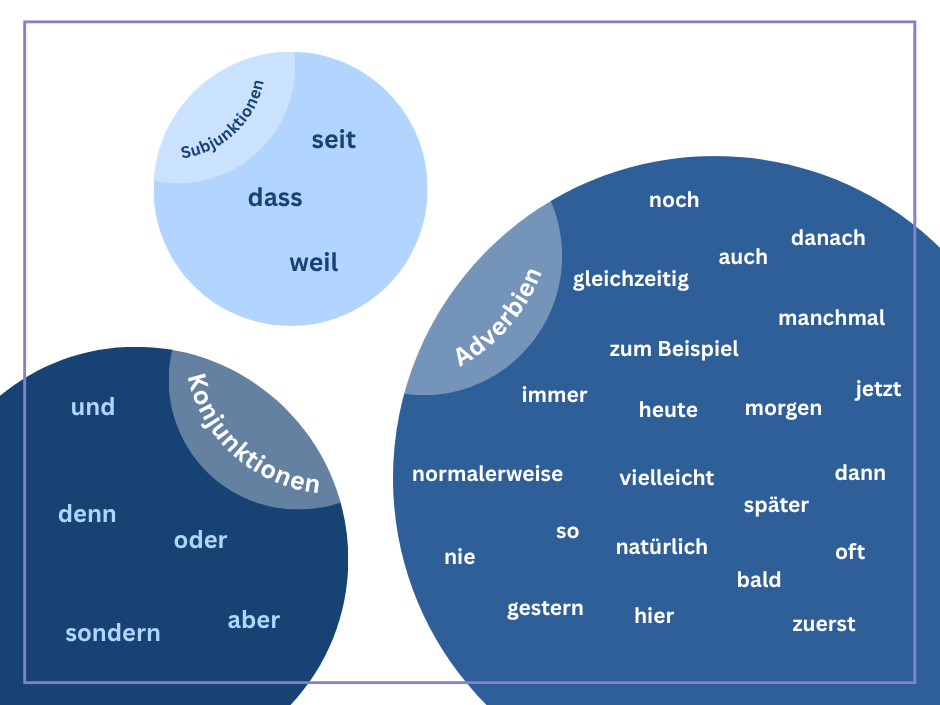
Using denn is an easy way to start giving reasons for your opinions, making your descriptions much more persuasive.
3. Let's Build a Description Together
Now, let's assemble these blocks into a coherent paragraph. Imagine we want to describe a favorite video game. We can do it step-by-step.
-
State your hobby and your favorite:
Ich spiele gern Videospiele in meiner Freizeit.(I like to play video games in my free time.)Mein Lieblingsspiel ist 'The Legend of Zelda'.(My favorite game is 'The Legend of Zelda'.)
-
Describe it and give your opinion:
Es ist ein Abenteuerspiel.(It is an adventure game.)Ich finde die Welt sehr schön und interessant.(I find the world very beautiful and interesting.)
-
Add details and connect your thoughts:
Ich spiele oft am Wochenende, **aber** in der Woche habe ich nicht so viel Zeit.(I often play on the weekend, but during the week I don't have so much time.)Ich mag die Rätsel, **denn** sie sind herausfordernd.(I like the puzzles, because they are challenging.)Die Musik ist auch super **und** ich höre sie manchmal nur zum Entspannen.(The music is also great and I sometimes listen to it just to relax.)
Putting it all together, you get a nice, descriptive paragraph:
Ich spiele gern Videospiele in meiner Freizeit. Mein Lieblingsspiel ist 'The Legend of Zelda'. Es ist ein Abenteuerspiel und ich finde die Welt sehr schön und interessant. Ich spiele oft am Wochenende, aber in der Woche habe ich nicht so viel Zeit. Ich mag die Rätsel, denn sie sind herausfordernd. Die Musik ist auch super und ich höre sie manchmal nur zum Entspannen.
The guide you just read offers a similar template. Take a look at their beginner-level example to see another model of how these sentences connect.
How to Discuss Hobbies in German: A Comprehensive Guide
Let's return to the Olesen Tuition guide.
Find the section Sample German Sentences & Paragraphs about Hobbies, and read the paragraph under the Beginner Level (A1) heading. Analyze how it uses simple sentences, conjunctions, and frequency words to create a complete description.
4. Your Turn: Describe Your Favorite
Now it's time for you to practice. Choose a real video game or vlog that you genuinely enjoy. Write a short paragraph of 3-5 sentences describing it.
Use the following questions as a guide:
- What is your hobby? (
In meiner Freizeit...) - What is the name of your favorite game/vlog? (
Mein Lieblings... ist...) - What kind of game/vlog is it? (
Es ist ein...) - What is your opinion of it? Why? (
Ich finde es..., denn...) - How often do you play/watch it? (
Ich spiele/schaue oft/manchmal...)
Try to use at least one frequency adverb (oft, manchmal) and at least two different conjunctions (und, aber, denn).
For more hobby-related vocabulary to inspire you, this resource is a great place to look.
Hobbies in German [How to Talk About Your Interests]
This article from Emma Loves German provides a helpful table of hobbies.
Look at the table under the heading Hobbies in German & Their Verbs. You will find Videospiele spielen and can adapt fernsehen (to watch TV) for watching vlogs (Vlogs schauen).
5. From Hobby to Learning Tool
As a gamer, you have a unique advantage in language learning. Your interest in gaming can become a powerful engine for acquiring German. The vlog "how to learn ANY language by gaming" explores this very idea. While the video is in English, it shows how immersing yourself in a game's world—by changing the language settings, for example—can dramatically accelerate your learning. This is something to keep in mind as your German skills advance. You can turn your playtime into study time without it feeling like a chore.
Conclusion
Congratulations! You have successfully completed the final lesson of this module. You have taken individual words and grammar rules and combined them to express complex thoughts, opinions, and preferences about your personal interests. This is a significant step in your language journey.
Key Takeaways:
- Combine Your Skills: To describe something, you can combine hobby vocabulary, expressions of liking (
gern,mögen), conjunctions (und,aber,denn), and opinions (finden). - Add Detail: Use adverbs of frequency (
oft,manchmal) to say how often you do something. - Give Reasons: Use the conjunction
dennto explain why you feel a certain way, without worrying about changing the word order. - Structure is Key: Building a paragraph sentence by sentence—stating the topic, giving an opinion, and adding details—makes the task manageable.
In our next module, "City & Travel: Two-Way Prepositions," we will shift our focus from your personal world to the world outside. You will learn how to navigate a German city, ask for directions, and talk about location and movement—essential skills for your goal of studying in Germany or Austria.
Bis zum nächsten Mal