Welcome back! In our last lesson, you were introduced to one of the most powerful concepts in German grammar: the nine two-way prepositions, or Wechselpräpositionen. You learned the fundamental rule that governs them: they take the accusative case to show direction and the dative case to show a static location.
Today, we will build directly on that foundation. Our goal is to move from knowing the rule to mastering its application. This lesson is dedicated to sharpening your ability to differentiate between the accusative and dative cases, especially in situations that might seem ambiguous at first. We will analyze more nuanced examples and tackle common points of confusion, ensuring you can use these prepositions with precision and confidence.
1. Recapping the Core Principle: Wo? vs. Wohin?
As a quick refresher, the choice between dative and accusative hinges on the question you are answering:
Wo?(Where?) — asks about a static location. The answer uses the Dative case.- Wo ist das Buch? — Das Buch ist auf dem Tisch. (The book is on the table.)
Wohin?(Where to?) — asks about movement toward a destination. The answer uses the Accusative case.- Wohin legst du das Buch? — Ich lege das Buch auf den Tisch. (I am putting the book onto the table.)
This distinction is the key. Let's look at the overview diagram again to situate the Wechselpräpositionen among the other preposition types.
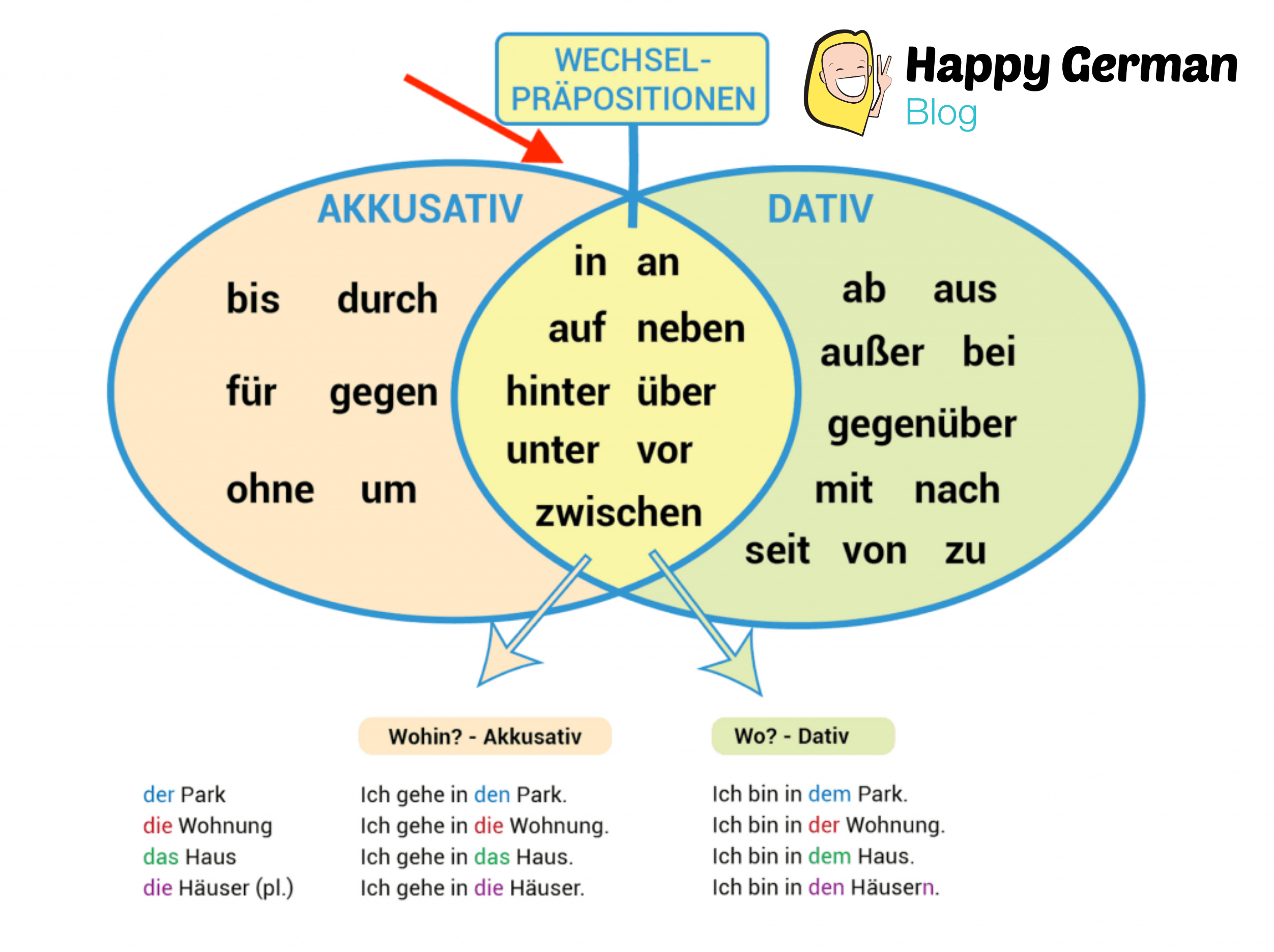
2. A Systematic Review of the Nine Prepositions
In the previous lesson, you saw several of the nine Wechselpräpositionen in action. To ensure you're comfortable with all of them, let's watch some more clear visual examples from the "YourGermanTeacher" video. For each preposition, observe the contrast between the action of moving an object (Wohin? -> Accusative) and its final resting state (Wo? -> Dative).
Wechselpräpositionen Dativ und Akkusativ | German Two-Way Prepositions
This video provides excellent, simple visual demonstrations for each of the two-way prepositions.
Watch the following short clips, focusing on the distinction between movement and location. neben (next to): A spoon is placed next to a cup. Then it is next to the cup. zwischen (between): A picture is placed between books. Then it is between the books. hinter (behind): A person sits down behind a desk. Then he is sitting behind the desk. über (above/over): A lamp is hung above the table. Then it is hanging above the table. an (on/at a vertical surface): A photo is taped onto the wall. Then it is on the wall.
These examples reinforce the core rule across all nine prepositions. The change in the article (e.g., die Wand vs. der Wand) is the grammatical signal that carries the change in meaning.
3. Digging Deeper: When the Rules Get Tricky
Now that the basic principle is clear, let's explore some situations where choosing the correct case requires more careful thought. The "German with Antrim" article, which you consulted in the last lesson, has some excellent explanations of these subtleties.
The "Perfekt" Tense Problem
One common point of confusion arises when using the Perfekt (present perfect) tense with verbs of motion like gehen (to go), fahren (to drive), or fliegen (to fly). You know that these verbs show movement. So, shouldn't they always take the accusative? Not necessarily. The crucial factor is what the prepositional phrase is describing. Is it the destination of the movement, or the location where the movement is taking place?
Let's read a section of the article that clarifies this.
Two-Way Prepositions with Accusative & Dative
This article explains common challenges with two-way prepositions.
Please find the section titled The Perfekt Tense Problem. Read this part carefully. It explains why a motion verb doesn't automatically trigger the accusative case in the prepositional phrase. Then, continue to the next part, What you mean to say is key!. This section provides excellent contrasting examples like hiking in the mountains versus hiking into the mountains.
Let's break down the key idea from the reading with an example:
Mein Bruder ist in die Berge gewandert.(My brother hiked into the mountains.)- Accusative: This answers
Wohin?(Where did he hike to?). He started outside the mountains and his destination was inside them. There is a change of location into the mountains.
- Accusative: This answers
Mein Bruder ist in den Bergen gewandert.(My brother hiked in the mountains.)- Dative: This answers
Wo?(Where did he hike?). The entire action of hiking took place within the mountains. The prepositional phrase describes the location of the activity, not the destination.
- Dative: This answers
The meaning you intend to convey is what dictates the grammar. German allows you to be very precise here.
4. Practice in a Real-World Context
Let's see this principle applied in a more dynamic, conversational way. The "Easy German" channel uses a vlog style to demonstrate grammar in authentic contexts. In the following video, pay close attention to how they form sentences to describe both actions and locations. Listen for the Wo? and Wohin? questions.
German Two Way Prepositions (Prepositions with Accusative and Dative) | Super Easy German (27)
This video from Easy German shows various real-life scenarios applying the two-way prepositions.
Watch the following clips. For each pair of actions, notice how the sentence structure changes from direction (accusative) to location (dative). auf: Ture legt den Stift auf den Tisch. (Wohin?) Then: Der Stift liegt auf dem Tisch. (Wo?) in: Die Schüler gehen in den Bus. (Wohin?) Then: Die Schüler sitzen in dem Bus. (Wo?) in: Mia legt das Holzstück in die Tasche. (Wohin?) Then: Das Holzstück liegt jetzt in der Tasche. (Wo?) unter: Wir stellen uns unter das Dach. (Wohin?) Then: Jetzt stehen wir unter dem Dach. (Wo?)
5. Test Your Differentiation Skills
Now it's your turn to apply what you've learned. For each sentence below, choose the correct article. Think carefully: is the sentence describing a destination (Wohin?) or a static location (Wo?)?
- Als Zahnmedizinstudent lege ich meine Instrumente auf ______ Tablett. (das / dem)
(As a dental student, I lay my instruments onto the tray.) - Die Instrumente liegen jetzt auf ______ Tablett. (das / dem)
(The instruments are now lying on the tray.) - Gestern bin ich in ______ Bibliothek gegangen, um zu lernen. (die / der)
(Yesterday I went into the library to study.) - Ich habe den ganzen Tag in ______ Bibliothek gelernt. (die / der)
(I studied the whole day in the library.) - Der Professor hängt die anatomische Zeichnung an ______ Wand. (die / der)
(The professor hangs the anatomical drawing onto the wall.) - Die Zeichnung hängt jetzt neben ______ Tür. (die / der)
(The drawing is now hanging next to the door.)
Answers and Explanations:
- das (Accusative). The verb
legen(to lay) describes an action, a movement of the instruments onto the tray. This answersWohin?. - dem (Dative). The verb
liegen(to lie) describes a static state. The instruments are in a fixed location on the tray. This answersWo?. - die (Accusative). The verb
gegangen(went) describes movement from one place into another (the library). This answersWohin?. - der (Dative). This is a tricky one, like in our reading! Even though
lernen(studying) happened after you went there, the phrase "in the library" describes where the studying took place, not the destination. This answersWo?. - die (Accusative). The verb
hängthere is used with a direct object (die Zeichnung), implying the action of hanging something up. It's a movement onto the wall.Wohin?. - der (Dative). The verb
hängthere describes the static state of the drawing. It is located next to the door.Wo?.
Conclusion
In this lesson, you have honed your ability to differentiate between the accusative and dative cases with two-way prepositions. You've moved beyond the basic rule to analyze more complex sentences and common pitfalls, such as those involving the Perfekt tense.
Key Takeaways:
- Meaning is paramount: The choice between accusative and dative is a conscious one that determines the meaning of your sentence—are you describing a destination or a location?
Wo?andWohin?are your guides: Always ask yourself which question the prepositional phrase is answering.Wohin?leads to the accusative;Wo?leads to the dative.- Context overrules simple verb types: Even with a verb of motion, the prepositional phrase takes the dative if it describes the location where the action occurs, rather than the destination of the action.
You now have a solid command of how to describe location and direction. In our next lesson, we will put this skill to immediate practical use as you learn to ask for and give simple directions, helping you navigate a German-speaking city.