Welcome back! In our last two lessons, we've taken a deep dive into the grammar of location and direction, focusing on the powerful two-way prepositions and the crucial difference between the accusative and dative cases. You now have the grammatical tools to describe where things are (Wo?) and where they are going (Wohin?).
Today, we will put those tools to immediate, practical use. This lesson is all about navigating a German-speaking city. By the end of our session, you will be able to ask for and give simple directions using common landmarks. This is an essential skill for your future as a student in Germany or Austria, whether you're finding your way to the university library, a new café, or a friend's apartment.
1. The Vocabulary of Navigation
Before we can construct sentences, we need the basic building blocks. When giving or getting directions, you'll constantly encounter a core set of words for movements, places, and positions.
The poster below provides an excellent visual overview of the most common phrases. Take a moment to familiarize yourself with the words and their corresponding icons.
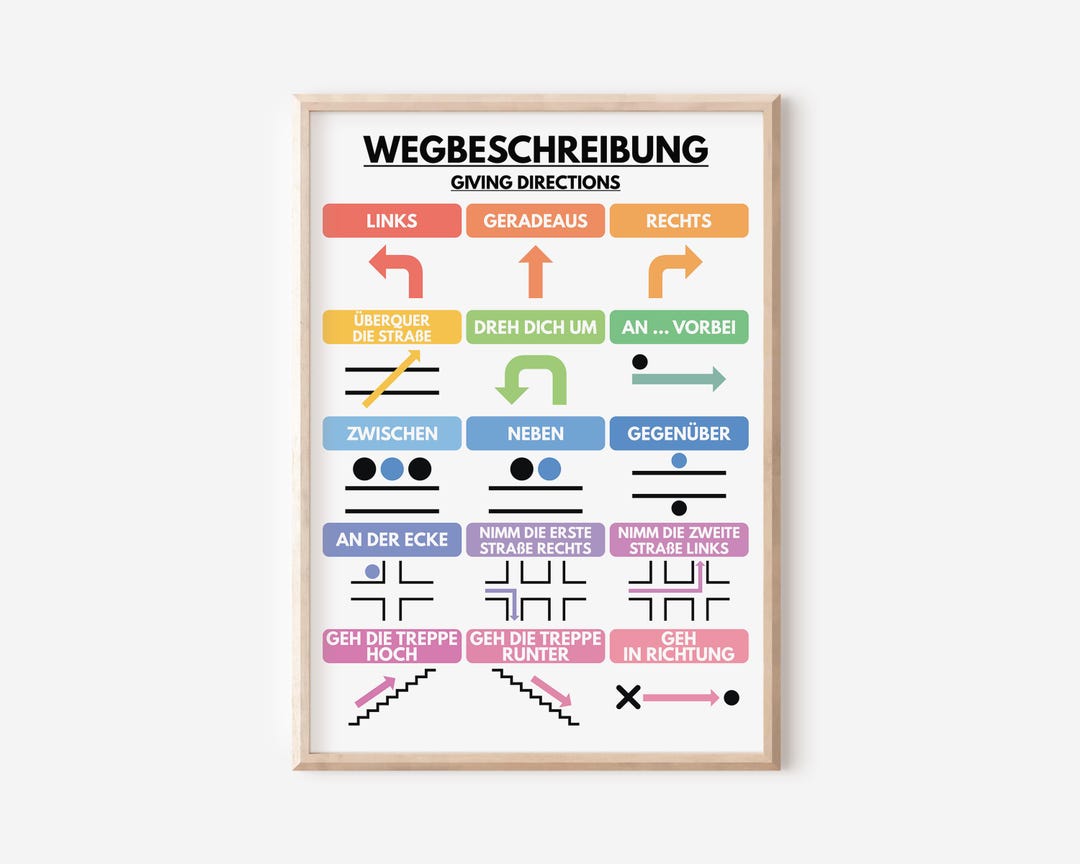
To build on this, let's look at a more structured list of essential nouns and verbs you'll need.
Directions in German: Essential vocabulary and phrases ...
This article from Preply provides a concise list of the fundamental vocabulary for directions.
Please read the two short subsections under "Key direction words": Nouns and Verbs. As you read, make sure to note the gender of each noun (der, die, das), as this will be important for choosing the correct articles later on.
2. How to Ask for the Way
Now that you have the basic words, let's look at how to formulate a question. When you're lost, a polite and clear question is your best tool. As you'll see, the questions often incorporate the Wo? and Wohin? concepts we've studied.
How to Give Directions in German | Super Easy German 185
This video from the "Easy German" channel, which uses a vlog style you might find engaging, demonstrates how real people on the street ask for directions.
Watch the clip from this section. Pay attention to the different ways the speakers get someone's attention and phrase their questions. You'll hear phrases like: Entschuldigung, können Sie mir kurz helfen? (Excuse me, can you help me quickly?) Entschuldigung, wissen Sie, ob es hier eine Apotheke gibt? (Excuse me, do you know if there is a pharmacy here?) Ich suche eine Apotheke. (I'm looking for a pharmacy.)
The most common and direct way to ask how to get somewhere is with the phrase Wie komme ich zu...? (How do I get to...?). This construction uses the preposition zu, which you learned always takes the dative case. This is why the articles change:
- Wie komme ich zum Bahnhof? (
zu+demBahnhof, masculine) - Wie komme ich zur Post? (
zu+derPost, feminine) - Wie komme ich zum Museum? (
zu+demMuseum, neuter)
The following video provides a clear, concise recap of how to use these important phrases.
How to give directions in German 🛵
The "YourGermanTeacher" channel offers a very structured explanation of these question formats.
First, watch the brief introduction from the beginning to hear the most common questions. Then, jump to the summary section and watch the explanation from this clip. The presenter clearly breaks down how kennen Sie den Weg zu... and wie komme ich zu... work with the dative contractions zum and zur.
3. How to Give Directions
Giving directions in German usually involves using the formal imperative (command form), which for Sie is simply the verb followed by Sie. For example, Gehen Sie... (You go...). This is then combined with the vocabulary we learned earlier.
Giving directions requires the same precision as explaining a complex procedure. You provide a series of clear, sequential steps that guide the listener from their current location to their destination, using landmarks as reference points.
Let's watch how this is done in a real conversation.
How to Give Directions in German | Super Easy German 185
Let's return to the "Easy German" video to see how a local gives instructions.
Watch the interaction from this part. Notice how the person giving directions uses simple, direct commands: "gehen Sie hier links, dann ein Stück geradeaus...". The video then helpfully recaps the key vocabulary used. Pay attention to the explanations for: ein Stück geradeaus (a little ways straight ahead) die Ampel, die Kreuzung, die Seite (the traffic light, the intersection, the side) weit weg, nah, um die Ecke, gegenüber (far away, near, around the corner, opposite)
As you heard, landmarks are crucial. Phrases like auf der rechten Seite (on the right side) or gegenüber dem Platz (opposite the square) rely directly on your knowledge of prepositions and cases.
- Das Kino ist auf der rechten Seite. (
auf+ Dative = location) - Gehen Sie an der Kirche vorbei. (
vorbei an+ Dative = location of path) - Gehen Sie über die Straße. (
über+ Accusative = direction of movement)
4. Sample Dialogue and Practice
Let's put everything together in a typical conversation. Notice how the speakers use politeness markers (Entschuldigung, Vielen Dank) and reference landmarks to ensure clarity.
A Guide to Asking for and Giving Directions in German
This article from Olesen Tuition provides a perfect example of a realistic dialogue.
Read the Sample Dialogue section. As you read, try to identify: The question used to ask for the way. The imperative verbs used to give instructions. The landmarks and prepositions used to give reference points.
Now, it's your turn to be the navigator. Imagine you are in the city depicted below.

Your Task:
You are standing at the Supermarkt. You want to get to the Bibliothek (library).
- Ask for directions: How would you ask a passerby for the way to the library? Write the full German sentence.
- Give directions: Now, imagine you are the local. Write down the instructions you would give. Use at least three steps and refer to at least one landmark (e.g., the fountain, the restaurant). Use phrases like Gehen Sie..., Biegen Sie ab..., and prepositions like an...vorbei or gegenüber.
Take a few minutes to formulate your answers before checking the suggestions below.
Suggested Answers:
- Asking: Entschuldigung, wie komme ich zur Bibliothek? (Or: Entschuldigung, wo ist die Bibliothek?)
- Giving: Here is one possible set of directions: "Gehen Sie geradeaus am Restaurant vorbei. An der Kreuzung biegen Sie rechts ab. Gehen Sie weiter geradeaus. Die Bibliothek ist dann auf der linken Seite, gegenüber dem Park."
(Go straight ahead past the restaurant. At the intersection, turn right. Continue going straight. The library is then on the left side, opposite the park.)
Conclusion
In this lesson, you've transformed abstract grammatical rules into a vital real-world skill. You learned the essential vocabulary and phrases to both ask for and give simple directions in German.
Key Takeaways:
- Asking: The key phrases are Entschuldigung, wo ist...? and Wie komme ich zu...?, remembering to use
zumfor masculine/neuter nouns andzurfor feminine nouns. - Giving: Use the formal imperative (Gehen Sie..., Biegen Sie ab...) combined with core directional words (links, rechts, geradeaus).
- Landmarks are key: Anchor your directions with landmarks using prepositions. This is where your knowledge of two-way prepositions and dative-only prepositions becomes critical for specifying both location (auf der linken Seite) and path (am Museum vorbei).
You are now much better equipped to find your way around a German city. In our next lesson, we will continue with this theme by learning how to ask for and buy a public transport ticket, another crucial skill for navigating student life.