Hello! Welcome to the next lesson in our journey through Cosmological Perturbation Theory.
In the last lesson, we completed a crucial part of the story: the origin of structure. We performed a rigorous calculation to find the primordial power spectrum of curvature perturbations, , generated by quantum fluctuations during inflation. The result was a nearly scale-invariant spectrum of tiny ripples in spacetime, frozen on scales much larger than the cosmic horizon.
Today, we address the next logical question: what happens to these perturbations after inflation ends and the hot Big Bang phase begins? Our learning outcome is to analyze the evolution of perturbations after they re-enter the horizon during the radiation- and matter-dominated eras. This process is what transforms the simple, primordial power-law spectrum into the complex, structured matter power spectrum we observe in the universe today.
1. From Super-horizon to Sub-horizon
Let's begin by recalling the concept of horizon re-entry. During inflation, the comoving Hubble radius shrinks, causing quantum fluctuations to be stretched to super-horizon scales. After inflation, during the radiation and matter eras, the universe's expansion decelerates.
- Radiation domination: , . The comoving Hubble radius grows as .
- Matter domination: , . The comoving Hubble radius grows as .
Since the comoving wavelength of a given perturbation, , remains constant, the growing Hubble radius will eventually overtake it. This is horizon re-entry. A perturbation is "sub-horizon" when its physical wavelength is smaller than the Hubble radius, , or equivalently, its comoving wavenumber is larger than the comoving Hubble rate, .
Because the Hubble radius grows with time, small scales (large ) re-enter the horizon earlier, during the radiation-dominated era. Large scales (small ) re-enter later, during the matter-dominated era. The boundary between these two regimes is marked by the scale , which re-enters the horizon precisely at the time of matter-radiation equality, . This scale leaves a distinct feature in the matter power spectrum.
To reinforce the distinction between the particle horizon and the Hubble radius, and how they relate to causal contact, you may find it helpful to watch this segment of a lecture by Antonio Riotto.
Inflation and cosmological perturbations - A. Riotto - lecture 1/5
This video section clearly defines and contrasts the particle horizon and the Hubble radius, which is the key length scale for our discussion of perturbation evolution.
Watch from 30:39 to 46:11. Focus on the definitions of the particle horizon and the Hubble radius (H^{-1}). Pay attention to the conclusion that for a decelerating universe (radiation or matter dominated), the two scales are proportional, so we can use the Hubble radius as our measure of causality.
2. The Equation of Growth for Sub-horizon Perturbations
Once a perturbation enters the horizon, it becomes causally connected and can evolve dynamically. On these sub-horizon scales, we can use a Newtonian description of gravity, which captures the essential physics.
Our main variable will be the density contrast, , which measures the fractional overdensity of matter:
where is the average background density. The evolution of its Fourier modes, , is governed by a competition between self-gravity, which drives collapse, pressure, which resists it, and the overall cosmic expansion, which damps the growth.
The following reading develops the Newtonian framework and derives the fundamental equation for the evolution of .
These lecture notes by Hannu Kurki-Suonio provide a clear derivation of the Newtonian perturbation equations in a cosmological context.
Please read the introduction to Section 8.2, 'Newtonian perturbation theory' (pages 39-40). The goal is to understand how the standard fluid equations (continuity, Euler) and the Poisson equation are adapted to an expanding background. You don't need to re-derive every step, but appreciate how they combine into a single second-order ODE for the density contrast.
The resulting linearized equation for a single fluid component is:
Let's break this down:
- : The acceleration of the perturbation.
- : The Hubble friction term. The expansion of the universe resists the growth of structure, acting as a damping force.
- : The gravitational instability term. Overdense regions have stronger gravity and attract more matter, driving growth.
- : The pressure term. Pressure resists compression, counteracting gravity. is the sound speed of the fluid. This term is only important for scales smaller than the Jeans length, .
The evolution of perturbations depends critically on the dominant energy component (which sets ) and the properties of the perturbed fluid itself (its pressure and its contribution to gravity ). In our universe, we must consider two distinct matter components: cold dark matter (CDM) and baryons.
3. Evolution in the Radiation-Dominated Era ()
For modes with , re-entry happens when the universe is dominated by radiation. The dynamics of CDM and baryons are starkly different.
Cold Dark Matter (CDM)
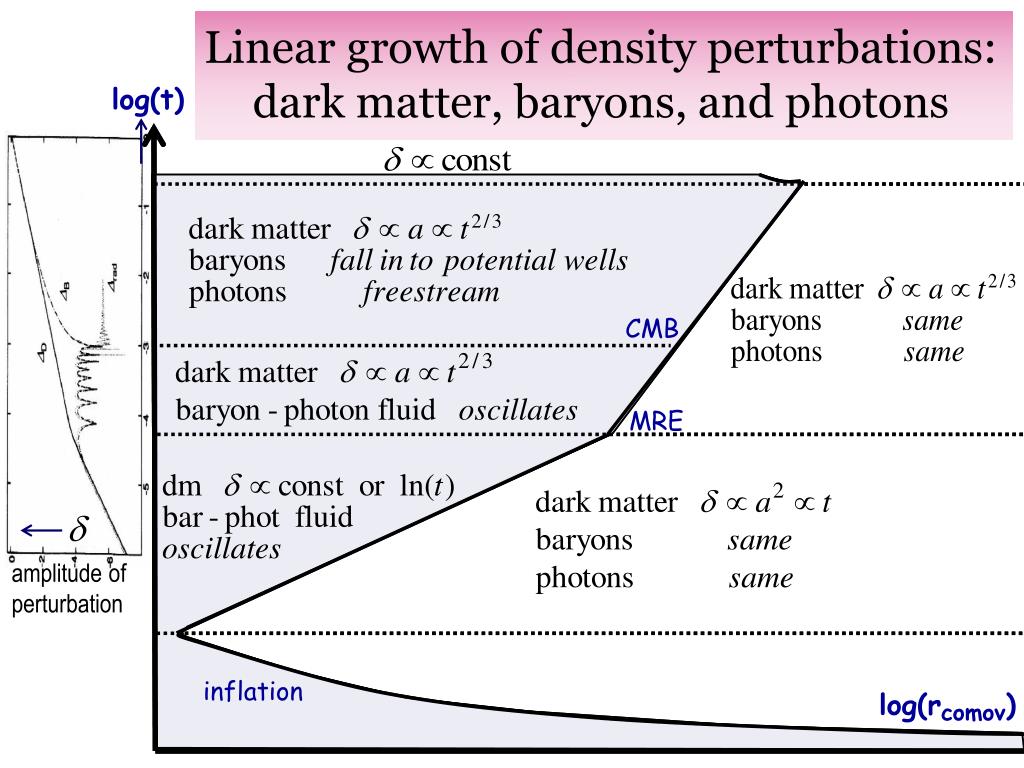
CDM is, by definition, pressureless (). However, during this era, the total energy density is dominated by radiation (), which is very smoothly distributed on sub-horizon scales. CDM perturbations are a negligible contribution to the gravitational source term. The perturbation equation for CDM () simplifies drastically:
The gravitational driving term is gone! The rapid expansion driven by radiation essentially prevents CDM perturbations from growing. This phenomenon is known as the Meszaros effect. The perturbations effectively stagnate.
A more careful analysis gives a slow, logarithmic growth, but the key takeaway is the dramatic suppression of growth compared to the later matter-dominated era. The following reading derives this result.
Here, we will derive the famous Meszaros equation, which governs the evolution of CDM perturbations through the transition from radiation to matter domination.
Please read Section 8.2.11, 'Meszaros equation' (pages 52-53). Follow the derivation of Eq. (186). The key result is the growing mode solution, Eq. (187): \delta \propto (1 + rac{3}{2}y), where y = a/a_{eq}. Note how for y \ll 1 (deep in the radiation era), \delta is approximately constant (stagnated).
Baryon-Photon Fluid
Before recombination, baryons are tightly coupled to photons via Thomson scattering, forming a single baryon-photon fluid. This fluid has immense pressure, dominated by the photons (). The Jeans length of this fluid is comparable to the Hubble radius.
For any sub-horizon mode, the enormous pressure term overwhelms the gravitational term. Instead of growing, the perturbations oscillate as acoustic waves. Gravity compresses a perturbation, but the resulting high pressure pushes it back out, causing it to rarefy, which allows gravity to take over again.
4. Evolution in the Matter-Dominated Era ()
After matter-radiation equality, the universe's dynamics change. Matter (mostly CDM) now dictates the expansion rate and provides the dominant gravitational source.
Cold Dark Matter (CDM)
For , the Meszaros solution we found earlier, , simplifies to:
Once matter starts to dominate, the CDM perturbations, now the main source of gravity, begin to grow linearly with the scale factor. This is the canonical growth of structure in a matter-dominated universe. Modes that entered during the matter era () begin this growth immediately upon re-entry.
Test your understanding!
Consider two CDM perturbation modes: a large-scale mode and a small-scale mode . Both start with the same primordial amplitude on super-horizon scales. By the time the universe is deep into the matter-dominated era (e.g., ), how do their amplitudes compare?
Show answer
The large-scale mode enters the horizon during the matter-dominated era. It begins to grow as soon as it's sub-horizon, so its amplitude is roughly .
The small-scale mode enters during the radiation era. Its growth stagnates until matter-radiation equality at . Only after does it begin to grow proportionally to . So, its amplitude is roughly .
Since , it enters the horizon much earlier, so . The growth of the large-scale mode starts "later" but from a higher baseline scale factor. A full treatment using the transfer function is needed, but the key insight is that the small-scale mode's growth is suppressed relative to the large-scale mode's because it "missed" the growth opportunity between its horizon entry and . This is why the matter power spectrum has a "turnover" at .
Baryons
The story for baryons has a final, crucial twist at recombination (, redshift ).
- Before recombination (): Baryons are still tightly coupled to photons and continue to oscillate within the now-growing CDM potential wells.
- After recombination (): Protons and electrons combine to form neutral hydrogen. Photons decouple and stream freely (becoming the CMB). The baryons are suddenly released from the immense photon pressure. Their own thermal pressure is negligible for all scales of cosmological interest.
At this moment, the baryons are a pressureless gas sitting in the deep gravitational potential wells carved out by the CDM perturbations, which have been steadily growing since . The baryons rapidly fall into these wells, and their density contrast quickly catches up to the CDM density contrast .
The following reading provides a detailed analysis of this process, explaining why the existence of CDM is essential for forming the structures we see today.
This section explains the crucial role of CDM by analyzing the post-recombination evolution of baryons and why they need pre-existing potential wells to grow into.
Please read Section 8.3.4, 'Baryon density perturbations' (pages 58-61). Focus on the physical argument. First, understand why baryons oscillate before decoupling. Second, see how after decoupling, they become effectively pressureless. Finally, follow the argument for why \delta_b catches up to \delta_c, as illustrated in Figure 7. The final paragraphs explain why this two-step process (CDM grows first, baryons fall in later) is a cornerstone of modern cosmology.
Conclusion
Today we have charted the journey of a primordial density perturbation from its re-entry into the causal horizon to the modern era. We saw that this journey is highly dependent on the scale of the perturbation and the component of matter we are considering.
Key Takeaways:
- Perturbations re-enter the horizon as the universe's decelerating expansion causes the comoving Hubble radius to grow. Small scales enter during the radiation era; large scales enter during the matter era.
- During radiation domination:
- Pressureless CDM perturbations stagnate (the Meszaros effect).
- The tightly coupled baryon-photon fluid oscillates as acoustic waves.
- During matter domination:
- CDM perturbations grow unimpeded, with .
- After photons decouple at recombination, baryons become pressureless and fall into the gravitational wells created by the CDM, with quickly growing to match .
- This complex evolutionary history means that perturbations on different scales experience different amounts of growth. Small-scale modes () that enter during the radiation era are suppressed relative to large-scale modes that enter during the matter era.
Preview of the Next Lesson:
We have assembled all the physical ingredients describing the scale-dependent growth of perturbations. The next logical step is to formalize this into a single mathematical object: the transfer function, . In the next lesson, we will define the transfer function and show how it acts as a filter on the primordial power spectrum to produce the final matter power spectrum, which we can directly compare with observations of large-scale structure.