Hello! Welcome to the next stage of our journey into the most advanced topics in gravity.
In our last lesson, we confronted the Wheeler-DeWitt equation. By applying canonical quantization to the geometrodynamical variables of GR, we arrived at a "wavefunction of the universe" that is static and plagued by profound technical and conceptual difficulties, most notably the problem of time. This has led physicists to question whether the metric variables are the right ones to quantize.
Today, we explore a powerful and distinct alternative: Loop Quantum Gravity (LQG). LQG also starts from a Hamiltonian formulation of GR, but it performs a clever change of variables before quantizing. This recasts GR into a language strikingly similar to the gauge theories of the Standard Model. This change of perspective leads to a remarkably different picture of quantum reality.
Our objective is to introduce the basics of LQG, focusing on its fundamental building blocks—spin networks—and deriving one of its most startling predictions: the quantization of space itself, manifested as discrete spectra for area and volume.
1. A New Starting Point: From Geometry to Gauge Theory
The Wheeler-DeWitt approach attempted to quantize the spatial metric directly. LQG begins by reformulating classical GR in a new set of variables, discovered by Abhay Ashtekar. This reformulation is a key conceptual leap.
A Short Review of Loop Quantum Gravity
To understand LQG, we must first appreciate its classical foundation. The review 'A Short Review of Loop Quantum Gravity' by Ashtekar and Bianchi provides an excellent, concise explanation of how General Relativity can be recast as a background-independent gauge theory.
Please read Section 2.1, 'Gauge theory notions simplify GR' (pages 4-7). Focus on understanding the transition from geometrodynamic variables (q_ab, p_ab) to the new 'Ashtekar variables': An SU(2) connection A_i^a (analogous to the vector potential in electromagnetism). A densitized triad E_a^i (an 'electric field' which encodes the spatial geometry). Notice how this change makes the complex constraint equations of GR become simple low-order polynomials. This simplification is the primary motivation for this new formalism.
The core idea is that instead of the metric, the fundamental variables are a pair .
- is an SU(2) connection. It tells you how to parallel transport spinors (like electrons) from one point to another.
- is the conjugate momentum, a vector density sometimes called the "electric field". It is directly related to the spatial metric; you can think of it as a set of three orthonormal vector fields that determine the geometry at each point (a "triad").
In this framework, the elementary classical quantities are not points in spacetime, but rather:
- Holonomies: The parallel transport of the connection along a path or link, denoted . This is an element of the SU(2) group.
- Fluxes: The integral of the "electric field" across a 2-dimensional surface, denoted .
These are the variables that LQG promotes to quantum operators.
2. The Hilbert Space of Quantum Gravity
The quantization of the holonomy-flux algebra is where LQG makes a radical departure from previous attempts. One imposes the crucial physical requirement of background independence (specifically, invariance under spatial diffeomorphisms). This requirement is so powerful that it singles out a unique representation of the quantum algebra. This is a landmark result, known as the LOST theorem (for Lewandowski, Okolow, Sahlmann, and Thiemann), and it overcomes the ambiguity in defining a Hilbert space that plagued the Wheeler-DeWitt approach.
The states in this unique Hilbert space are not functionals of metrics, but functionals of the connection, supported on graphs embedded in the spatial manifold.
A graph is a collection of one-dimensional links connected at zero-dimensional nodes. A quantum state associated with a given graph with links and nodes is an SU(2)-gauge-invariant function of the holonomies along each link, . The space of such states for a fixed graph is:
This is precisely the Hilbert space of an SU(2) lattice gauge theory. The full kinematical Hilbert space of LQG is then constructed by taking a limit over all possible graphs.
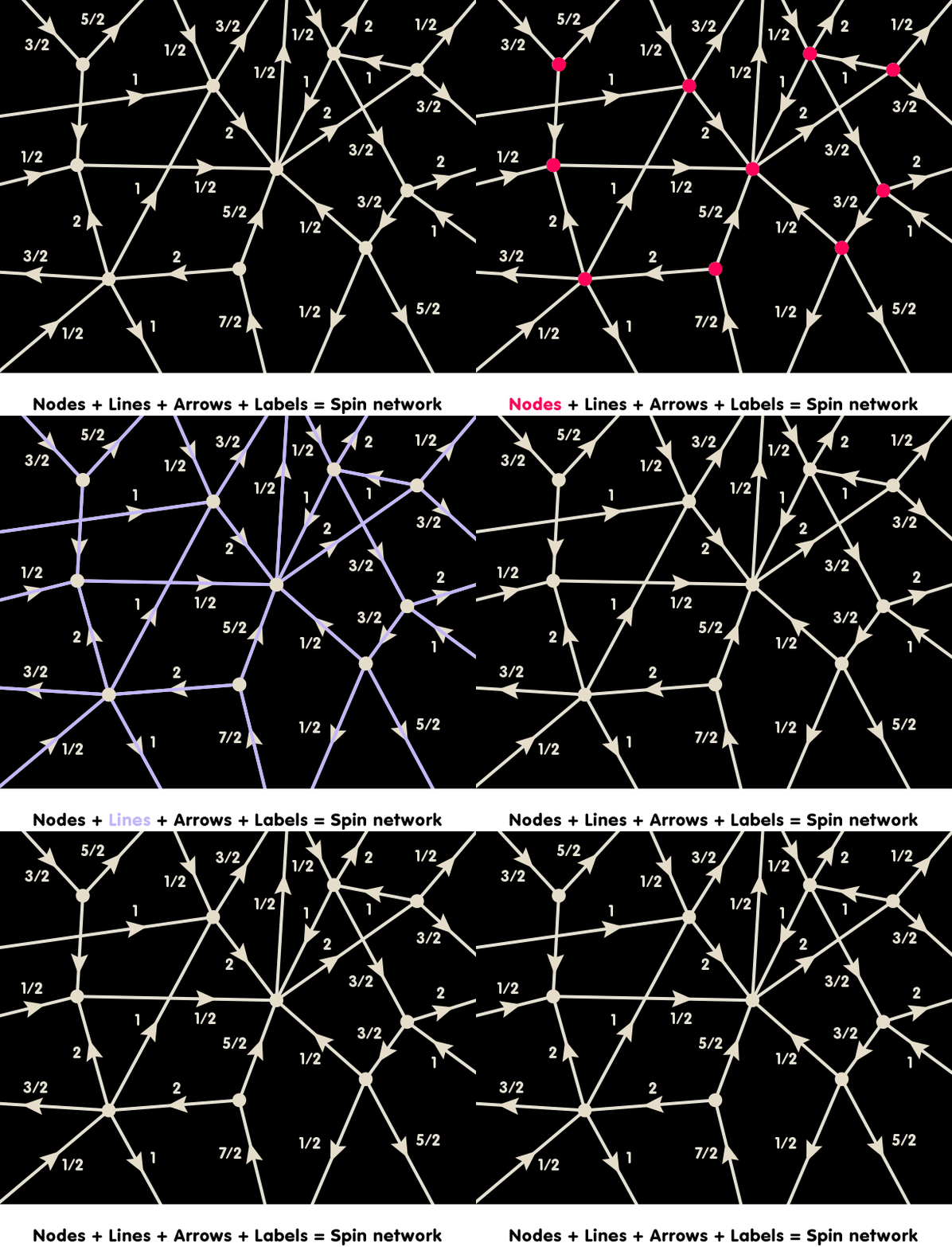
3. The Spin Network Basis
Within this vast Hilbert space, we can choose a particularly useful orthonormal basis: the spin network basis. These states are simultaneous eigenstates of geometric operators like area and volume.
A spin network state is defined by:
- A graph : This defines the relational structure of space—which "chunks" of space are adjacent to which.
- Spins : An irreducible representation of SU(2) (a spin ) is assigned to each link of the graph.
- Intertwiners : An invariant tensor, called an intertwiner, is assigned to each node . It acts as a gauge-invariant way to "glue together" the representations from the links meeting at that node.
Given your background in physics, you can think of this structure in terms of angular momentum addition. If you have several systems with angular momentum (the links), the intertwiner at the node specifies a particular way of combining them to get a total angular momentum of zero (enforcing gauge invariance).
The physical picture that emerges is one of a "granular" or "atomic" space.

This picture of space is not an a priori assumption. It is a direct consequence of the quantization procedure. To see this, we now turn to the geometric operators themselves.
4. Quantized Area and Volume
With the spin network states defined, we can now investigate the action of geometric operators. This is the payoff for all the mathematical setup. We will focus on the Area operator.
The classical flux of the field across a surface is the quantity we promote to an operator. When this operator acts on a spin network state, it is non-zero only where the surface is pierced by the links of the graph. The strength of the operator's action depends on the spin j decorating the link.
Introduction to Loop Quantum Gravity - Lecture 7: Quanta of Space, spin networks and discreteness
The emergence of discrete geometry is a direct result of an eigenvalue calculation, much like finding the discrete energy levels of the hydrogen atom. This technical lecture provides a detailed derivation of the spectrum of the area operator.
Please watch the segment from 15:56 to 34:00. The lecturer performs the eigenvalue calculation for the area operator. Your goal is not to memorize every step, but to understand the logic: He starts with the basis states constructed from Wigner D-matrices (the spin network states). He defines the Area-squared operator, A_l^2, noting that it is simply the Casimir operator of SU(2) acting on the link l. He then finds the eigenvalues of this operator, which are known from the representation theory of SU(2) to be j(j+1). Focus on the final result and its profound physical implication.
As shown in the video, the operator for the area squared, , associated with a single link with spin , is proportional to the Casimir operator of the SU(2) group in the representation . Its eigenvalues are therefore well-known from standard quantum mechanics.
The spectrum of the Area operator for a surface pierced by a set of links with spins is given by:
where is the Planck length, and is a free constant of the theory known as the Barbero-Immirzi parameter.
This result has two immediate, profound consequences:
- Discreteness: The possible values of area are quantized. Any measurement of an area can only yield a value from this discrete set, just as the energy of an atom can only take on discrete values.
- Area Gap: Since the smallest non-zero spin is , there exists a fundamental, minimum possible area, an "atom of area": This provides a natural, physical cutoff at the Planck scale. The infinities arising from operators acting at the same point in the WDW equation are resolved because, in LQG, there is no "same point"—there is a minimum area.
The Volume operator is more complex. It acts on the nodes of the spin network, and its value depends on the intertwiner at that node. Its spectrum is also discrete but requires numerical computation to find the eigenvalues. The physical picture is consistent: each node corresponds to a "chunk" of space with a quantized volume.
Test your understanding!
Imagine a simple spherical surface in a quantum state of geometry described by a spin network. The surface is pierced perpendicularly by three links. Two links are labeled with the lowest possible non-zero spin, , and one link is labeled with spin . What is the total area of this spherical surface? (Express your answer in units of .)
Show answer
The total area is the sum of the areas contributed by each link.
The area for a link with spin is .
For the two links:
.
For the one link:
.
The total area is .
Finally, it's essential to grasp the revolutionary picture of spacetime that LQG provides.
Carlo Rovelli, one of the founders of LQG, provides a beautiful conceptual summary of how spin networks describe quantum spacetime and lead to the quantization of area and volume.
Please watch from 32:19 to 43:57. Pay close attention to two key ideas: How the abstract spin networks, which came from representation theory, emerged in the mid-1990s as the natural basis states (eigenstates) for the area operator in the quantum theory of gravity. The final picture: Spin networks are not objects in space. They are space. There is nothing 'between' the nodes and links. They are the fundamental quanta of the gravitational field, which in turn is the fabric of space.
Conclusion
This lesson marked a significant departure from the continuum picture of the Wheeler-DeWitt equation. By reformulating GR as a gauge theory, Loop Quantum Gravity arrives at a mathematically rigorous and physically compelling picture of a discrete, granular quantum spacetime.
Key Takeaways:
- LQG begins by reformulating classical GR using Ashtekar variables, which describe the theory in the language of an SU(2) gauge theory.
- Quantization of this theory, respecting background independence, leads to a unique Hilbert space where states are supported on graphs.
- The basis states of this Hilbert space are spin networks: graphs with links labeled by spins () and nodes by intertwiners ().
- Spin networks represent the quanta of space. Nodes are quanta of volume, and links are quanta of area.
- Geometric operators, like the Area operator, are well-defined and have a discrete spectrum. The area of any surface is quantized in units of the Planck area, with a minimum non-zero value called the area gap. This provides a natural resolution to the ultraviolet divergences that plague other approaches.
Preview of the Next Lesson:
We have now explored two major, and very different, approaches to quantum gravity rooted in General Relativity: the geometrodynamics of Wheeler and DeWitt, and the gauge-theoretic approach of Loop Quantum Gravity. Both attempt to quantize gravity directly. In our next lesson, we will shift our perspective entirely to explore String Theory. String Theory did not start as a theory of gravity, but as a theory of the strong nuclear force. It posits that fundamental entities are not point particles but one-dimensional "strings," and, to the surprise of its discoverers, it was found to necessarily contain a quantum description of gravity. This will lead us to a very different set of ideas, including extra dimensions and supersymmetry.