Hello! Welcome to the sixth lesson in our module on Advanced Topics in Gravity.
In our previous lesson, we delved into Loop Quantum Gravity. We saw how reformulating General Relativity as a background-independent gauge theory and then quantizing it leads to a granular, discrete picture of spacetime itself, with quantized areas and volumes carried by spin networks. LQG is a "bottom-up" approach, attempting to build a quantum theory of gravity directly from the principles of GR.
Today, we pivot to explore its primary rival: String Theory. String theory's origin story is quite different. It began as an attempt to describe the strong nuclear force and was only later discovered to contain a quantum theory of gravity as an unavoidable consequence. This "top-down" approach, where gravity emerges from a theory of matter, leads to a radically different, and in many ways grander, vision of the cosmos.
This lesson provides a conceptual overview of string theory. Our goal is to understand its foundational premise—that fundamental entities are not point particles but tiny vibrating strings—and to explore two of its most profound and startling consequences: the natural emergence of gravity and the necessity of extra spatial dimensions.
1. The Fundamental Idea: From Worldlines to Worldsheets
Your study of physics, from classical mechanics to quantum field theory, has been built upon the idea of point particles. A particle's history is represented by its path through spacetime, a one-dimensional trajectory called a worldline. The dynamics are governed by an action principle, such as minimizing the proper time along this worldline.
String theory's foundational leap is to replace the point particle with a one-dimensional object, a string. As a string moves through time, it sweeps out a two-dimensional surface called a worldsheet.
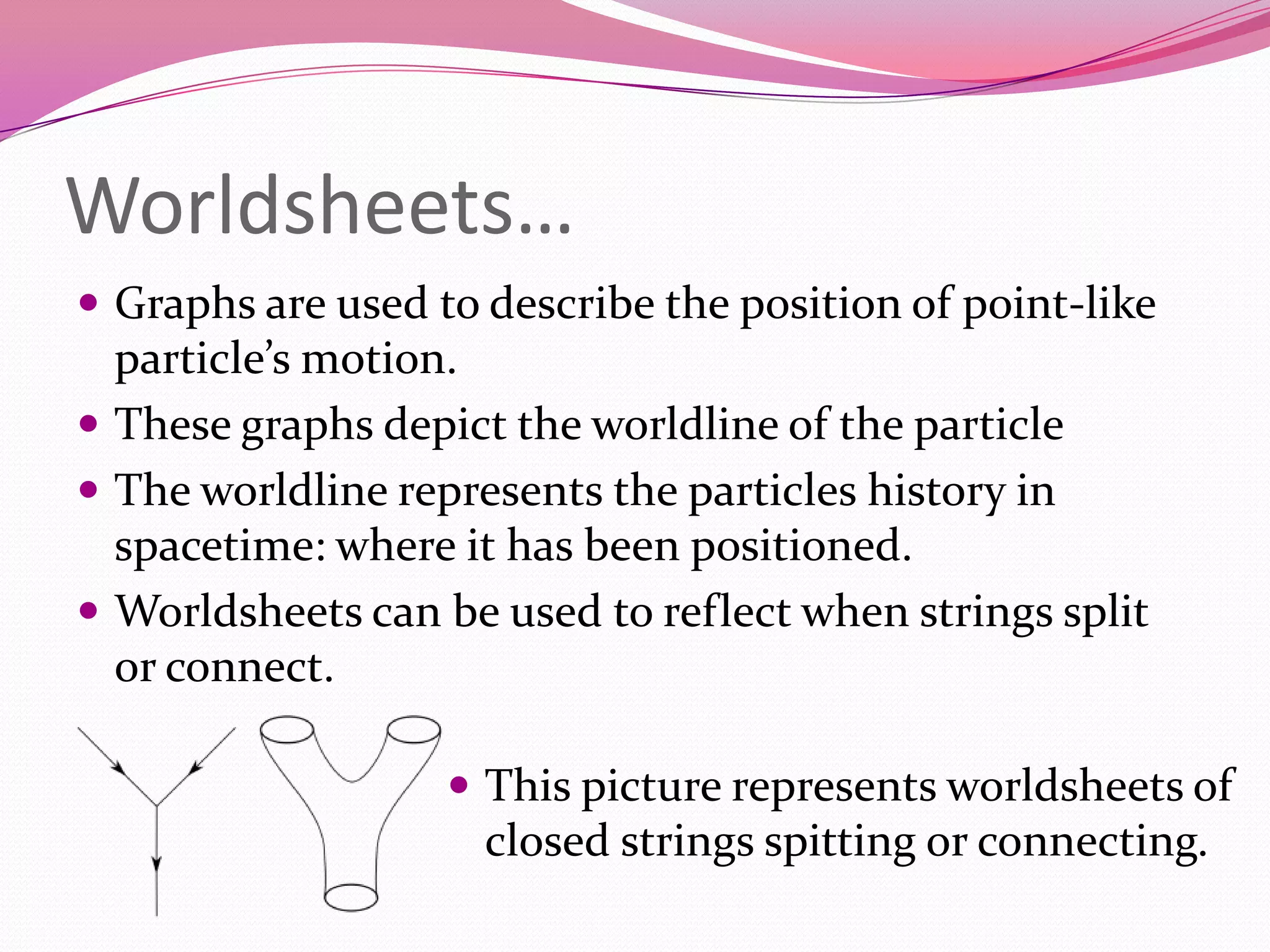
To describe the dynamics of this string, we need an action. In direct analogy to the point particle action being proportional to the length of the worldline, the most natural action for a string is proportional to the area of its worldsheet. This is the Nambu-Goto action. However, much like its point-particle counterpart, this action contains a difficult square root.
A more manageable, but classically equivalent, formulation is the Polyakov action, which introduces an independent metric on the worldsheet itself. This approach makes the symmetries of the theory much clearer and is the standard starting point for quantization.
To get a feel for this transition from particle to string dynamics, the following lecture segment provides an excellent, rigorous overview.
Neil Lambert - Introduction to String Theory, Part 1
Professor Neil Lambert's 'Introduction to String Theory' provides a masterful recap of the point particle action and its generalization to strings. This will connect directly with your background in Lagrangian mechanics.
Please watch the lecture from 07:03 to 1:12:00. This covers two main topics: The Point Particle (07:03 - 55:52): Pay close attention to how the reparameterization-invariant action is formulated and then replaced by the more tractable Polyakov-like ('How-Tucker') action with an auxiliary field. Notice how quantization leads to the Klein-Gordon equation as a constraint. The String (55:52 - 1:12:00): See how the exact same logic is applied to the string. The Nambu-Goto action (minimizing area) is introduced and then replaced by the Polyakov action with a worldsheet metric γ_αβ. Focus on understanding the symmetries he discusses: Poincaré, reparameterization (diffeomorphism), and the crucial Weyl (conformal) invariance that arises in 2D.
The key takeaway is that the string is described by a 2D quantum field theory on its worldsheet. The fields of this theory are the spacetime coordinates of the string, .
2. How Gravity Emerges: A Symphony of Strings
The next step is to quantize this 2D field theory. The procedure is analogous to quantizing the simple harmonic oscillator: you find the normal modes of vibration. For a string, these vibrational modes have a profound physical meaning.
Each vibrational mode of the string corresponds to an elementary particle.
A string vibrating in one pattern might appear to us as an electron. The same string, vibrating in a different pattern, would appear as a photon, or a quark. All the particles we know (and many we don't) are proposed to be merely different "notes" played by the same fundamental string.
This is where the magic happens. When we analyze the spectrum of a closed string (a loop), we find a particular set of vibrational modes. Among the massless modes, there is one with the following properties:
- It is a spin-2 particle.
- It is massless.
- It interacts in a way consistent with the principle of equivalence.
A fundamental theorem of physics states that any consistent, interacting theory of a massless spin-2 particle must, at low energies, be indistinguishable from Einstein's General Relativity. This particle is the graviton, the quantum of the gravitational field.
This is arguably the most stunning feature of string theory: gravity is not an input; it is a prediction. By simply postulating the existence of a relativistic string, the theory requires the existence of gravity.
Similarly, the massless modes of open strings (which have endpoints) correspond to spin-1 particles, the carriers of gauge forces like electromagnetism. Thus, string theory naturally incorporates both gravity and the gauge theories of the Standard Model in a single framework.
The Critical Dimension
This unification comes at a price. During quantization, a deep mathematical consistency requirement appears. To prevent the theory from having "ghosts" (states with negative probability, which would render it physically meaningless), the number of spacetime dimensions is fixed.
- For the initial bosonic string theory (containing only force-carrying particles), the spacetime must have D=26 dimensions.
- For superstring theory (which introduces supersymmetry to include fermions like electrons and quarks), the spacetime must have D=10 dimensions.
The bosonic string theory is also plagued by a state with imaginary mass, a tachyon, which signals an instability of the vacuum. Superstring theories are free of this problem and are therefore the primary focus of research. Our universe, according to string theory, is fundamentally ten-dimensional (9 space + 1 time).
3. Hiding the Extra Dimensions
This immediately raises a critical question: If the universe is 10-dimensional, why do we only perceive 3 spatial dimensions?
The answer proposed by string theory is compactification. The idea is that the extra six spatial dimensions are curled up into a tiny, compact space, too small to be seen in everyday life or even in our most powerful experiments.
Here Is Why Extra Dimensions ACTUALLY Make Sense
The concept of compact dimensions and their consequences for physics is explained brilliantly in the following video.
Please watch the segment from 00:00 to 22:14. It's divided into three key parts: The Concept (00:00 - 06:58): This introduces the idea of a compact dimension using the analogy of a line being curled into a circle, and a plane into a cylinder or torus. Quantum Mechanics on a Compact Dimension (06:58 - 17:34): This is the crucial physical argument. You'll see how imposing periodic boundary conditions on a quantum wavefunction quantizes the momentum in the compact direction. Critically, the energy spacing is inversely proportional to the size of the dimension (E \propto 1/R^2). Why They're Hidden (17:34 - 22:14): This puts it all together. If the compact dimension's radius R is extremely small, the energy required to excite any motion in that dimension is enormous. At low energies, these modes are 'frozen out', and the world appears to have fewer dimensions.
The tower of quantized energy states arising from a compact dimension is known as a Kaluza-Klein tower. The existence of these states is a generic prediction of any theory with extra dimensions.
T-Duality: A Uniquely Stringy Idea
For point particles, a smaller dimension is always harder to probe. For strings, the situation is more subtle and leads to a remarkable new symmetry of nature called T-duality.
A closed string in a compact dimension can store energy in two ways:
- Momentum Modes: The string can move around the compact dimension, just like a particle. As we saw, this momentum is quantized in units of . The energy contribution is .
- Winding Modes: The string can physically wrap around the compact dimension. To do this, it must stretch, and since the string has tension, this costs energy. The energy contribution is proportional to the length, so , where is the integer winding number.
The total mass-squared of a string state includes both contributions:
Notice the striking symmetry in this formula. If we perform the transformation:
where is the fundamental length-squared scale of the string, the mass spectrum remains identical!
This is T-duality. It implies that a string theory in a universe with a very small compact dimension of radius is physically indistinguishable from a theory with a very large compact dimension of radius . This leads to the concept of a minimum length scale in physics; from the perspective of a string, trying to probe distances smaller than the string length is equivalent to probing large distances.
Test your understanding!
Consider two separate universes, both described by the same superstring theory in D=10.
- Universe A has one spatial dimension compactified into a circle of radius .
- Universe B has one spatial dimension compactified into a circle of radius .
An observer in Universe A finds a string state with momentum number and winding number . What are the quantum numbers () of the corresponding state in Universe B that has the exact same mass?
Show answer
T-duality relates the two universes since . The duality transformation swaps the momentum and winding numbers. Therefore, the state in Universe B with the same mass will have a momentum number and a winding number .
The state in Universe A is a pure momentum mode, moving rapidly around a tiny circle. The state in Universe B is a pure winding mode, wrapped twice around a large circle. T-duality asserts that these two physically distinct situations are described by the same mass and are, in a deep sense, equivalent.
4. The Shape of Inner Space
In superstring theory, we must compactify six spatial dimensions. The geometry of this 6D "inner space" is not arbitrary. For the resulting 4D theory to have desirable properties (like a minimal amount of supersymmetry, as observed in nature), this compact space must satisfy stringent mathematical conditions. The primary candidates for these spaces are known as Calabi-Yau manifolds.
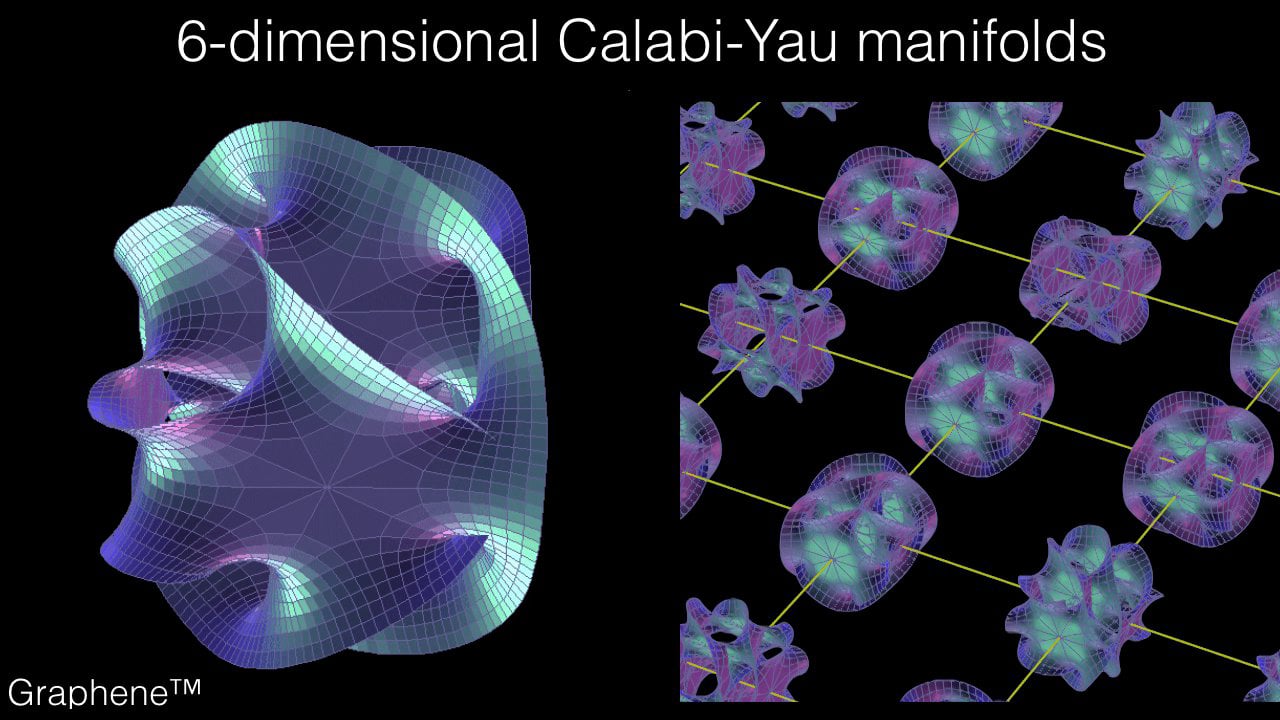
The geometry of the Calabi-Yau manifold dictates the physics of the 4D world we experience. The number of "holes" in the manifold determines the number of families of particles. The way strings can wrap around its cycles determines the particle masses and charges. In a very real sense, the laws of physics are a reflection of the geometry of these hidden dimensions.
This leads to both the greatest promise and the greatest challenge of string theory.
- The Promise: A unified description where all of physics emerges from the geometry of a single, unified object.
- The Challenge: It turns out there is not one, but an enormous number (perhaps or more) of possible Calabi-Yau manifolds and related constructions that satisfy the consistency conditions. Each one corresponds to a different universe with different physical laws. This vast array of possibilities is called the String Landscape. Understanding if there is a principle that selects our specific universe from this landscape is one of the biggest open questions in theoretical physics.
Conclusion
In this lesson, we took our first steps into the world of string theory, a framework that proposes a profound shift in our understanding of reality.
Key Takeaways:
- Fundamental Objects: String theory replaces point particles with one-dimensional, vibrating strings. The dynamics of a string are described by a 2D quantum field theory on its worldsheet.
- Emergent Physics: The different vibrational modes of a string correspond to the different elementary particles. Crucially, the graviton appears as a natural vibration of the closed string, meaning gravity is a necessary consequence of the theory.
- Extra Dimensions: The quantum consistency of string theory requires spacetime to be 10-dimensional (for superstrings). The six extra spatial dimensions are thought to be compactified into a tiny space, invisible at low energies.
- Geometry is Destiny: The specific geometry of the extra dimensions (a Calabi-Yau manifold) determines the spectrum of particles and forces observed in our 4D world.
- T-Duality: A new symmetry, unique to string theory, relates physics on small and large compact dimensions, implying a minimum effective length scale in the universe.
Preview of the Next Lesson:
Having explored the foundational concepts of string theory, we will next delve into one of its most important and concrete results: the AdS/CFT correspondence. This remarkable duality, also known as the holographic principle, proposes a precise equivalence between a theory of gravity in a certain spacetime (Anti-de Sitter space) and a quantum field theory without gravity living on its boundary. It is our most powerful tool for understanding quantum gravity and has had a revolutionary impact on many areas of physics.