Hello! Welcome back to our exploration of General Relativity's deep structure.
In our previous lesson, we recast Einstein's theory into the language of Hamiltonian mechanics using the ADM formalism. We found that GR is a constrained system, with the dynamics governed by the Hamiltonian constraint () and the momentum constraint (). These constraints are not evolution equations; they are conditions that the state of the gravitational field (the 3-metric and its conjugate momentum ) must satisfy on any given slice of spacetime.
Today, we take a momentous and challenging step from the classical to the quantum realm. Our goal is to formulate the Wheeler-DeWitt equation, a candidate equation for a quantum theory of gravity. We will do this by applying the rules of canonical quantization to the constrained Hamiltonian system we just constructed. This process will force us to think about concepts like the "wavefunction of the universe" and will confront us with one of the most profound conceptual puzzles in physics: the problem of time.
1. From Classical to Quantum Constraints
The path from a classical Hamiltonian system to a quantum one is, in principle, a well-trodden recipe known as canonical quantization. When the system has constraints, as GR does, we follow a procedure developed by Paul Dirac:
- Promote classical variables to operators. The classical phase space variables (like position and momentum ) become operators (, ) that obey commutation relations reflecting their classical Poisson brackets, e.g., .
- Define a state space. The operators act on state vectors (wavefunctions) that live in a Hilbert space. The wavefunctions are functions over the classical configuration space.
- Impose constraints as operator equations. The classical constraint equations, like , are promoted to operator equations that select the physical states from the larger Hilbert space: .
Let's apply this recipe to General Relativity.
- Our "position" variable is the 3-metric .
- Our "momentum" variable is its conjugate, .
This means our quantum state will not be a function of a finite number of coordinates, but a functional of the entire 3-metric, written as . This object is the celebrated wavefunction of the universe. It assigns a quantum amplitude to each possible spatial geometry.
But what is the space of all possible spatial geometries? This is the configuration space of GR, a concept that John Wheeler termed Superspace.
The Superspace of geometrodynamics
Before we can define the wave function, we must understand its domain. In General Relativity, the configuration variable is the geometry of space itself. The arena for quantum geometrodynamics is the space of all possible 3-geometries, known as 'Superspace'. The paper 'The Superspace of geometrodynamics' by Domenico Giulini provides a rigorous introduction.
Please read the 'Introduction' and Section 2, 'Defining Superspace'. Focus on understanding Superspace, S(Σ), as the space of Riemannian metrics on a 3-manifold Σ, modulo diffeomorphisms (S(Σ) := Riem(Σ)/Diff(Σ)). This infinite-dimensional manifold is the domain of the wave function of the universe.
2. The Quantum Constraints of Gravity
With the concept of the state functional on Superspace, we can now translate the classical constraints into quantum operator equations. We make the following operator assignments in the "metric representation," analogous to the position representation in quantum mechanics:
- The metric operator acts by multiplication: .
- The momentum operator acts as a functional derivative: . (We'll set from now on).
The video below by Prof. Renate Loll provides an excellent, clear walk-through of this quantization procedure and its immediate consequences.
The Wheeler-DeWitt Equation - Renate Loll
Professor Renate Loll provides a concise overview of the canonical quantization of gravity. This video will guide us through the steps of promoting classical variables to operators and imposing the momentum and Hamiltonian constraints.
Watch the video from the beginning until 16:40. Pay close attention to: The four steps of the Dirac quantization program for gravity (0:04 - 4:43). How the classical momentum and Hamiltonian constraints are turned into quantum operator equations acting on the wave functional Ψ (8:09 - 11:25). The geometric interpretation of the momentum constraint: it ensures the wave functional is invariant under spatial coordinate transformations, meaning it is truly a function on Superspace (11:25 - 16:40).
As explained in the video, applying this quantization procedure to the two classical constraints yields two sets of quantum equations.
1. The Quantum Momentum Constraint:
The classical momentum constraint, , becomes:
This equation has a beautiful geometric interpretation: it ensures that is invariant under infinitesimal diffeomorphisms of the spatial slice . In other words, the value of the wave functional depends only on the intrinsic geometry of space, not on the particular coordinates used to describe it. This formally establishes as a function on Superspace.
2. The Wheeler-DeWitt Equation:
The classical Hamiltonian constraint (in vacuum) is:
Here, is a tensor on Superspace known as the Wheeler-DeWitt metric. It defines a "distance" between different 3-geometries.
Promoting this to a quantum equation gives us the famous Wheeler-DeWitt Equation:
This is the central result of our lesson. It's a functional differential equation on the space of all 3-geometries. It resembles a time-independent Schrödinger equation, , where:
- The "kinetic energy" term involves second derivatives with respect to the "coordinates" .
- The "potential energy" term involves the intrinsic curvature of space, .
- The total "energy" is zero.
The Lorentzian signature of the Wheeler-DeWitt metric makes this a hyperbolic differential equation, akin to a wave equation, rather than an elliptic one like the Schrödinger equation for a bound state.
3. The Mountain of Problems
The Wheeler-DeWitt equation is a profound and compelling idea, but it is not a complete theory. In fact, it is fraught with severe difficulties that have occupied physicists for decades.
The Wheeler-DeWitt Equation - Renate Loll
As formidable as the Wheeler-DeWitt equation appears, its formulation is plagued by deep technical and conceptual issues. These problems are not minor details; they strike at the heart of what a quantum theory of gravity should be. Prof. Loll discusses these challenges, which represent the major roadblocks in this approach.
Please watch the remaining key segments from 4:43 to 8:09, 16:40 to 23:07, and 24:06 to 29:27. Focus on: Fundamental Issues (4:43-8:09): The problems with operator spectra, the lack of a mathematical measure on Superspace needed to define a Hilbert space, and the operator ordering ambiguity. Problems with the WDW Equation (16:40-23:07): Why the double functional derivative is ill-defined (a 'product of operators at the same point'), the need for regularization, and the fact that we don't know how to solve the equation in its full generality. The Problem of Time (24:06-29:27): Understand why the equation \hat{\mathcal{H}}\Psi=0 implies a 'frozen' universe where the wave function does not evolve with respect to an external time parameter.
Let's summarize these critical issues.
Technical Problems
- Operator Ordering: The classical product becomes a product of non-commuting derivative operators. The expression also depends on , so the order in which we write the operators fundamentally changes the equation. There is no unique, compelling choice.
- Mathematical Rigor: The second functional derivative is taken at the same spacetime point, leading to infinities. The equation requires a process of regularization and renormalization that is not well understood in this context.
- The Hilbert Space: We don't have a natural definition of an inner product on the space of functionals . Without one, we cannot normalize wavefunctions or compute probabilities, which are central tenets of quantum theory.
The Conceptual Catastrophe: The Problem of Time
The most striking feature of the Wheeler-DeWitt equation is the absence of time. Unlike the Schrödinger equation, , there is no time derivative. The equation is simply . This implies that the wavefunction of the universe is static, or "frozen."
This is the problem of time. If the fundamental state of the universe does not evolve, how do we reconcile this with the dynamic, evolving universe we observe? How can change and motion be recovered from this timeless picture? This remains one of the deepest unresolved questions in fundamental physics.
Test your understanding!
The Wheeler-DeWitt equation is often written schematically as (∇² - V)Ψ = 0, where ∇² is a "Laplacian" on Superspace and V is a "potential" related to spatial curvature. How does this compare to the Klein-Gordon equation for a scalar field, (∂²/∂t² - ∇² + m²)φ = 0? What might this analogy suggest about the nature of the Wheeler-DeWitt equation?
Show answer
The analogy is quite direct. Both are second-order hyperbolic differential equations. The Wheeler-DeWitt equation resembles a Klein-Gordon equation on the infinite-dimensional Superspace, where one of the "directions" in Superspace plays the role of a time-like variable. Specifically, the conformal mode of the metric (related to the overall volume of space) often acts as this intrinsic time. The Klein-Gordon equation describes relativistic fields, and its solutions are not interpreted as single-particle probability densities like in the Schrödinger equation. This suggests that might be better understood as a "third-quantized" field on Superspace, rather than a simple wavefunction, but this path also has its own set of difficulties.
4. Minisuperspace: A Toy Model
Given the overwhelming complexity of the full Wheeler-DeWitt equation, a common strategy is to study simplified "toy models" called minisuperspace models. In this approach, one freezes almost all of the infinite degrees of freedom of the gravitational field, leaving only a few.
For example, in a homogeneous and isotropic FRW universe, the only gravitational degree of freedom is the scale factor, . Superspace, the infinite-dimensional space of all 3-geometries, collapses to a one-dimensional "minisuperspace" parametrized by .
The Wheeler-DeWitt equation then becomes an ordinary differential equation for a wave function , which is much easier to solve and interpret.
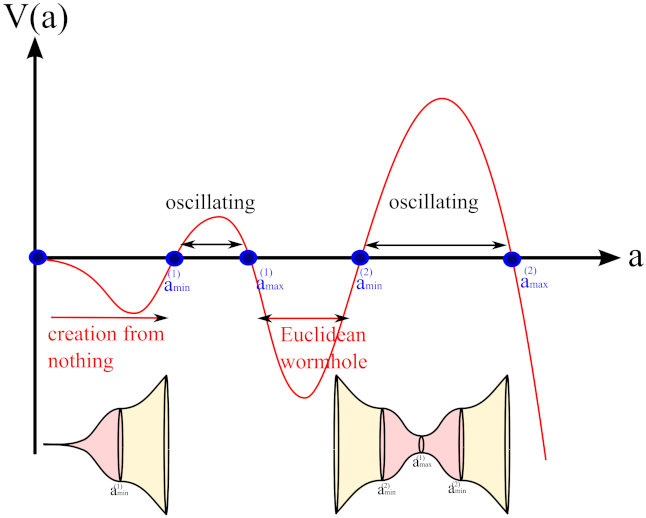
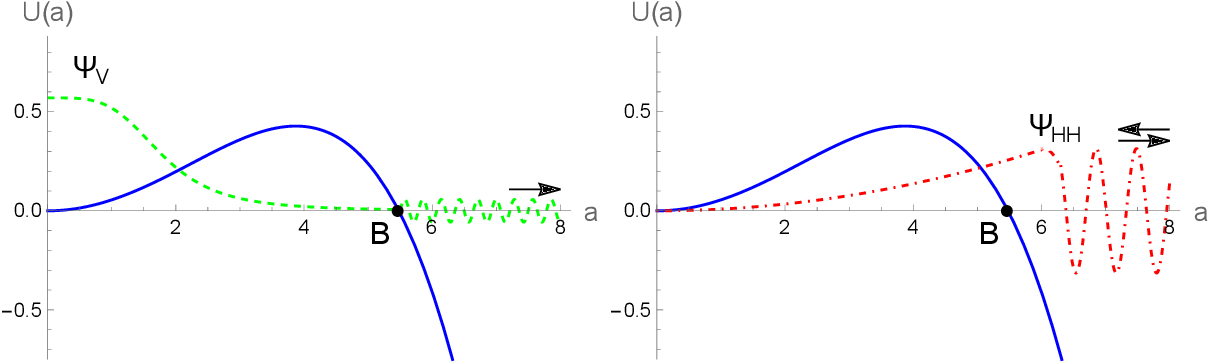
These minisuperspace models have been a fertile ground for exploring conceptual questions in quantum cosmology, such as the origin of the universe (e.g., the "no-boundary proposal" of Hartle and Hawking, or Vilenkin's "tunneling from nothing" scenario).
Conclusion
In this lesson, we have ascended to one of the highest peaks of theoretical physics, formulating the Wheeler-DeWitt equation as the result of applying canonical quantization to General Relativity.
Key Takeaways:
- Canonical quantization of GR leads to a wavefunction of the universe, , which is a functional on Superspace—the space of all possible 3-geometries.
- The quantum momentum constraint ensures that the wavefunction is independent of spatial coordinates.
- The quantum Hamiltonian constraint is the Wheeler-DeWitt equation. It is a second-order functional differential equation on Superspace that does not contain an external time parameter.
- The equation is beset by severe technical problems (operator ordering, regularization, Hilbert space measure) and a profound conceptual problem (the problem of time).
- Minisuperspace models, where most degrees of freedom are frozen, provide a simplified arena to explore the physical and philosophical implications of the equation, such as the quantum origin of the universe.
Preview of the Next Lesson:
The Wheeler-DeWitt equation, also known as "geometrodynamics," is one major path toward quantizing gravity, but its difficulties have motivated other approaches. In our next lesson, we will introduce the basics of Loop Quantum Gravity (LQG). LQG also starts from the Hamiltonian formulation of GR, but it uses a different set of classical variables (Ashtekar variables) which cast GR in a language closer to a gauge theory. This leads to a different quantization procedure that elegantly solves some of the problems that plague the Wheeler-DeWitt approach and results in a fascinating picture of a discrete, quantized spacetime.