Hello! Welcome back to our course on General Relativity.
In our last lesson, we took a crucial step by introducing the metric tensor . This endowed our manifold with a geometric structure, allowing us to measure lengths and angles and to define the causal structure of spacetime. However, the picture we have is still static. Physics is about dynamics, so we need a way to describe how tensor fields change from one point to another.
Today, we introduce our first tool for differentiating tensor fields: the Lie derivative. This concept answers the question: "How does a tensor field change as it is dragged along the flow of another vector field?" It provides a notion of differentiation that is intrinsic to the manifold's smooth structure, completely independent of any metric. This is a profound idea that distinguishes it from the metric-dependent derivative we will encounter later.
Our learning outcome for this lesson is to define the Lie derivative of a tensor field with respect to a vector field. We will explore this concept from three angles that cater to your preference for both rigorous mathematics and deep physical intuition:
- The intuitive idea of "Lie dragging" fields along flows.
- The formal limit-based definition.
- The powerful equivalence with the Lie bracket and its geometric interpretation.
1. The Intuition: Flows and Lie Dragging
Imagine a fluid flowing on the surface of our manifold. The velocity of the fluid at each point defines a vector field, let's call it . The path a small particle follows in this fluid is an integral curve of . The collection of all these integral curves defines the flow of the vector field, which we can represent by a one-parameter family of diffeomorphisms, . For a given time , the map takes every point on the manifold and moves it to the point by following the integral curve of for a parameter distance .
Now, suppose there is another field on the manifold, say a temperature field (a scalar field) or an electric field (a vector field). How does this second field change from the perspective of an observer being carried along by the flow of ? To answer this, we need a way to compare the field at point with the field at the nearby point . But these fields live in different tangent spaces.
The solution is to "drag" the field from back to using the inverse flow map, . This process is called Lie dragging. Once we have dragged the field back to the original point , we can compare it to the original field at and see how it has changed.
The following text formalizes this idea of "dragging" objects—points, functions, and vector fields—along the flow of a vector field. This is the essential machinery for defining the Lie derivative.
A Self-Contained Introduction to Lie Derivatives
This reading from 'A Self-Contained Introduction to Lie Derivatives' introduces the concept of Lie dragging. It formally defines how to transport, or 'drag,' various objects on a manifold using the flow of a vector field. This is the core intuitive and mechanical basis for the Lie derivative.
Please read Section 7.1, 'Dragging' (pages 30-33). Pay close attention to: How a point m is dragged to e^X_t(m) (their e^X_t is our φ_t). How a function f is dragged: f ∘ e^X_{-t} (note the inverse map, this is a pullback). How a vector field Y is dragged: d(e^X_t) ∘ Y ∘ e^X_{-t}. Understand that d(e^X_t) is the pushforward map, which transports vectors between tangent spaces.
2. The Formal Definition of the Lie Derivative
With the concept of Lie dragging established, the formal definition of the Lie derivative becomes a natural extension of the standard definition of a derivative from calculus. We want to find the rate of change of a tensor field. We do this by dragging the field at a nearby point back to , finding the difference from the original field at , dividing by the parameter , and taking the limit as .
Definition: The Lie Derivative
The Lie derivative of a tensor field with respect to a vector field is the tensor field defined by:
Here, denotes the pullback of the tensor field by the flow map . A more explicit way to write this for a vector field is:
where is the pushforward map that does the "dragging" from back to .
Let's see this definition in action, starting with the simplest case.
A Self-Contained Introduction to Lie Derivatives
The same resource now applies the 'dragging' concept to construct the formal limit definition of the Lie derivative. It also shows a crucial first result: for a scalar function, the Lie derivative is simply the directional derivative.
Read Section 7.2 'The Idea' and Section 7.3 'The Definition' (pages 33-34). Note how the general idea of (backdragged - original) / amount leads to the formal limit definition. Work through the calculation for a scalar function f to see that £_X f = X(f).
The result is very satisfying. It confirms that the Lie derivative is a sensible generalization of the directional derivative you already know. The vector field , which we defined as a derivation on functions, is precisely the Lie derivative operator for scalar fields.
3. The Lie Bracket: A Geometric and Computational Shortcut
While the limit definition is conceptually fundamental, it is cumbersome for calculations. Fortunately, for vector fields, there is a remarkably simple and powerful equivalent formulation.
Theorem: The Lie derivative of a vector field with respect to a vector field is their Lie bracket (or commutator):
Since vector fields are differential operators, means "first apply , then apply ". This expression makes it clear that is also a vector field.
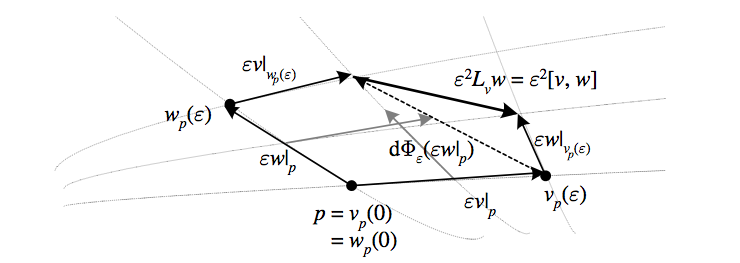
Geometric Interpretation of the Lie Bracket
The Lie bracket has a beautiful geometric meaning. It measures the failure of infinitesimal flows to commute. Imagine starting at a point and trying to trace out an infinitesimal parallelogram.
- Flow along by .
- Then, flow along by .
Now, compare this to the path where you flow in the opposite order:
- Flow along by .
- Then, flow along by .
If you end up at the same point, the flows commute, and . If you don't, the vector connecting the two endpoints is proportional to .
Proving the Equivalence
Connecting the intuitive limit definition to the elegant Lie bracket formula is a cornerstone of understanding the Lie derivative. Given your interest in formal proofs, the following reading provides a detailed derivation.
A Self-Contained Introduction to Lie Derivatives
The following section provides a rigorous proof that the Lie derivative of a vector field is equivalent to the Lie bracket. The proof starts from the limit definition of the Lie derivative and carefully applies the chain rule to the flows.
Read Section 7.6.1 'Proof That £XY = [X, Y]' (pages 37-39). The proof is notationally dense but conceptually straightforward. It boils down to expressing both £_X Y and [X, Y] as second-order partial derivatives of a function composed with the flows (f ∘ e^Y_u ∘ e^X_t) and showing they are equal.
4. Generalization and Component Formulas
The Lie derivative can be defined for any tensor field. The principle remains the same: use the flow to drag the tensor and its arguments back to the starting point.
- For a (0,1) tensor (a one-form) , its Lie derivative is defined such that for any vector field :
This is a direct consequence of the Leibniz rule, , applied to the scalar .
The following video provides a clear derivation of the component formulas for the Lie derivatives of scalar fields, vector fields, and one-forms.
Intro to General Relativity - 18 - Differential geometry: Pull-back, Push-forward and Lie Derivative
This video from the 'Intro to General Relativity' series by Barrio RQI provides clear, step-by-step derivations of the component formulas for Lie derivatives. It uses a clever algebraic trick based on the Leibniz rule to derive the formulas for vectors and one-forms.
Please watch the following segments: Scalar Field (24:07 - 26:15): A quick derivation showing L_V f = V(f) = V^μ ∂_μ f. Vector Field (26:15 - 31:47): Follow the derivation showing that (L_V W)^μ = V^ν ∂_ν W^μ - W^ν ∂_ν V^μ, which are precisely the components of the Lie bracket [V,W]. One-Form (31:47 - 36:14): See the analogous derivation for a one-form, resulting in the component formula (L_V ω)_μ = V^ν ∂_ν ω_μ + ω_ν ∂_μ V^ν.
For a general tensor , the component formula can be constructed by applying the Leibniz rule. For example, for a tensor with components , the Lie derivative has components:
Notice the pattern:
- The first term is the directional derivative of the tensor's components along .
- Then, there is a "correction" term for each index. It involves the derivative of the vector field and the tensor components. A contravariant index gets a minus sign, and a covariant index gets a plus sign.
Test your understanding!
Let's work in with Cartesian coordinates . Consider two vector fields:
- (a uniform flow to the right)
- (a shear flow, moving up faster for larger )
Calculate the Lie derivative . What does the result tell you about how the vector field changes as you move along the flow of ?
Show answer
We use the Lie bracket formula: .
To see what this operator does, let's have it act on an arbitrary smooth function .
First, calculate :
Using the product rule for differentiation:
Next, calculate :
Since partial derivatives commute for smooth functions, . So, .
Now, subtract the two:
Since this must hold for any function , we can identify the resulting operator:
Interpretation: The result, , is a constant vector field pointing straight up. This means that as you are "dragged" to the right by the flow of , the vector field appears to change. Specifically, the difference between the actual vector at the new point and the "dragged" version of from the old point is a vector pointing in the -direction. This makes intuitive sense: because , its magnitude increases as increases. So moving from to (the flow of ) increases the magnitude of , and this change manifests as the vector .
Conclusion
In this lesson, we have developed a powerful and intuitive notion of differentiation on a manifold that requires no extra structure like a metric.
Key Takeaways:
- The Lie derivative measures the change of a tensor field along the flow of a vector field .
- It is conceptually defined by "dragging" the tensor field from a nearby point back to the original point and taking a limit.
- For vector fields, the Lie derivative is equivalent to the Lie bracket, , which geometrically measures the failure of their flows to commute.
- The Lie derivative obeys the Leibniz rule and can be applied to any tensor field, with component formulas that follow a consistent pattern.
- Crucially, this entire construction is metric-independent. It relies only on the differentiable structure of the manifold.
We now have one way to differentiate tensors. However, the Lie derivative has a limitation for physics: the Lie derivative of a tensor of type is another tensor of type . It doesn't allow for the kinds of derivatives you're familiar with from vector calculus, like gradient (), divergence (), or curl. For that, we need a different kind of derivative.
In our next lesson, we will explore differential forms and the exterior derivative. The exterior derivative is another metric-independent derivative, but one that specifically acts on a special class of antisymmetric tensors called differential forms. It naturally generalizes the gradient, curl, and divergence operations into a unified framework.