Welcome to the fifth lesson in our foundational module on differential geometry.
In our previous lesson, we generalized our framework of vectors and covectors to define a general (r,s) tensor as a multilinear map. We established that these tensors live in tensor product spaces and can be represented by components in a chosen basis. However, our manifold is still just a "floppy" space; the tangent spaces are abstract vector spaces with no inherent notion of length, distance, or angle. We have the language of tensors, but no geometry to apply it to.
Today, we introduce the single most important tensor in General Relativity: the metric tensor, . This is the mathematical object that endows spacetime with a definite geometric structure. It is the "ruler" we were missing.
Our learning outcome is to define the metric tensor and its signature, and use it to raise and lower indices. We will:
- Formally define the metric tensor as a symmetric, non-degenerate (0,2) tensor field.
- Discuss the metric's signature and how it distinguishes between the geometry of space (Riemannian) and spacetime (Lorentzian).
- Explore the primary algebraic function of the metric: to provide a natural isomorphism between vectors and covectors, which is realized through the operations of raising and lowering indices.
1. The Metric Tensor: An Inner Product on Tangent Space
The metric tensor provides a way to compute an inner product (a generalization of the dot product) between any two vectors in the same tangent space . Since this structure is defined smoothly across the entire manifold, it gives us a way to measure lengths and angles everywhere.
Definition: The Metric Tensor
A metric tensor on a manifold is a smooth tensor field of type (0,2) that is:
- Symmetric: For any two vector fields , .
- Non-degenerate: If for all at a point , then it must be that .
The non-degeneracy condition is crucial; it ensures that the metric is a faithful "measuring device" and that no non-zero vector has zero "length" with respect to every other vector (with an important exception for null vectors in a Lorentzian metric, which we'll see shortly).
The following resource gives a crisp, formal definition of the metric and its properties.
Differential and Riemannian Geometry for General Relativity
This section from 'Differential and Riemannian Geometry for General Relativity' provides the formal definition of the metric as a symmetric, non-degenerate (0,2) tensor field, which is the foundational starting point for this lesson.
Read the first part of Section 2.2, 'Metric', up to (but not including) the subsection 'Raising and Lowering of Indices' (pages 19-20). Focus on the formal definition and the component expression for the metric.
In a coordinate basis for and for , the metric tensor can be written as:
where the components are given by evaluating the metric on the basis vectors:
The symmetry of implies that the matrix of components is symmetric: .
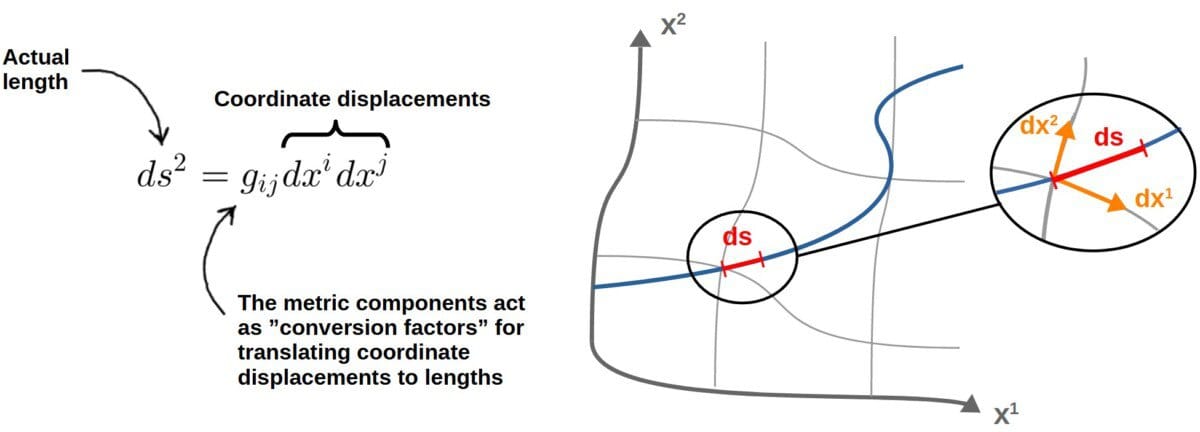
The most fundamental physical interpretation of the metric is its role in defining the infinitesimal distance or line element, . For an infinitesimal displacement vector , the squared length is:
This equation is the heart of metric geometry. It tells us how to convert abstract coordinate displacements into a physical, invariant length.
2. Metric Signature and Spacetime Structure
Because the metric components form a real, symmetric matrix at each point , it can be diagonalized. The non-degeneracy condition ensures that none of the eigenvalues are zero. The signature of the metric is the count of positive and negative eigenvalues. This signature is constant across a connected manifold.
The signature defines the fundamental character of the geometry:
- Riemannian Metric: The signature is . All eigenvalues are positive. This metric is positive-definite: for any non-zero vector . This is the geometry of ordinary curved spaces.
- Lorentzian Metric: The signature has one negative sign and the rest positive. For the 4-dimensional spacetime of General Relativity, we will use the convention . This is the geometry of spacetime.
The Lorentzian signature is what distinguishes spacetime from space. It partitions the tangent space at every point into three distinct types of vectors based on their "norm," :
- Timelike vectors: . These represent the worldlines of massive particles, which travel slower than light. The set of all timelike vectors forms the interior of the light cone.
- Null (or Lightlike) vectors: . These represent the paths of massless particles, like photons, traveling at the speed of light. They form the boundary of the light cone. Note that for a null vector , , but its norm is zero. This is possible because the metric is not positive-definite.
- Spacelike vectors: . These represent spatial separation. Events separated by a spacelike interval cannot be causally connected. They lie outside the light cone.
The following reading elaborates on this crucial concept, formally distinguishing Riemannian and Lorentzian manifolds.
The following text from N.P. Landsman's lecture notes introduces the concept of metric signature with mathematical precision, making the clear distinction between Riemannian and Lorentzian manifolds that is essential for General Relativity.
Read the first page of Chapter 3 (page 47). Pay close attention to the definitions of Riemannian and Lorentzian metrics based on their signature. Note the introduction of the Minkowski metric (\eta_{\mu u}) as the simplest example of a Lorentzian metric.
3. Raising and Lowering Indices: The Musical Isomorphisms
So far, we have viewed the tangent space (home of vectors) and the cotangent space (home of covectors) as separate entities. The metric tensor provides a canonical, basis-independent isomorphism between them. This allows us to treat a vector as a covector and vice-versa. This mechanism is called raising and lowering indices.
Why is this important? It gives us a way to uniquely pair vectors and covectors. In physics, this is essential for contracting tensors to form scalars, which are the basis of any invariant physical law (e.g., Lagrangians).
The following video provides an excellent motivation and step-by-step explanation of this process.
Tensors for Beginners 16: Raising/Lowering Indexes (with motivation, sharp + flat operators)
This 'Tensors for Beginners' video by eigenchris masterfully motivates the need for a basis-independent way to relate vectors and covectors. It then introduces the metric as the tool for this job and explains the mechanics of raising and lowering indices with exceptional clarity.
Watch the video from the beginning up to 12:45. The key ideas to focus on are: The Problem (0:00 - 2:53): Understand why a simple basis-dependent pairing of vectors and covectors is unsatisfactory. The Solution (2:53 - 5:31): See how the dot product (i.e., the metric) provides a natural, basis-independent way to define a covector partner for any given vector. Lowering the Index (5:31 - 9:05): Follow the derivation of how the metric components g_{ij} are used to compute the components of the covector partner from the vector components. This is the definition of 'lowering' an index. Raising the Index (9:05 - 11:02): Learn about the inverse metric tensor and how it performs the reverse operation, 'raising' an index to convert a covector back into a vector. Generalization (11:02 - 12:45): See how this operation is not limited to vectors and covectors but can be applied to any index of any tensor.
Let's formalize the operations described in the video.
Lowering Indices (The "Flat" Map)
Given a vector , we can define a unique corresponding covector, denoted . Its action on an arbitrary vector is defined by the metric:
This defines a linear map . In components, if , the components of the covector are found by:
(Note the summation over ). The metric tensor components have "lowered" the contravariant index to a covariant index .
Raising Indices (The "Sharp" Map)
To perform the inverse operation, we need the inverse metric tensor. Its components, denoted , are defined by the matrix inverse of :
where is the Kronecker delta. The inverse metric is a type (2,0) tensor, .
Given a covector , we can define its corresponding vector, denoted , via the inverse map . In components, if , the components of the vector are found by:
The inverse metric components have "raised" the covariant index to a contravariant index .
These and maps are sometimes called musical isomorphisms, a term you will appreciate given your interest in the formal structures. The notation comes from music, where a flat symbol () lowers a note's pitch and a sharp symbol () raises it.
Test your understanding!
Let's use your background in Special Relativity. Spacetime in SR is described by the 4D manifold with the Minkowski metric, whose components in standard inertial coordinates or are:
Consider the 4-momentum of a particle with mass , .
- What are the components of the inverse metric, ?
- Use the metric to lower the index of to find the components of the corresponding covector, .
- Calculate the scalar invariant . What is its physical significance?
Show answer
-
The inverse matrix of a diagonal matrix is simply the diagonal matrix of the reciprocals of the entries. Since and , the inverse metric has the exact same components: .
-
We use the index-lowering formula: . Let's compute each component:
- .
- .
- Similarly, and .
So, the covector components are . The time component flips its sign.
-
The scalar invariant is . Using our results:
From the relativistic energy-momentum relation, , we can rearrange this to . Dividing by , we get .
Therefore, the invariant is the negative of the squared rest mass (times ):
This demonstrates how contracting a vector with its dual version, made possible by the metric, produces a physically meaningful scalar invariant.
Conclusion
This lesson introduced the central object of metric geometry. We have moved from an abstract manifold to a semi-Riemannian manifold—a space where we can measure distances, angles, and define causality.
Key Takeaways:
- The metric tensor is a symmetric, non-degenerate (0,2) tensor field that functions as a generalized inner product on each tangent space.
- The line element relates coordinate intervals to physical, invariant distances.
- The signature of the metric determines the type of geometry. For General Relativity, the Lorentzian signature is key, partitioning vectors into timelike, null, and spacelike categories.
- The metric and its inverse provide a canonical way to convert vectors to covectors and back again. This is implemented via lowering indices with and raising indices with .
We now have a static geometric structure. But physics is about dynamics and change. We need tools to differentiate tensor fields. In the next lesson, we will introduce our first notion of a derivative on a manifold: the Lie derivative. It describes how a tensor field changes as it is dragged along the flow of a vector field. This concept is independent of the metric and provides a different perspective on change compared to the metric-compatible derivative we will encounter later.