Hello! Welcome back to your detailed study of General Relativity.
In our last lesson, we investigated the Lie derivative, a metric-independent tool for differentiating tensor fields. We saw that it describes how a tensor changes when dragged along the flow of a vector field and that it is a type-preserving operation. While powerful, it doesn't quite capture the structure of differentiation familiar from vector calculus, such as the gradient, curl, and divergence.
Today, we introduce another fundamental, metric-independent concept: differential forms and the exterior derivative. This framework provides a profound and elegant unification of those vector calculus operations. The exterior derivative, denoted by d, acts on a special class of antisymmetric tensors called differential forms, increasing their "rank" by one. It is the key that unlocks a coordinate-invariant theory of integration on manifolds, which we will explore next.
Your goal for this lesson is to define differential forms and the exterior derivative operator. We will cover:
- The definition of a differential form as an antisymmetric tensor.
- The wedge product (), which gives forms an algebraic structure.
- The definition and properties of the exterior derivative (
d). - The crucial property and its implications for "closed" and "exact" forms, which touches upon the topological nature of the manifold.
1. Differential Forms and the Wedge Product
Let's begin by formally defining what a differential form is. As you'll see, it's a specific kind of tensor field you've already been working with, but singling it out provides access to a powerful new set of tools.
A differential p-form is simply a totally antisymmetric tensor field.
- A 0-form () is a scalar field .
- A 1-form () is a covector field (a dual vector field) .
- A 2-form (), like the electromagnetic Faraday tensor , is a tensor field satisfying .
The following video from Frederic Schuller's lecture series provides a rigorous introduction to differential forms and the essential operation that combines them: the wedge product.
Grassmann algebra and deRham cohomology - Lec 12 - Frederic Schuller
This first segment defines differential forms, provides physical examples (including the electromagnetic field strength), and then rigorously constructs the wedge product, which allows us to multiply forms in a way that preserves antisymmetry.
Please watch the following two parts of the lecture: What is a differential form? (01:20 - 08:50): Focus on the definition of a p-form as a totally antisymmetric (0,p) tensor field. Note the examples, especially the Faraday tensor. The Wedge Product (10:43 - 37:08): This is a detailed section. Absorb the motivation: the standard tensor product of two forms is not a form. Understand how the wedge product ∧ is constructed to solve this. Pay attention to the anti-commutative property: ω ∧ σ = (-1)^{mn} σ ∧ ω for an m-form ω and an n-form σ.
The collection of all p-forms on a manifold is denoted . The wedge product endows the direct sum of these spaces, , with the structure of a graded algebra, known as the Grassmann algebra or exterior algebra.
2. The Exterior Derivative Operator d
Now that we have our objects (differential forms) and a way to multiply them (the wedge product), we need a way to differentiate them. This is the role of the exterior derivative, d. It's an operator that takes a p-form and produces a (p+1)-form, written .
There are two common ways to define d: a coordinate-free definition and a coordinate-based one. Both are equivalent and offer different insights.
The Coordinate-Free Definition
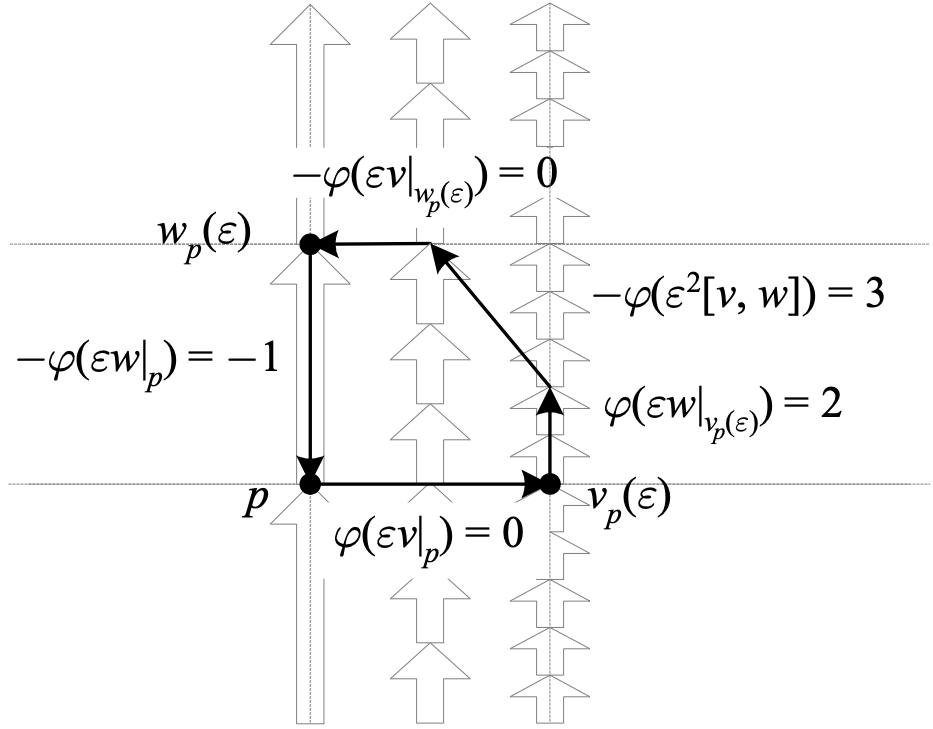
The Schuller video you just watched continues with a beautiful, abstract definition of d that doesn't rely on any coordinate system. This is the most fundamental definition.
Grassmann algebra and deRham cohomology - Lec 12 - Frederic Schuller
This segment presents the coordinate-free definition of the exterior derivative. It is quite abstract but reveals the deep structure of the operator. The example calculation for a 1-form is crucial for seeing how the definition works in practice and why it must have the structure it does to be a valid tensor operator.
Please watch from 37:48 to 56:21. Pay close attention to: The structure of the definition, with its two sums. The crucial role of the Lie bracket [X, Y] in the second term, which ensures the result is a tensor (i.e., C∞(M)-linear). This directly connects to what you learned about Lie derivatives. The worked example for a 1-form, which makes the abstract formula concrete.
The Coordinate-Based Definition
While the coordinate-free definition is elegant, a coordinate-based formula is often more practical for calculations. Given a p-form with components in some coordinate basis, its exterior derivative is a (p+1)-form with components:
where the square brackets denote total antisymmetrization over all enclosed indices.
Let's unpack this for the first few cases:
-
0-form (function ): . is a 1-form.
This is just the gradient. In basis form, . -
1-form (): is a 2-form.
You might recognize this form from the definition of the Faraday tensor from the vector potential, .
This definition is presented clearly in the following reading.
Lecture Notes on General Relativity
These notes from Sean Carroll's GR course provide a concise, component-based definition of the exterior derivative.
Please read the short subsection 'The exterior derivative' on page 22. It starts just after equation (1.81). Note the definition in equation (1.82) and the simple example for the gradient in (1.83).
3. The Fundamental Property:
The single most important property of the exterior derivative is that applying it twice always yields zero.
This is often written compactly as .
The proof in a coordinate basis is surprisingly simple and relies on the symmetry of second partial derivatives (Schwarz's theorem).
Geometry for General Relativity
This reading from a set of MIT lecture notes provides a very clean and direct proof of the d²=0 property using the coordinate definition of d.
Read the paragraph on page 14 starting with 'Important: d²=0'. Follow the short calculation to see how the symmetry of ∂j∂i and the antisymmetry of dxj ∧ dxi conspire to make the result zero.
This simple identity has profound consequences, leading to a rich mathematical structure. It allows us to classify forms into two important categories.
Definition: Closed and Exact Forms
- A p-form is called closed if .
- A p-form is called exact if it is the exterior derivative of some (p-1)-form , i.e., .
From , it immediately follows that every exact form is closed.
If , then .
The much deeper question is the converse: is every closed form exact? The answer, remarkably, depends on the global topology of the manifold.
- On "simple" manifolds without holes (like ), the answer is yes. This is Poincaré's Lemma.
- On manifolds with non-trivial topology (like a torus or a sphere with a point removed), there can be closed forms that are not exact.
The study of the "failure" of closed forms to be exact is called de Rham cohomology, a powerful tool that connects differential geometry to topology. Schuller's video gives an excellent introduction to this idea.
Grassmann algebra and deRham cohomology - Lec 12 - Frederic Schuller
This final segment from Schuller's lecture uses the d²=0 property to build the 'de Rham complex' and formally define closed and exact forms. It explicitly makes the connection to topology, which aligns with your interests.
Please watch from 01:11:31 to 01:33:16. The first part (until 01:22:13) gives a coordinate proof of d²=0, which you've already seen, but it's good for reinforcement. The second part (from 01:22:13 onwards) introduces the concepts of the image and kernel of d, defines closed and exact forms, and shows how d²=0 implies that the image of d is a subset of the kernel of d (every exact form is closed).
A Deeper Dive on `d`: Uniqueness and Existence (Optional)
You have expressed a preference for complete mathematical rigor. The exterior derivative d is uniquely defined by three properties:
- For a 0-form , .
dsatisfies the graded Leibniz rule: .- .
Proving that an operator satisfying these properties exists and is unique is a non-trivial but very rewarding exercise in mathematical physics. The following video provides a full, rigorous inductive proof. This is not essential for moving forward, but if you want to see the full logical underpinnings, it's an excellent resource.
What is a Tensor? Lesson 24: The Exterior Derivative - formal introduction
This video provides a complete proof of the uniqueness and existence of the exterior derivative based on its defining properties. It's a masterclass in the kind of rigorous reasoning that underpins differential geometry.
This is a long and dense video, but the core logic is in these parts: Setup (11:19 - 15:18): The two key properties (d(α∧β) and d²=0) are stated as axioms. Uniqueness Proof (15:18 - 47:10): An inductive proof showing that if an operator d with these properties exists, its form is completely determined. The key step is proving d annihilates basis p-forms (d(dx^{i_1} ∧ ... ∧ dx^{i_p}) = 0). Existence Proof (47:10 - 1:15:20): Shows that the formula derived in the uniqueness proof actually satisfies the required properties.
4. Application: Electromagnetism Revisited
The language of differential forms provides a breathtakingly elegant formulation of Maxwell's equations. Your background in the tensor formulation of electromagnetism will make this especially clear.
Let the vector potential be a 1-form .
The Faraday tensor is a 2-form defined as the exterior derivative of :
In components, this is , which is the definition you already know.
Now consider the exterior derivative of :
This is an identity! The equation automatically contains the two homogeneous Maxwell's equations (Gauss's law for magnetism, , and Faraday's law of induction, ). In this language, these laws are not independent equations of motion but are geometric identities that follow from the existence of the potential 1-form .
The invariance of under the gauge transformation (where is a 0-form) is also immediately obvious:
The remaining two (inhomogeneous) Maxwell's equations can be written as , where is the Hodge star operator (which we will not cover in detail now, but it is a map from p-forms to (n-p)-forms that requires a metric) and is the current 1-form. The full set of Maxwell's equations in vacuum is just and .
Conclusion
In this lesson, you have been introduced to the powerful language of differential forms. It provides not just a notational simplification, but a deeper understanding of the structures of calculus on manifolds.
Key Takeaways:
- Differential forms are totally antisymmetric covariant tensor fields.
- The wedge product () combines forms while preserving antisymmetry, creating the exterior algebra.
- The exterior derivative () is a metric-independent operator that maps p-forms to (p+1)-forms.
- The most crucial property of
dis . - This property implies that all exact forms () are automatically closed (). Whether the converse is true depends on the manifold's topology.
- This framework provides an exceptionally elegant formulation of physical laws, such as Maxwell's equations of electromagnetism.
We now have all the essential machinery in place to discuss the final piece of calculus on manifolds. In our next lesson, we will see how differential forms and the exterior derivative come together in the generalized Stokes' theorem, which provides a unified and powerful way to define integration on manifolds.