Hello! Welcome back to our study of rotating black holes.
In the previous lesson, we introduced the Kerr metric and uncovered its complex geometry. We identified the ring singularity, the inner and outer horizons, and a new, crucial surface called the static limit. We defined the region between the static limit and the event horizon as the ergoregion and established that inside this region, it's impossible for any observer to remain at a fixed spatial position. This is because spacetime itself is being twisted by the black hole's rotation.
This lesson builds directly on that discovery. Our objective is to define the ergosphere and derive the frame-dragging effect (Lense-Thirring effect). We will formalize the definition of the ergosphere and then quantify this "dragging" of spacetime. You will learn not just that observers are forced to move, but precisely how they must move and how this connects to observable phenomena.
1. The Ergosphere and the Impossibility of Being Static
Let's begin by solidifying our understanding of the ergosphere. As we found previously, the component of the Kerr metric is not always negative. The surface where it vanishes, , is called the static limit or, more commonly, the ergosphere. Its radius in Boyer-Lindquist coordinates is:
The region is the ergoregion.
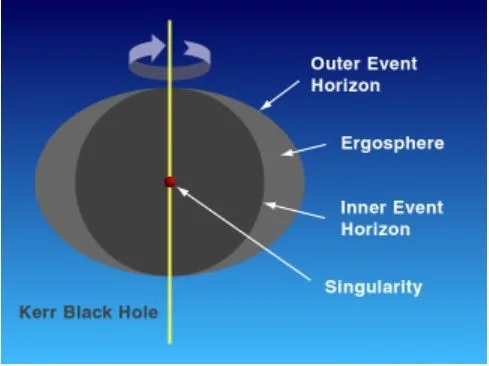
The physical meaning of the ergosphere is tied to the Killing vector field associated with time translation, . The squared norm of this vector is .
- For , , so is a timelike vector. An observer can have a four-velocity proportional to . Such an observer is static—at rest with respect to the distant stars.
- For , , so is a spacelike vector. Since an observer's four-velocity must be timelike (), it cannot be proportional to a spacelike vector.
Therefore, inside the ergosphere, no observer can remain static. This isn't because of a force that needs to be overcome; it's a fundamental property of the spacetime geometry. To be "at rest" would be equivalent to traveling faster than light.
2. Stationary Observers and Forced Co-rotation
If an observer cannot be static, can they at least be stationary? A stationary observer is one who moves in such a way that the spacetime geometry appears constant to them. Since the Kerr metric is stationary and axisymmetric, its isometries are time translation () and rotation about the z-axis (). A stationary observer's worldline must therefore be a linear combination of these two Killing vectors.
Consider an observer moving in a circular orbit at constant and . Their four-velocity is of the form:
where is the observer's coordinate angular velocity. For this to represent a physical observer, the four-velocity must be timelike: .
Since must be positive, this requires the term in the parenthesis to be negative:
This is a quadratic inequality for the allowed angular velocity . To find the allowed range, we first solve the corresponding equality:
The solutions are:
As shown in the resource LINK from the previous lesson (specifically eq. 21.77), the discriminant is . Since is positive outside the horizon, the inequality is satisfied for between the roots, .
Let's analyze the physical meaning of this result.
The following text from 'Chapter 21 The Kerr solution' analyzes the consequences of this inequality for stationary observers. It clearly explains why co-rotation is mandatory inside the ergosphere.
Please reread the part of Section 21.5 titled 'Static and stationary observers' (starting on page 308). This time, focus on the analysis of the inequality for Ω (eq. 21.74) and its solutions (eq. 21.76). Pay close attention to the conclusions drawn about the signs of Ω± outside and inside the ergosphere (eq. 21.82 and 21.83).
As you've just reviewed, the signs of the limiting angular velocities reveal the essence of frame-dragging:
- Outside the ergosphere (): . This makes negative and positive. A stationary observer can exist with either a positive (co-rotating) or negative (counter-rotating) angular velocity, or even zero angular velocity.
- Inside the ergosphere (): . Since is negative (for ), both roots and are positive.
This is a remarkable result. It means that within the ergosphere, any stationary observer must have a positive angular velocity. It is impossible to counter-rotate or even to have zero angular velocity. You are inevitably dragged along in the direction of the black hole's spin. This forced co-rotation is a direct, non-negotiable consequence of the geometry of spacetime.
3. Quantifying Frame-Dragging: Zero Angular Momentum Observers (ZAMOs)
We have established that everything inside the ergosphere is forced to rotate. But how fast? To quantify this, we need a special class of local observers to define a reference frame. A natural choice is the Zero Angular Momentum Observer (ZAMO). These are observers who are "locally non-rotating" in the sense that they have zero angular momentum . Imagine an observer falling into the black hole from rest at infinity; they would follow a ZAMO trajectory.
What is the angular velocity of a ZAMO? The video below provides a clear and rigorous derivation based on the conservation laws associated with Killing vectors, a concept you are well-versed in.
The video 'Kerr metric - 1' from the Tensor Calculus channel provides an excellent derivation of the angular velocity acquired by a freely falling particle (or photon) with zero initial angular momentum.
Please watch the segment from 11:38 to 18:25. The presenter shows that for a particle with zero initial angular momentum, the final angular velocity is non-zero. Follow the argument which uses the conservation of the covariant momentum component p_φ to derive the expression for the angular velocity dφ/dt.
The video demonstrates that a particle with conserved covariant angular momentum will have a coordinate angular velocity given by:
Using the relations between covariant and contravariant momentum components () and the condition , this simplifies to:
As we proved in the thought process, this is equivalent to the expression found in many textbooks:
This is the angular velocity of the local inertial frames. It quantifies how much spacetime itself is rotating at a given location . Any object, regardless of its motion, will perceive this local "swirling" of spacetime.

4. The Lense-Thirring Effect
The frame-dragging we've derived is a strong-field effect applicable right up to the black hole's horizon. A specific, measurable manifestation of this in the weak-field, slow-rotation limit is known as the Lense-Thirring effect, first predicted by Josef Lense and Hans Thirring in 1918.
This effect describes, for example, the precession of a gyroscope's spin axis or the precession of a satellite's orbital plane around a massive, rotating body like the Earth. This precession is caused by the same term in the metric, but evaluated far from the source where and .
Introduction. Weak Field General Relativity.
This resource, 'Slowly Rotating Stars, Frame-Dragging and Lense-Thirring Precession', provides a first-principles derivation of this effect using linearized gravity. It's a great example of applying GR to a concrete, physical problem.
Please read the section 'Slowly Rotating Stars, Frame-Dragging and Lense-Thirring Precession' (pages 6-9). Focus on: How the metric for a slowly rotating body is derived from linearized gravity, resulting in an off-diagonal g_0i term (Eq. 15). The setup of the problem: a gyroscope falling along the axis of rotation. The final result: the gyroscope's spin vector precesses with an angular velocity ω (Eq. 28 and 29). You don't need to re-derive every Christoffel symbol, but understand how they lead to the final precession equation.
The Lense-Thirring effect, as derived in the text, shows that a gyroscope near a rotating mass with angular momentum will precess with an angular velocity:
For an orbit in the equatorial plane, this simplifies and causes the orbit itself to precess. This tiny effect has been experimentally confirmed with incredible precision by satellites like LAGEOS and Gravity Probe B, providing direct evidence for the reality of frame-dragging.
Test your understanding!
Consider a ZAMO at the outer horizon, . What is its angular velocity? This is often called the angular velocity of the black hole horizon, . (Hint: At the horizon, , which means ).
Show answer
The angular velocity of a ZAMO is .
The full expression is:
At the horizon , we have . The expression simplifies to:
Now, we use the hint: on the horizon, . Substituting this into the denominator gives:
And since , we can also write it as:
This constant value is the angular velocity with which the black hole's event horizon itself rotates. Every observer at the horizon, no matter their history, is forced to rotate at this specific speed.
Conclusion
In this lesson, we have moved from the qualitative idea of "spacetime dragging" to a precise, quantitative understanding. We have seen how the geometry of the Kerr spacetime enforces motion and how this manifests from the strong-field regime near the horizon to the weak-field limit around Earth.
Key Takeaways:
- The ergosphere is the surface where . Inside it, the timelike Killing vector becomes spacelike, making it impossible for any observer to remain static.
- While static observers are impossible, stationary observers can exist. However, inside the ergoregion, they are all forced to co-rotate with the black hole ().
- The frame-dragging effect can be quantified by the angular velocity of the ZAMO frames, , which represents the local rotational velocity of spacetime itself.
- The Lense-Thirring effect is the weak-field, slow-rotation approximation of frame-dragging, causing observable precessions of gyroscopes and orbits.
Preview of Next Lesson:
The ergosphere is more than just a region of forced rotation. The fact that the timelike Killing vector is spacelike inside allows for particles to have negative energy as measured by an observer at infinity. In our next lesson, we will explore this fascinating consequence and see how Roger Penrose devised a mechanism—the Penrose process—to exploit this property to extract rotational energy from the black hole.