Hello! In our last lesson, we explored the fascinating geometry of the ergoregion—the region around a rotating black hole where spacetime itself is dragged into motion. We established that the timelike Killing vector , which represents "rest" for a distant observer, becomes a spacelike vector inside the ergosphere. This means nothing can remain stationary.
Today, we will uncover a profound consequence of this fact. The energy of a particle, as measured from infinity, is defined by its relationship with this vector. If this vector becomes spacelike, could a particle have negative energy? The answer is yes, and this possibility opens the door to one of the most ingenious thought experiments in physics.
Our goal is to describe the Penrose process for extracting energy from a rotating black hole. We will see how Roger Penrose conceived a way to mine the immense rotational energy of a Kerr black hole, a process that relies entirely on the strange properties of the ergosphere we've just learned.
1. The Concept of Negative Energy
In our previous studies of conserved quantities, we learned that if a spacetime has a timelike Killing vector field, like in a stationary spacetime, there is a conserved quantity along any geodesic with 4-momentum . We call this quantity energy:
Ordinarily, this energy is positive. For a massive particle, its 4-momentum is a future-pointing timelike vector. In a standard region of spacetime (like outside the ergosphere), is also a future-pointing timelike vector. The inner product of two future-pointing timelike vectors is always negative, so the minus sign in the definition ensures .
However, inside the ergosphere, is spacelike. The inner product of a timelike vector () and a spacelike vector () can be positive, zero, or negative. This means it is physically possible for a particle inside the ergosphere to have a trajectory with negative energy () as measured by an observer at infinity.
Let's ground this crucial idea in a formal text.
6 Black Holes‣ General Relativity by David Tong
The following excerpt from David Tong's notes on General Relativity introduces the Penrose process by first motivating this very concept of negative energy.
Please read the first three paragraphs of the subsection titled 'The Penrose Process'. Focus on how the energy E is defined and why it can become negative specifically within the ergoregion.
As the text confirms, the possibility of is not a mathematical quirk but a direct physical consequence of the ergosphere's geometry. A particle with negative energy cannot escape the ergosphere and return to infinity (where energy must be positive), but it can exist on a trajectory that crosses the event horizon. This is the key insight we need.
2. The Penrose Process: A Thought Experiment
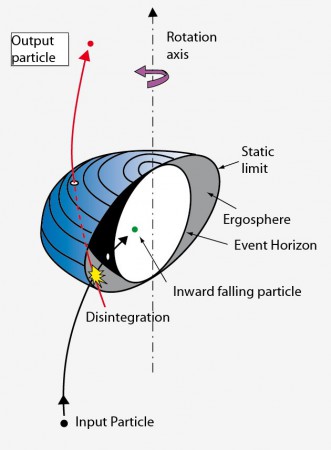
In 1969, Roger Penrose devised a clever thought experiment to exploit these negative energy states. Here is the mechanism, step by step:
- Launch: A particle (or shell, let's call it particle 0) with 4-momentum and positive energy is sent from infinity into the ergosphere of a Kerr black hole.
- Split: Once inside the ergosphere, the particle is made to split into two fragments (particles 1 and 2), with 4-momenta and . This could be a decay, or an explosion from a rocket engine.
- The Trick: The split is carefully arranged so that particle 1 enters a trajectory with negative energy, . As we just discussed, such a trajectory must lead into the event horizon. Particle 2 is placed on a trajectory that allows it to escape the ergosphere and fly back out to infinity.
By the law of conservation of 4-momentum at the splitting point, we have:
This implies the conservation of energy as measured from infinity:
Now, if we successfully engineered the split such that , then the energy of the escaping particle is:
This means . The particle that returns to infinity comes back with more energy than the original particle had. This extra energy didn't appear from nowhere; it was extracted from the black hole.
The following image provides a clear visualization of this process.
Test your understanding!
Where does the extracted energy come from? Does the process violate the conservation of energy?
Show answer
The extracted energy comes from the rotational energy of the black hole. The black hole's mass is a combination of its irreducible mass and its rotational energy. The Penrose process taps into the rotational part. When the negative-energy particle is absorbed, the black hole's total mass-energy decreases by , and its angular momentum also changes. The overall conservation of energy is perfectly maintained; energy is simply transferred from the black hole to the escaping particle.
3. Cosmic Censorship and the Limits of Extraction
This process seems almost too good to be true. Could we repeat it indefinitely? Could we extract so much energy and angular momentum that we reduce the spin parameter past the extremal limit (), thereby destroying the event horizon and exposing the singularity? This would violate the Cosmic Censorship Hypothesis, which posits that singularities should not be visible to distant observers.
Fortunately, general relativity has a built-in safety mechanism. The amount of energy we can extract is intrinsically limited by the amount of angular momentum we give to the black hole.
To see this, we use the fact that any particle crossing the future event horizon must have a future-pointing 4-momentum. A special Killing vector that generates the null geodesics on the horizon is , where is the horizon's angular velocity and is the rotational Killing vector.
For the captured particle with momentum , the condition of it being future-pointing on the horizon implies . Expanding this gives:
Recalling the definitions and , this becomes:
The change in the black hole's mass is and the change in its angular momentum is . Thus, any physical process must obey:
This fundamental inequality dictates that you cannot reduce the angular momentum without also reducing the mass by a proportional amount, preventing you from ever reaching the state.
4. Irreducible Mass and Maximum Efficiency
This constraint is best understood through the concept of irreducible mass, , introduced by Demetrios Christodoulou. The total mass of a Kerr black hole can be thought of as being composed of this irreducible part and a rotational part. The irreducible mass is related to the surface area of the event horizon, , by:
The total mass-energy is given by the famous formula:
The Penrose process extracts energy from the second term—the rotational energy. Using the inequality , one can prove that the irreducible mass can never decrease:
This implies that the surface area of the event horizon, , can also never decrease. This is a special case of Hawking's powerful Area Theorem, a precursor to the laws of black hole thermodynamics.
To understand the full derivation and calculate the maximum efficiency of this process, the following resource is excellent.
The following lecture notes provide a detailed mathematical treatment of the Penrose process, the concept of irreducible mass, and the calculation for the maximum possible energy extraction.
Please read the section '4.3 Energy Extraction From Kerr Black Holes', but this time focus on the second half, starting from the paragraph 'Consider the geodesic that describes the negative energy photon...'. Follow the derivation of the inequality δM ≥ ΩH δJ (eq. 68), the definition of irreducible mass (eq. 70), the proof that it cannot decrease (eq. 73), and the final calculation of the maximum extractable energy (eqs. 74-76).
As the notes demonstrate, the maximum possible energy is extracted when the black hole's rotation is completely stopped (). At this point, the final mass is equal to the initial irreducible mass. For a black hole that starts as maximally rotating (), its initial irreducible mass is .
The total energy extracted is the difference between the initial and final mass:
The efficiency is therefore:
This means up to 29% of the total mass-energy of a maximally rotating black hole can be extracted through the Penrose process.
Conclusion
The Penrose process is a remarkable testament to the predictive power of general relativity. It transforms the bizarre geometry of the ergosphere into a potential power source of cosmic proportions. While the engineering challenges of carrying out this process are fantastical, it is a physically valid mechanism. A more realistic, wavelike version of this process, known as superradiance, where waves scatter off the ergosphere and are amplified, is an active area of research and may have observable astrophysical consequences.
Key Takeaways:
- Inside the ergosphere, the timelike Killing vector is spacelike, allowing for particle trajectories with negative energy as measured from infinity.
- The Penrose process is a thought experiment where a particle splits in the ergosphere. One fragment with negative energy falls into the black hole, while the other escapes with more energy than the original particle.
- The extracted energy comes from the rotational energy of the black hole, decreasing both its mass and angular momentum .
- The process is limited by the constraint , which ensures that the irreducible mass and the horizon area can never decrease.
- The maximum theoretical efficiency of the Penrose process is about 29% of the black hole's initial mass, achievable for a maximally rotating Kerr black hole.
Preview of Next Lesson:
Having explored the complex but classical geometry of rotating black holes, we will now prepare to construct a more intuitive and global picture of their causal structure. Our next task will be to construct the Penrose diagram for the maximal analytic extension of the Kerr spacetime. This will allow us to visualize the entire spacetime, including its multiple universes and strange temporal features, in a single, compact diagram.