Hello! Welcome to the fifth module of our course. In the previous module, we explored the spacetimes of non-rotating black holes, deriving the Schwarzschild solution for an uncharged mass and the Reissner-Nordström solution for a charged mass. We analyzed their causal structures, identified their horizons, and even constructed their full Penrose diagrams.
However, almost every object in the universe, from planets to stars to galaxies, rotates. To describe the spacetime around a more realistic collapsed object, we must account for angular momentum. This brings us to the Kerr metric, the exact solution for a rotating, uncharged black hole, discovered by Roy Kerr in 1963. Its discovery was a monumental achievement in theoretical physics.
In this lesson, your objective is to analyze the Kerr metric, identifying its horizons and its static limit. Unlike the Schwarzschild case, where a single surface (the event horizon) encapsulated most of the interesting physics, the Kerr spacetime has a much richer and more complex structure. We will dissect its geometry piece by piece, introducing new concepts like the ergosphere and frame-dragging, which have no counterpart in the non-rotating solutions we've studied.
The full derivation of the Kerr metric is notoriously difficult and far beyond the scope of this lesson. Instead, we will take the solution as given and dedicate our efforts to analyzing its profound physical and geometric properties.
1. The Kerr Metric in Boyer-Lindquist Coordinates
The Kerr metric is most commonly expressed in Boyer-Lindquist coordinates . These coordinates are convenient because at large distances from the black hole (), they resemble standard spherical coordinates. The metric is characterized by two parameters: the mass and the spin parameter . The parameter is related to the black hole's total angular momentum by .
Let's begin by examining the form of the metric and its fundamental properties.
The following text from the resource 'Chapter 21 The Kerr solution' presents the Kerr metric and discusses its essential characteristics. This will be our starting point.
Please read Section 21.1, 'The Kerr metric in Boyer-Lindquist coordinates' (pages 297-299). Focus on: The line element itself (Eq. 21.1) and the definitions of the functions Δ(r) and Σ(r, θ). The key properties listed: Why is it stationary but not static? Why is it axisymmetric? How it reduces to the Schwarzschild metric when a=0 and to flat spacetime when M=0. The identification of Δ=0 and Σ=0 as potential locations of singularities.
As you've just read, the Kerr metric is:
where and .
The most striking new feature is the cross-term:
This term couples time and azimuthal angle, and it is the mathematical signature of rotation. Its presence means the spacetime is stationary (the metric components are independent of , so is a Killing vector) but not static. A spacetime is static only if the timelike Killing vector is also hypersurface-orthogonal, which is not the case here (a condition known as Frobenius's theorem). Physically, this means that while the spacetime geometry doesn't change over time, it lacks time-reversal symmetry—reversing time is not equivalent to reversing the direction of rotation.
2. The Singularity: A Ring of Infinite Curvature
The metric components diverge when either or . As with the Schwarzschild metric, we must determine which of these corresponds to a true physical singularity versus a mere coordinate artifact.
The quantity is zero only when both and (i.e., ). A calculation of curvature invariants, like the Kretschmann scalar , shows that they diverge as . This confirms that is a physical singularity.
Unlike the point-like singularity at in the Schwarzschild and Reissner-Nordström spacetimes, the Kerr singularity occurs at in the equatorial plane (). This is a ring singularity of radius . This is a profound departure from the non-rotating case.
3. The Horizons: Gateways to the Interior
Next, let's analyze the surface where . This is a quadratic equation in :
The solutions are:
These roots are real and distinct provided .
- If , there are two distinct surfaces at and .
- If , the roots coincide, . This is called an extremal black hole.
- If , there are no real roots. This would correspond to a naked singularity, a singularity not hidden behind any horizon. According to the (weak) Cosmic Censorship Conjecture, such objects should not form from generic gravitational collapse. We will focus on the case .
Just as with the surface in Schwarzschild spacetime, the surfaces at are not physical singularities; they are coordinate singularities. The surface is the outer horizon, which functions as the event horizon—the point of no return. The surface is the inner horizon, also known as a Cauchy horizon.
To understand the nature of these surfaces, we consider the character of a hypersurface of constant . Its normal vector is . The norm of this vector is . As shown in resource LINK, .
- For , , so . The constant- surfaces are timelike.
- For , , so . The constant- surfaces are spacelike.
- At , , so . The surfaces are null hypersurfaces.
The fact that the surfaces are null confirms their status as horizons. An observer who crosses the event horizon at finds themselves in a region where surfaces of constant are spacelike. Just like being forced to move towards the future in time, the observer is now forced to move towards smaller values of .
4. The Static Limit and the Ergosphere
In the Schwarzschild metric, the event horizon at was also the surface where vanished. In the Kerr metric, these two surfaces are distinct. Let's find the surface where .
This implies . Solving this quadratic equation for gives:
The outer surface, , is called the static limit. The region between the static limit and the outer event horizon, , is called the ergoregion. The boundary itself is often called the ergosphere.
The physical significance of the static limit is profound. The timelike Killing vector is , corresponding to an observer "at rest" in the Boyer-Lindquist coordinate system. The squared norm of this vector is .
- Outside the ergosphere (), , so is timelike. An observer can remain at a constant .
- Inside the ergosphere (), , so becomes spacelike. An observer cannot remain at rest; it is impossible for them to have a four-velocity proportional to .
This phenomenon is called frame-dragging. Spacetime itself is being dragged around by the black hole's rotation so powerfully that within the ergosphere, nothing can stand still. Any observer is forced to co-rotate with the black hole to some degree.
Let's consolidate our understanding of this new region.
The following section of 'Chapter 21 The Kerr solution' details the infinite redshift surface (our static limit) and the ergosphere, and discusses the implications for observers.
Please read Section 21.5, 'The infinite redshift surface and the ergosphere' (pages 307-310). Focus on: The derivation of the surfaces where g_tt = 0. The relationship between the horizons (r±) and the static limit surfaces (r_S±), particularly the inequality r+ ≤ r_S+. The definition of the ergoregion. The distinction between a 'static observer' and a 'stationary observer', and why the former cannot exist inside the ergosphere.
5. Visualizing the Kerr Spacetime
We have now identified four key surfaces for a rotating black hole ():
- Ring Singularity:
- Inner Horizon:
- Outer (Event) Horizon:
- Static Limit (Ergosphere):
The following diagram provides a cross-section of the Kerr spacetime, showing how these surfaces are nested.
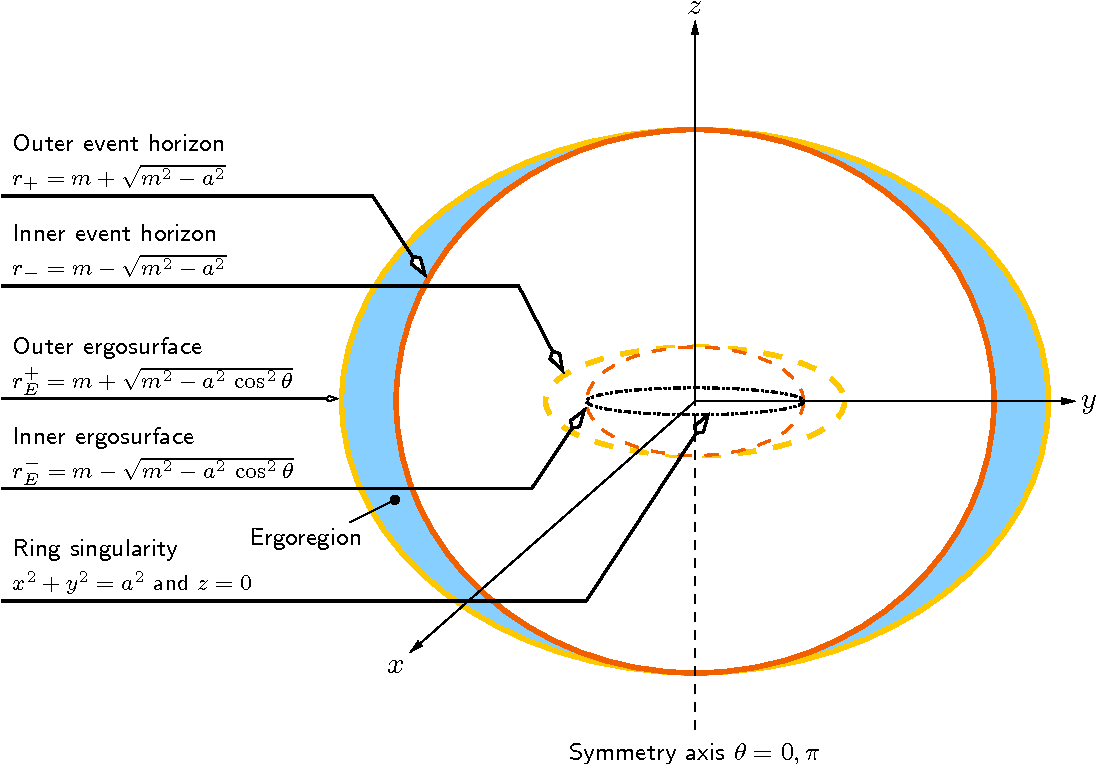
Notice the relationship between the event horizon and the ergosphere .
- At the poles (), , so . The ergosphere touches the event horizon.
- At the equator (), , so . This is the maximum extent of the ergosphere.
The ergoregion is the volume between these two surfaces. An object can enter the ergoregion from far away and, if it has enough power, can maneuver to exit again. It is only by crossing the event horizon at that an object becomes trapped.
Test your understanding!
Consider an extremal Kerr black hole, where . What is the structure of its horizons and ergosphere? Specifically, what are the values of , , and what is the shape of the ergosphere ?
Show answer
For an extremal black hole, .
-
Horizons: The horizon radii are . The inner and outer horizons merge into a single null surface at .
-
Ergosphere: The static limit surface is given by .
- At the poles (), , so . The ergosphere touches the (merged) horizon.
- At the equator (), , so . The ergosphere still extends out to at the equator.
The ergoregion for an extremal black hole is the region .
Conclusion
In this lesson, we have taken our first deep dive into the geometry of a rotating black hole. We have moved beyond the simpler, spherically symmetric spacetimes and uncovered a far more intricate structure.
Key Takeaways:
- The Kerr metric describes a stationary, axisymmetric spacetime characterized by mass and spin parameter . Its defining feature is a component, which signifies rotation.
- The physical singularity is not a point but a ring of radius in the equatorial plane.
- For , the metric has horizons where . This gives an outer event horizon at and an inner Cauchy horizon at .
- The static limit is a surface distinct from the event horizon, located where . This surface, called the ergosphere, encloses a region where spacetime is dragged so intensely that no observer can remain at rest.
- The ergoregion is the volume between the ergosphere and the event horizon (). It is possible to enter and leave this region.
Preview of Next Lesson:
The existence of the ergoregion is not just a geometric curiosity; it has dramatic physical consequences. Because the timelike Killing vector becomes spacelike inside the ergoregion, it is possible for particles to have negative energy with respect to an observer at infinity. In the next lesson, we will explore this bizarre possibility, defining the ergosphere and deriving the frame-dragging effect. We will then see how Roger Penrose used this property to devise a mechanism—the Penrose process—for extracting rotational energy from the black hole itself.