Hello! Welcome to the next lesson in our journey into quantum fields in curved spacetime.
In our last session, we established the crucial concept of Bogoliubov transformations. We saw that because the notion of "positive frequency" is not unique in a general spacetime, different observers can have different definitions of particles and vacua. The transformation relating one observer's creation/annihilation operators () to another's () is of the form . The non-zero coefficient signals that one observer's vacuum will appear to be populated with particles from the other's perspective, with an average particle number .
Today, we will apply this powerful mathematical framework to a concrete and profound physical scenario. Our learning goal is to derive the Unruh effect, which is the prediction that a uniformly accelerating observer in empty Minkowski vacuum will perceive a thermal bath of particles. This effect provides a crucial link between acceleration, horizons, and thermodynamics, and serves as the gateway to understanding Hawking radiation.
1. A Coordinate System for Accelerated Observers: Rindler Spacetime
Before we can quantize a field for an accelerating observer, we must first describe their motion and the spacetime they perceive. We are not dealing with a curved spacetime here—this entire analysis takes place in flat Minkowski space. We are simply describing it from the perspective of a non-inertial reference frame.
An observer with constant proper acceleration in the -direction follows a hyperbolic trajectory in Minkowski spacetime, given by . This motivates a change of coordinates from the inertial Minkowski coordinates to a new set that is better adapted to the accelerating observer. These are called Rindler coordinates.
Relativity 105b: Acceleration - Bell's Spaceship Paradox and Rindler Coordinates
For an excellent and intuitive introduction to Rindler coordinates, please watch the following video from the eigenchris channel. It uses Bell's Spaceship Paradox to motivate the need for these coordinates and provides clear visualizations of how they describe the spacetime of a constantly accelerating observer.
Watch the video from the beginning until 22:22. Pay close attention to: How a family of accelerating worldlines (hyperbolas) forms the basis of the new coordinate system. The transformation equations relating Minkowski (t,x) and Rindler ( ilde{t}, ilde{x}) coordinates. The concept of the 'Rindler horizon,' a boundary beyond which the accelerating observer cannot see.
The video provides a great visual foundation. For our derivation, we'll use a slightly different but equivalent parameterization of Rindler coordinates, , which is standard in the literature on the Unruh effect. For an observer with a given acceleration, these coordinates provide a local notion of time () and space ().
UNRUH EFFECT Introductory Notes
Now let's formalize the mathematics of Rindler spacetime. The following notes provide a concise derivation of the coordinate transformation and the metric.
Please read section 3.1 'Rindler Spacetime' (pages 17-19). This section introduces the coordinates (\eta, \xi) and shows how they relate to the Minkowski coordinates (t,x). Notice how curves of constant \xi are the hyperbolic worldlines of uniformly accelerating observers.
To summarize, the transformation from Rindler coordinates to Minkowski coordinates (in natural units, ) is:
A crucial result is the form of the Minkowski line element in these new coordinates:
This metric is conformally flat, meaning it's the flat Minkowski metric multiplied by a position-dependent factor . This property is key.
The Rindler coordinates only cover the region of Minkowski space where . This region is called the Rindler wedge. The boundaries of this wedge, , act as causal horizons for any observer confined to the wedge.
2. Field Quantization: Minkowski vs. Rindler
Now we consider a massless scalar field propagating in this spacetime. We will quantize it from two different points of view.
A. The Inertial (Minkowski) Observer
This is the standard quantization you've seen before.
- The field equation is .
- The observer defines positive-frequency modes with respect to their time coordinate , using the timelike Killing vector . A mode is positive frequency if with . These modes are plane waves, .
- The field operator is expanded as .
- The Minkowski vacuum is defined as the state annihilated by all : for all .
B. The Accelerating (Rindler) Observer
This observer lives entirely within the Rindler wedge.
- In Rindler coordinates, the Klein-Gordon equation becomes , which simplifies to . This is just the wave equation in coordinates!
- The Rindler observer has their own timelike Killing vector within the wedge, . They use this to define their positive-frequency modes. A Rindler mode is positive frequency if with . The solutions are plane waves in Rindler coordinates, .
- The field operator is expanded using these modes: .
- The Rindler vacuum is defined as for all .
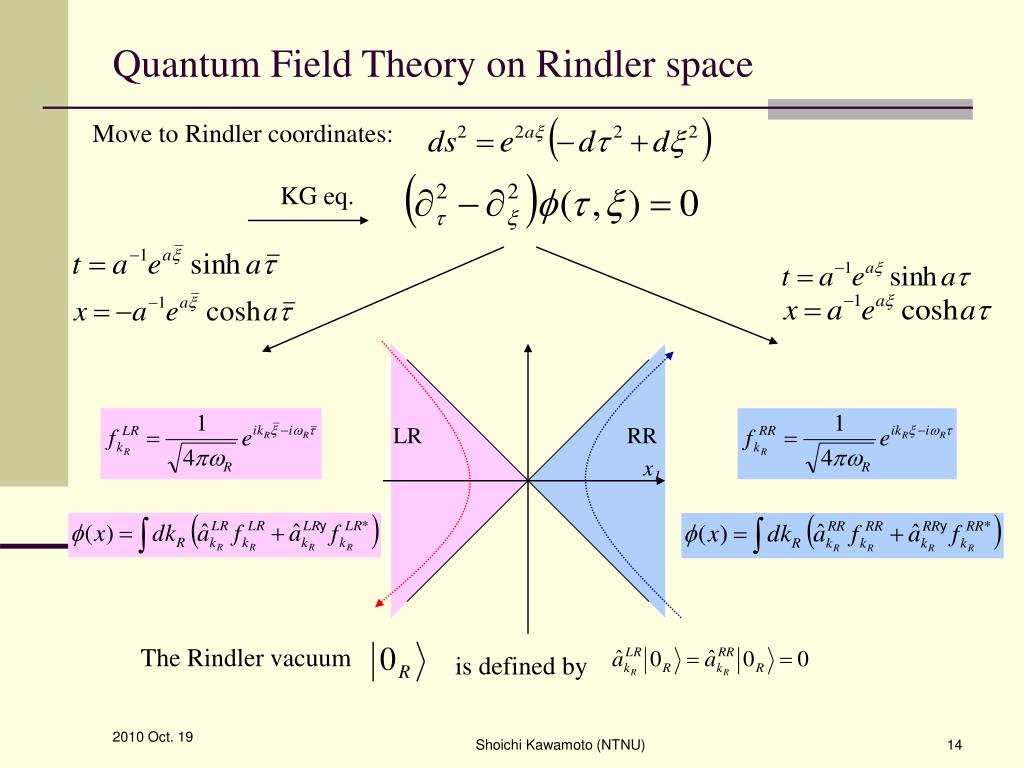
We have two different definitions of the vacuum, and , based on two different notions of time evolution. Our goal is to find out what an accelerating observer sees when the field is in the Minkowski vacuum. That is, we must compute the number of Rindler particles in the state : .
3. The Derivation: Bogoliubov Coefficients via Analytic Continuation
To find the number of Rindler particles, we need the Bogoliubov coefficients relating the Minkowski and Rindler operators. We will follow a particularly elegant method pioneered by Unruh, which relies on analytic continuation in the complex plane. This avoids a direct, and more cumbersome, calculation of the overlap integrals.
UNRUH EFFECT Introductory Notes
The following text from the 'UNRUH EFFECT Introductory Notes' walks through this elegant derivation. It is the core of today's lesson.
Please read Section 3.2 'Positive Frequency Modes in Rindler Spacetime' and Section 3.3 'Extension of Rindler Modes' (pages 20-27). The argument is subtle but powerful, so take your time with it. Key steps to follow: Section 3.2: Understand how the Rindler modes f_k are defined using the timelike Killing vector \partial_\eta. Section 3.3: This is the crucial part. The goal is to construct a new set of modes, let's call them h_k, which are by construction positive-frequency for a Minkowski observer, but are written as linear combinations of the Rindler modes. The text does this by using a powerful criterion: a mode is positive-frequency with respect to Minkowski time if and only if it is analytic and bounded in the lower half of the complex plane for a coordinate like v=t-x. This analyticity requirement uniquely fixes the linear combination of Rindler modes from different wedges (see Eq. 3.10 and 3.11). These combinations are our h_k modes. Because the h_k modes are positive-frequency Minkowski modes, their annihilation operators (\hat{c}_k) annihilate the Minkowski vacuum: (\hat{c}_k |0_M angle=0). By equating the field expansion in terms of Rindler modes with the expansion in terms of these new h_k modes (valid within the Rindler wedge), the text derives the Bogoliubov transformation relating the Rindler operator \hat{b}_k to the Minkowski-friendly operators \hat{c}_k (Eq. 3.13). Finally, using this transformation, the number of Rindler particles in the Minkowski vacuum is calculated (Eq. 3.14), leading to the final result.
Let's recap the stunning result of that derivation. The Bogoliubov transformation relating the Rindler annihilation operator to the operators and (which define the Minkowski vacuum) is found to be:
Here, is the frequency of the Rindler mode. Now, we compute the expectation value of the Rindler number operator in the Minkowski vacuum . Since , the only term that survives is the one containing after commuting the operators. The calculation yields:
This is a momentous result. The spectrum of particles seen by the accelerating observer is not just some random distribution; it is a perfect Planckian thermal spectrum.
4. The Unruh Temperature
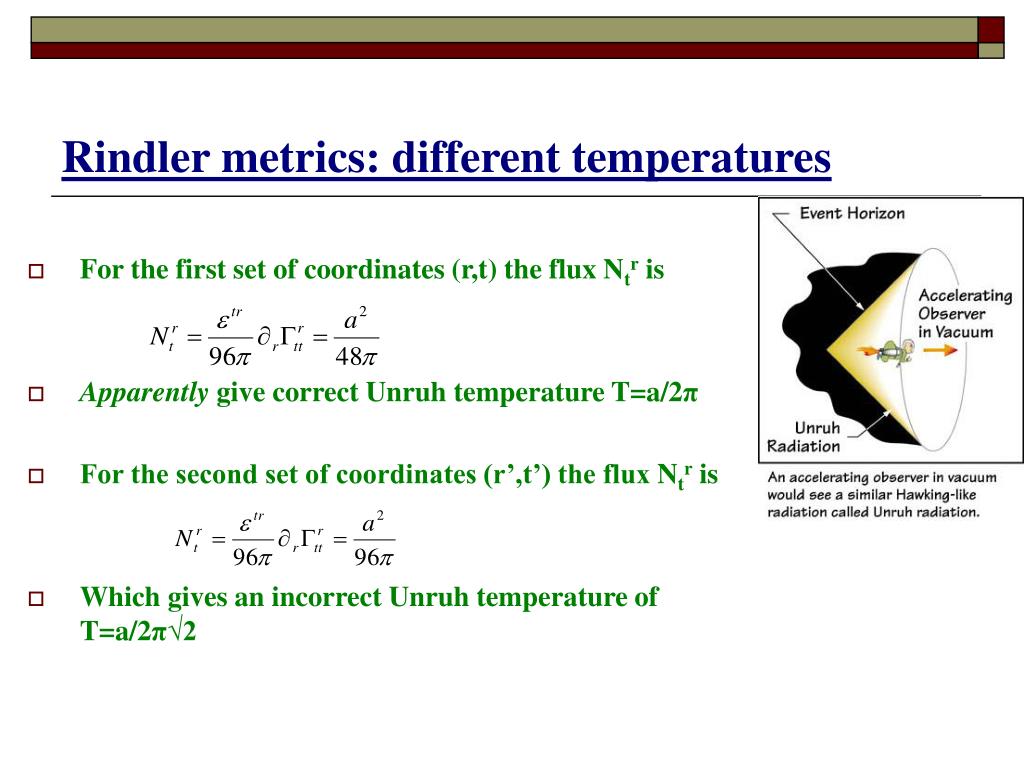
By comparing this result to the Bose-Einstein distribution for thermal radiation, , we can identify the energy of the Rindler particle as (setting ) and the temperature of the thermal bath.
This gives the Unruh Temperature:
Or in natural units ():
The temperature measured by the accelerating observer is directly proportional to their proper acceleration.
The accelerations required to produce a measurable temperature are enormous. To see a temperature of just 1 Kelvin, you would need an acceleration of about . Nevertheless, the Unruh effect is a fundamental prediction of quantum field theory and a crucial piece of the puzzle connecting gravity, quantum mechanics, and thermodynamics. It tells us that the vacuum state is more complex than it appears, and its particle content is in the eye of the beholder.
Test your understanding!
In the Unruh effect, the Rindler observer sees a thermal bath. Where do the particles in this bath "come from"?
A) They are pre-existing virtual particles in the Minkowski vacuum that the acceleration makes real.
B) They are radiated by the accelerating observer's own detector.
C) They are a manifestation of the mismatch between the definition of the ground state (vacuum) for the inertial observer and the accelerating observer.
D) They are created by the energy the observer expends to accelerate.
Show answer
The best answer is C). The effect arises because the mode functions used to define "particles" for the Rindler observer are different from those used by the Minkowski observer. The Rindler positive-frequency modes are a superposition of Minkowski positive- and negative-frequency modes. When the Rindler number operator acts on the Minkowski vacuum state, this "mixing" of modes results in a non-zero particle count. The particles are not "coming from" a specific location in space; they are a feature of how the quantum state of the field is interpreted by the accelerated frame of reference. Answer D is also related, as the observer must expend energy to maintain their accelerated trajectory, and this energy ultimately sustains the thermal bath they perceive, but C describes the fundamental quantum mechanical origin of the particles themselves.
Conclusion
This lesson has been a deep dive into one of the most remarkable predictions of theoretical physics. By combining the formalism of Bogoliubov transformations with the kinematics of accelerated reference frames, we have derived the Unruh effect from first principles.
Key Takeaways:
- A uniformly accelerating observer is best described using Rindler coordinates, which cover a 'wedge' of Minkowski spacetime and feature a causal horizon.
- The definition of a vacuum state is observer-dependent. The quantization of a scalar field by an inertial (Minkowski) observer leads to a different vacuum state, , than the one defined by an accelerating (Rindler) observer, .
- By computing the Bogoliubov transformation between the two frames, we found that the Minkowski vacuum contains a thermal distribution of Rindler particles.
- The temperature of this thermal bath, the Unruh temperature, is directly proportional to the observer's proper acceleration: .
Preview of the Next Lesson:
The structure we've analyzed—an observer near a causal horizon—has a profound parallel in general relativity: an observer hovering just outside the event horizon of a black hole. According to the equivalence principle, the physics for this stationary observer in a gravitational field should be locally indistinguishable from the physics for our accelerating Rindler observer. This powerful analogy is the key to our next topic: formulating quantum field theory near a black hole's event horizon and, from there, deriving the famous Hawking radiation.