Hello! Welcome to your next lesson in the Audit Evidence and Documentation module.
In our last lesson, we built a strong foundation by exploring SA 500, "Audit Evidence". We established that every audit opinion must be backed by evidence that is both sufficient (enough quantity) and appropriate (high quality, meaning relevant and reliable).
Today, we build directly on that foundation by moving to SA 501, "Audit Evidence—Specific Considerations for Selected Items". This standard doesn't introduce new types of procedures, but rather applies the ones we learned about in SA 500 to specific, often complex, financial statement items that require special attention from the auditor. Your articleship experience likely involved the practical challenges of verifying inventory or understanding the impact of legal cases, and SA 501 provides the formal framework for addressing these challenges.
By the end of this 60-minute lesson, you will be able to describe specific audit procedures for selected items like inventory and litigation/claims as per SA 501.
Let's begin by getting a quick overview of what SA 501 covers.
SA 501 Revision | CA Final Audit | CA Shubham Keswani (AIR 8)
This brief introductory clip from the video by CA Shubham Keswani clearly outlines the three specific items SA 501 deals with: Inventory, Litigation & Claims, and Segment Information. It also highlights the primary assertion we are concerned with for each.
Watch from 00:43 to 02:08. Pay close attention to the key objective for each item: 'existence and condition' for inventory and 'completeness' for litigation and claims.
As the video explained, SA 501 focuses our attention on gathering specific evidence for these key areas. We will now dive deep into the first two.
1. Inventory: Verifying Existence and Condition
When inventory is material to the financial statements, your primary objective under SA 501 is to obtain sufficient appropriate audit evidence regarding its existence and condition. Does the inventory physically exist? And is it in a saleable condition, or is it damaged, obsolete, or slow-moving?
The most direct way to achieve this is by attending the physical inventory count conducted by management.
Attending the Physical Inventory Count
Your attendance isn't passive. It's an active process of gathering evidence. The following video provides an excellent, practical walkthrough of what an auditor actually does during the count.
SA 501 Revision | CA Final Audit | CA Shubham Keswani (AIR 8)
This segment from CA Shubham Keswani's revision video uses a memorable story to walk through the auditor's key activities during a physical inventory count. This aligns perfectly with the hands-on experience you have from your articleship.
Watch from 02:08 to 05:09. Notice how the procedures performed (evaluating instructions, observing, inspecting, and test counting) are all applications of the general audit procedures we discussed in SA 500.
To summarize and formalize the steps from the video, when attending a physical inventory count, you should:
- Evaluate Management's Instructions and Procedures: Before the count begins, assess the instructions management has given their staff. Are there clear procedures for identifying damaged goods? Is there proper control over count sheets?
- Observe the Performance of the Count: Watch management's staff as they perform the count. Are they following the instructions? This provides evidence about the reliability of management's procedures.
- Inspect the Inventory: Physically look at the inventory yourself. This helps you ascertain its existence and assess its condition (e.g., looking for signs of damage, obsolescence, or rust).
- Perform Test Counts: This is a crucial step. You will select items from the count records and trace them to the physical inventory (floor-to-sheet) and also select items from the physical inventory and trace them to the count records (sheet-to-floor). This tests both the accuracy and completeness of the count records.
For a detailed, technical breakdown of these procedures and planning considerations, the ICAI's Implementation Guide is an excellent resource.
[PDF] Implementation Guide to Standard on Auditing (SA) 501
This Implementation Guide from ICAI provides the official, detailed guidance on auditing inventory. It's an essential read to understand the depth and precision expected in your exam answers.
Skim through Chapter 2, 'Existence and Condition of Inventory' (paragraphs 2.6 to 2.46). Focus on the sections discussing 'Auditor’s Responsibilities', 'Matters for consideration' for planning, and the detailed steps of evaluating instructions, observing, inspecting, and performing test counts. This will solidify your technical vocabulary.
Special Scenarios for Inventory Audits
Exam questions often focus on non-standard situations. Let's cover the most common ones.
A. Inventory Count at a Date Other Than the Financial Statement Date
For practical reasons, a company might count its inventory on, say, March 26th instead of March 31st. In this case, you must perform additional audit procedures on the transactions that occur in the intervening period (i.e., between the count date and the balance sheet date). This is known as a roll-forward (if the count is before year-end) or roll-back (if after year-end) analysis.
SA 501 Revision | CA Final Audit | CA Shubham Keswani (AIR 8)
This clip explains the procedures required when the inventory count date differs from the financial statement date. The 'RRR' mnemonic is a useful way to remember the key considerations.
Watch from 07:09 to 10:10. Focus on the auditor's need to verify the transactions in the intervening period and the three key matters to consider: Records adjusted, Reliability of records, and Reasons for differences.
B. Attendance at Inventory Count is Impracticable
Sometimes, you may not be able to attend the physical count. It's crucial to distinguish between genuine impracticability and mere inconvenience.
- Impracticable: The inventory is in a hazardous location, or a location with significant safety threats (e.g., a conflict zone). The ICAI study material's case of a protest blocking access is a perfect example.
- Not Impracticable: The location is remote, it's costly to travel, or it's difficult to schedule. As per SA 200, difficulty, time, or cost are not valid reasons to skip a necessary procedure.
If attendance is truly impracticable, you must perform alternative audit procedures.
SA 501 Revision | CA Final Audit | CA Shubham Keswani (AIR 8)
This segment is critical. It clarifies what makes attendance impracticable and outlines the alternative procedures you must perform. It also states the serious reporting implication if you cannot get sufficient evidence.
Watch from 13:40 to 18:20. Note the key alternative procedure: inspecting documentation of subsequent sales of specific inventory items purchased before the count. Also, understand that if alternative procedures are not possible, you must modify your audit opinion as per SA 705.
C. Inventory Held by a Third Party
If a material amount of inventory is held by a third party (e.g., at a public warehouse, with a consignee, or at a job worker's location), you still need to obtain evidence of its existence and condition.
The primary procedure is to request direct confirmation from the third party as per SA 505. However, if you have doubts about the third party's integrity or objectivity, you must perform other procedures.
SA 501 Revision | CA Final Audit | CA Shubham Keswani (AIR 8)
This video explains the procedures for inventory held by third parties, a common scenario in practice. It outlines what to do when you doubt the third party's reliability.
Watch from 22:18 to 26:30. Pay attention to the alternative procedures, such as attending the third party's count, obtaining another auditor's report on their controls, or inspecting warehouse receipts.
2. Litigation and Claims: Verifying Completeness
The second major area covered by SA 501 is ensuring the completeness of litigation and claims involving the entity. Have all potential liabilities from lawsuits and disputes been identified, accounted for (as provisions under Ind AS 37), or disclosed (as contingent liabilities)?
An undisclosed major lawsuit could materially misstate the financial statements. Your job is to actively search for them.
Procedures to Identify Litigation and Claims
SA 501 mandates a three-pronged approach to identify litigations:
- Inquiry of Management: Ask management and, where applicable, the in-house legal counsel for a list of all known litigations and claims.
- Reviewing Minutes: Read the minutes of meetings of Those Charged with Governance (e.g., the Board of Directors) and any correspondence with external lawyers. Major legal issues are almost always discussed at this level.
- Reviewing Legal Expense Accounts: Scrutinize the legal expense ledger. Large or unusual payments to law firms can be a clear indicator of undisclosed legal matters.
If these procedures reveal a risk of material misstatement, or if you feel the information is incomplete, you must take the next step: communicating directly with the entity's external legal counsel.
SA 501 Revision | CA Final Audit | CA Shubham Keswani (AIR 8)
This final video segment walks through the procedures for identifying litigation and claims, including when and how to communicate with the company's external lawyers.
Watch from 36:26 to 43:38. Focus on the process of sending a 'letter of inquiry' and the difference between a 'general inquiry' and a 'specific inquiry'. Also, note the consequences if management refuses to permit communication or if the lawyer doesn't respond.
Communicating with External Legal Counsel
- The communication should be a letter of inquiry, which is prepared by management on their letterhead but sent directly by you, the auditor.
- The lawyer should be requested to respond directly to you.
- If a general inquiry (asking for a list of all cases) is unlikely to get a response, you can send a specific inquiry (providing management's list and asking the lawyer to confirm its completeness and comment on the assessments).
- You can find official templates for these letters in Appendices 5 and 6 of the ICAI Implementation Guide (Resource ID LINK).
- Crucially: If management refuses to let you communicate with the lawyer, or if the lawyer refuses to respond and you cannot obtain SAAE through alternative procedures, it constitutes a limitation on the scope of your audit. You must then consider modifying your opinion as per SA 705.
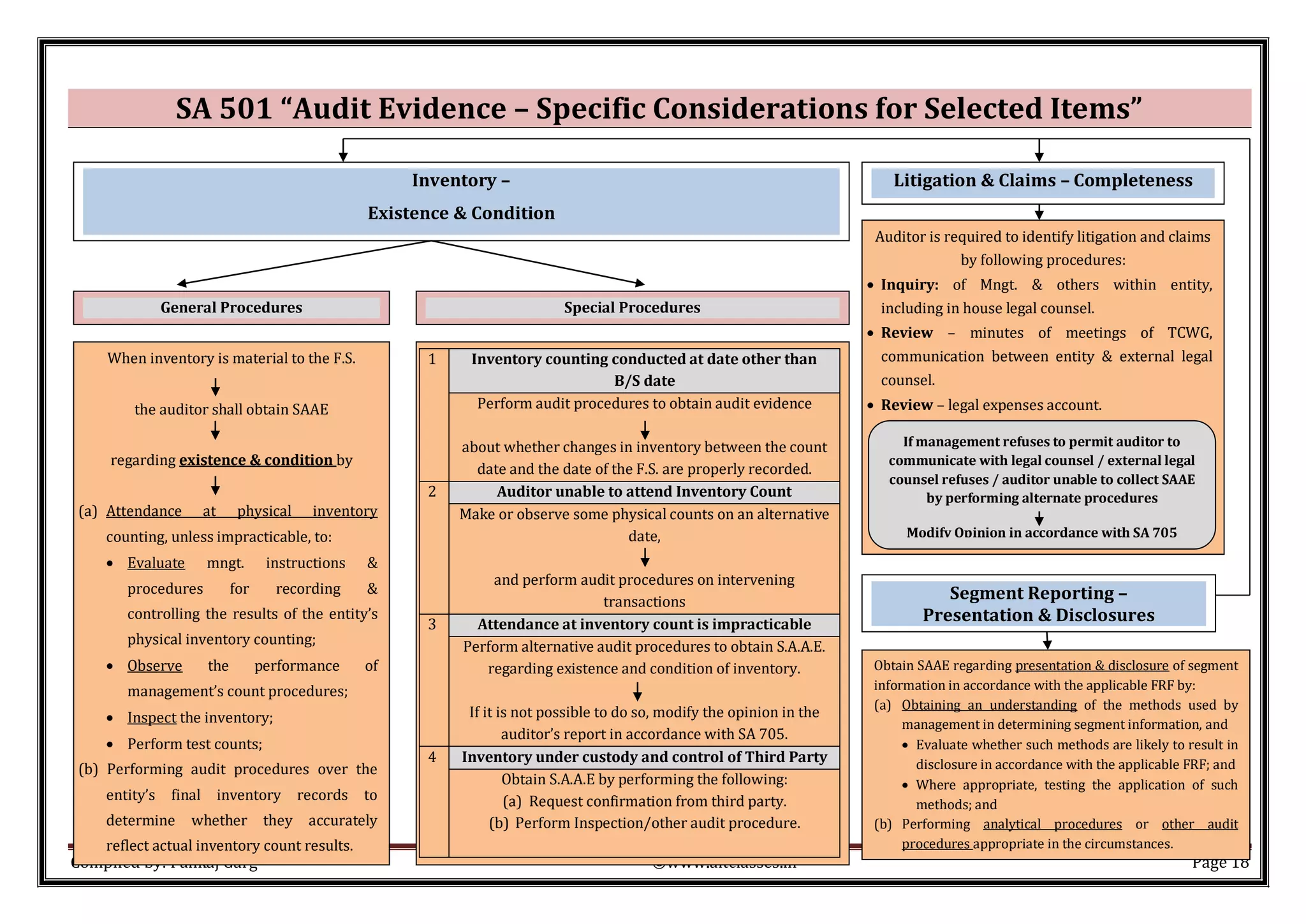
This flowchart provides a concise visual summary of the key procedures under SA 501.
Application Exercise
Let's test your understanding with a scenario from the ICAI study material.
Scenario:
During the audit of TS Ltd., you find that substantial inventories of the company (mast lighting poles) are held by "Super Industries" for finishing work. While planning, you intended to seek confirmation from Super Industries. However, you learn that Super Industries was recently raided for a fake billing scam, and its proprietor was arrested. This was widely reported in local newspapers.
Your Task:
As the auditor of TS Ltd., how should you proceed to verify the existence and condition of the inventory held by Super Industries?
Click here for the analysis.
This is a classic case where the integrity and objectivity of the third party (Super Industries) are highly questionable. Simply relying on a confirmation from them would not provide reliable audit evidence. Therefore, you must perform other, more robust audit procedures as per SA 501.
Your course of action should include one or more of the following:
- Arrange to attend the physical inventory count at the third party's location. This is the most direct way to verify existence and condition. You could attend yourself or arrange for another auditor to do so.
- Inspect documentation related to the inventory. This would include reviewing the records of goods sent to Super Industries (e.g., job work challans, e-way bills) and any goods received back. This provides evidence that the goods were indeed transferred.
- Obtain a service auditor's report (if available). If a service auditor has audited the internal controls at Super Industries (as per SA 402), their report might provide assurance on how inventory is safeguarded and counted.
- Request confirmation from other parties if the inventory has been pledged as collateral. For example, if a bank has a charge on this stock, they may have their own records or stock audit reports that you can use.
Simply stating that you couldn't get a reliable confirmation is not enough. You must demonstrate that you performed alternative procedures to obtain the required audit evidence.
Conclusion
In this lesson, we applied the general principles of SA 500 to the specific challenges of auditing inventory and litigations. We moved from theory to the practical steps you need to take to gather evidence for these material and often high-risk areas.
Key Takeaways:
- Inventory: The auditor's key objective is to verify existence and condition, primarily by attending the physical count. In special cases (impracticable attendance, count on a different date, third-party custody), you must perform specific alternative procedures.
- Litigation & Claims: The objective is to ensure completeness. This involves inquiry, reviewing minutes and legal expenses, and, when necessary, direct communication with external legal counsel via a formal letter of inquiry.
- The Golden Rule: Inability to perform a primary procedure is not the end of the road. You must always attempt to obtain sufficient appropriate audit evidence through alternative procedures. If this is still not possible, you must consider the impact on your audit opinion.
Preview of the Next Lesson
We have now discussed what audit evidence is (SA 500) and how to gather it for specific items (SA 501). But what do you do with all this information? How do you record the work you've done? In our next lesson, we will address this by covering SA 230, "Audit Documentation". We will explore the purpose, form, and content of audit documentation and what it means to prepare a file that would stand up to the "experienced auditor" test.