Hello! Welcome to your third lesson in the Audit Evidence and Documentation module.
In our previous lessons on SA 500 and SA 501, we focused on the principles of gathering sufficient appropriate audit evidence. We explored how to apply these principles to challenging areas like inventory and litigation. Now, we address the critical next step: recording the work you have performed. The saying in our profession, "if it’s not documented, it didn’t happen," is not just a cliché; it’s a fundamental principle. Your audit documentation is the primary evidence of the work you've done.
This lesson focuses on SA 230, "Audit Documentation." During your articleship, you would have spent countless hours preparing "working papers." SA 230 provides the formal standard that governs their purpose, structure, and content. Mastering this will help you bridge the gap between your practical experience and the technical precision required in your CA Final exams.
By the end of this 60-minute lesson, you will be able to explain the purpose, form, and content of audit documentation based on the 'experienced auditor' test as per SA 230.
1. The 'Why': Purpose and Nature of Audit Documentation
Before we get into the how, let's solidify the why. Audit documentation isn't just about keeping tidy files; it serves several crucial functions that form the bedrock of a quality audit.
Why SA 230 Deserves a Standing Ovation
This short article captures the essence of why audit documentation is so vital. Think of it as your 'legal shield' and the 'storyline' of your audit.
Read the sections 'Why SA 230 Deserves a Standing Ovation', 'It’s Not Just Notes—It’s a Legal Shield', and 'SA 230: A Checklist? Nope—It’s a Storyline'. This will set the context for the technical requirements we'll discuss next.
As the article highlights, documentation is your proof. It demonstrates that the audit was properly planned and performed, and it supports the basis for your final audit opinion.
Now, let's watch a video that breaks down the official definition and purposes of audit documentation as laid out in SA 230.
Ch. 6 - Audit Documentation Full | SA 230 | CA Inter Audit | ICAI Module | May 26/ Sept 26/ Jan 27
This video by CA Krupen Y. Hathi provides a structured explanation of the core concepts of SA 230.
Watch from 04:50 to 12:00. Pay close attention to the three components in the definition of audit documentation and the six distinct purposes it serves.
To summarise the key points from the standard:
Definition: Audit documentation is the record of:
- Audit procedures performed.
- Relevant audit evidence obtained.
- Conclusions the auditor reached.
Key Purposes:
- Primary Purposes:
- Provides evidence for the auditor's basis for the conclusion (the audit report).
- Shows the audit was planned and performed in accordance with SAs and legal/regulatory requirements.
- Additional Purposes:
- Assists the engagement team to plan and perform the audit.
- Assists in the supervision and review of audit work.
- Enables the engagement team to be accountable for its work.
- Retains a record of matters of continuing significance for future audits.
- Enables quality control reviews and external inspections (e.g., by peer reviewers or regulators like NFRA).
2. The Core Principle: The 'Experienced Auditor' Test
This is the central criterion for preparing audit documentation and a frequent subject of exam questions. The standard requires that your documentation be sufficient to enable an experienced auditor, having no previous connection with the audit, to understand the work you performed.
Let's break this down.
Who is an 'Experienced Auditor'?
The ICAI's Implementation Guide provides a precise definition.
[PDF] Implementation Guide to Standard on Auditing (SA) 230
To properly apply the test, we must first understand who an 'experienced auditor' is. This FAQ from the official ICAI Implementation Guide gives you the exact definition.
Read Question 7 (Q7) to understand the four key characteristics of an 'experienced auditor'.
An experienced auditor is an individual (internal or external to the firm) with practical audit experience and a reasonable understanding of:
- Audit processes
- SAs and legal/regulatory requirements
- The entity's business environment
- Auditing and financial reporting issues relevant to the entity's industry
The key condition is that this person has no previous connection with the engagement. They must be able to understand your work solely from the file you have prepared.
What Must the Experienced Auditor Understand?
The following video segment details exactly what your documentation must communicate to pass this test.
Ch. 6 - Audit Documentation Full | SA 230 | CA Inter Audit | ICAI Module | May 26/ Sept 26/ Jan 27
This is the most critical part of our lesson. This clip explains the three pillars of the 'experienced auditor' test.
Watch from 17:49 to 21:40. Focus on the three key things an experienced auditor must be able to understand from your working papers. We will analyze these in more detail below.
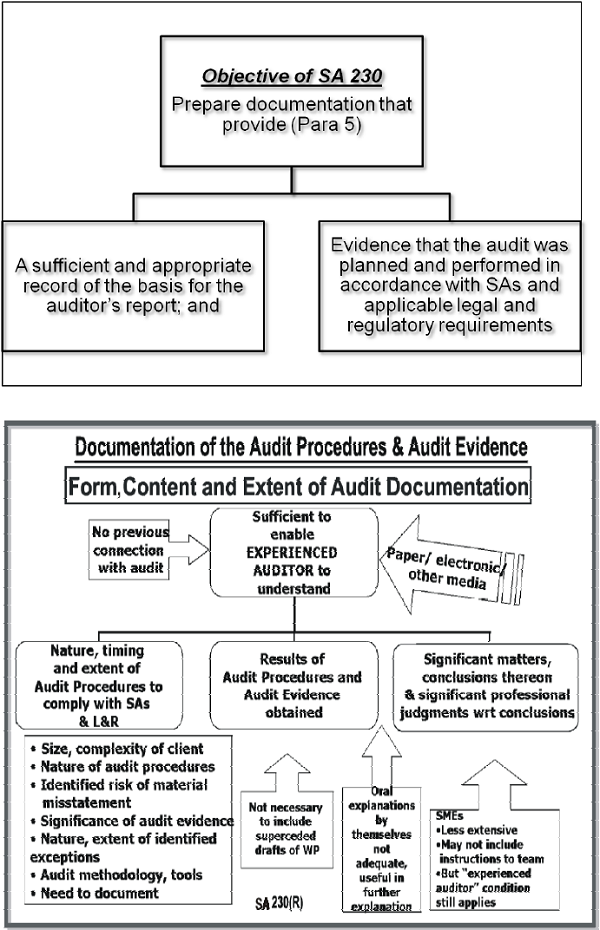
As the video explained, the documentation must be sufficient for an experienced auditor to understand:
-
The Nature, Timing, and Extent (NTE) of audit procedures performed. This includes:
- The identifying characteristics of the specific items tested (e.g., invoice numbers, journal entry details).
- Who performed the work and the date it was completed.
- Who reviewed the work, the date, and the extent of the review.
-
The results of the procedures and the audit evidence obtained. What did you find? This should be clearly stated.
-
Significant matters arising during the audit, the conclusions reached, and significant professional judgments made. This is where you document your thought process on complex issues. For example, why a particular accounting estimate was considered reasonable, or how a significant risk was addressed.
This flowchart visually summarizes the objective of SA 230 and the 'experienced auditor' test.
3. Form, Content, and Extent of Documentation
While the 'experienced auditor' test is the guiding principle, the actual form, content, and extent of your documentation will vary depending on several factors. You intuitively know this from your articleship—the file for a large, complex company is vastly different from that of a small proprietorship.
The standard lists several factors that influence this:
- The size and complexity of the entity.
- The identified risks of material misstatement.
- The nature of the audit procedures to be performed.
- The significance of the audit evidence obtained.
- The nature and extent of exceptions identified.
- The audit methodology and tools used.
Examples of Audit Documentation
Your audit file (which can be on paper, electronic, or other media) would typically include:
- Audit programs
- Analyses
- Issues memoranda
- Summaries of significant matters
- Letters of confirmation and representation
- Checklists
- Correspondence (including emails) concerning significant matters
4. Assembling and Retaining the Audit File
The lifecycle of audit documentation doesn't end when the audit fieldwork is done. SA 230, read with SQC 1 (Standard on Quality Control 1), sets out strict rules for the final assembly and retention of the audit file. These timelines are frequently tested in MCQs and case studies.
The video below explains these administrative but crucial requirements.
Ch. 6 - Audit Documentation Full | SA 230 | CA Inter Audit | ICAI Module | May 26/ Sept 26/ Jan 27
Let's cover the rules for finalizing and keeping your audit files. These timelines are non-negotiable and important for your exams.
Watch the following segments: Timely Preparation (31:12 - 32:54) Assembly of the Final Audit File (32:54 - 38:49) Retention of Documentation (38:40 - 40:15) - Note the small overlap is intentional. Ownership of Documentation (46:56 - 47:51) Focus on the specific time limits and what is permissible after the audit report date.
Let's reinforce those key timelines with the precise wording from the ICAI's guide.
[PDF] Implementation Guide to Standard on Auditing (SA) 230
These FAQs provide the exact timelines for assembly and retention as per SQC 1, which are critical to remember for your exams.
Read Question 32 (Q32), Question 33 (Q33), and Question 34 (Q34) to lock in the rules for file assembly and retention.
Here's a summary of those critical rules:
- Timely Preparation: Documentation should be prepared as the work is performed. Documentation prepared after the work is done is likely to be less accurate.
- Assembly of the Final Audit File: This is an administrative process that must be completed on a timely basis. SQC 1 specifies a period of ordinarily not more than 60 days after the date of the auditor's report.
- Permissible Changes during Assembly: Since it's an administrative process, you cannot perform new procedures or draw new conclusions. You can only make changes like:
- Deleting or discarding superseded documents.
- Sorting, collating, and cross-referencing working papers.
- Signing off on completion checklists.
- Retention Period: SQC 1 requires that audit files be retained for a period of no shorter than seven years from the date of the auditor's report (or the group auditor's report, if later). After assembly is complete, you cannot delete or discard any documentation before this period ends.
- Ownership: Unless specified by law, audit documentation is the property of the auditor.
Conclusion
Today, we've deconstructed SA 230 and established that audit documentation is far more than administrative work. It is the definitive record of the audit, providing the evidence that supports your opinion and protects you from scrutiny. You now have a clear framework, rooted in your practical experience but refined with the technical language of the standard.
Key Takeaways:
- Purpose: Audit documentation proves the audit was planned and performed in line with SAs and provides the basis for your report.
- The 'Experienced Auditor' Test: This is the core principle. Your file must be a standalone narrative that allows another competent auditor to understand the Nature, Timing, and Extent of procedures, the Results and Evidence, and the handling of Significant Matters and Judgments.
- Form & Content: While flexible, documentation must capture key details like who did the work, when it was done, what was tested, and who reviewed it.
- Key Rules (from SQC 1): You have 60 days from the report date to complete the administrative assembly of the file, and you must retain it for a minimum of 7 years.
Preview of the Next Lesson
In this lesson, we briefly mentioned the need to document "significant matters" and "significant professional judgments." This is such a critical area that it warrants a deeper look. In our next lesson, we will focus specifically on the requirements for documenting significant matters and professional judgments, exploring what qualifies as 'significant' and how to articulate the rationale behind your conclusions in your working papers.