Hello! Welcome to the first lesson of Module 4: Audit Evidence and Documentation.
In our previous module, we focused on how an auditor responds to assessed risks. We covered designing overall responses and specific procedures to tackle risks like management override and fraud in revenue recognition. The logical next step is to understand the outcome of performing all those procedures: the audit evidence you collect.
This lesson is dedicated to SA 500, "Audit Evidence". This standard is the foundation upon which your entire audit opinion rests. Your practical experience during articleship involved gathering documents, sending confirmations, and making inquiries—all of which are forms of audit evidence. Today, we'll structure that practical knowledge within the formal framework of SA 500, focusing on the precise language and concepts required for your CA Final exam.
By the end of this lesson, you will be able to explain what constitutes sufficient appropriate audit evidence and describe various audit procedures to obtain it (e.g., inspection, observation, confirmation) as per SA 500.
1. What is Audit Evidence?
At its core, audit evidence is any and all information used by you, the auditor, to arrive at the conclusions on which your opinion is based. It is the proof that backs up your final report. SA 500 clarifies that this includes not just the accounting records (like ledgers and journals) but also other information obtained during the audit (like confirmations from third parties or minutes of meetings).
Let's start with a short video that provides a clear and concise definition.
SA 500 Audit Evidence || CA Final & ca inter Auditing Standards
This video from CA Balakrishna Kovuru offers a straightforward introduction to SA 500, defining what audit evidence is and its central role in forming an audit opinion.
Please watch the segment from 00:28 to 01:29. Focus on how audit evidence is defined as the basis for the auditor's conclusions.
As the video explains, without evidence, an opinion is merely an unsubstantiated claim. The entire audit process is designed to gather and evaluate this evidence systematically.
2. The Core Principle: Sufficient and Appropriate Audit Evidence
SA 500's primary objective is to ensure the auditor obtains sufficient appropriate audit evidence. This two-part phrase is central to the entire standard, and understanding both components is critical. They address two different questions: "How much evidence do I need?" and "What kind of evidence do I need?"
Let's break them down.
Sufficiency of Audit Evidence
Sufficiency is the measure of the quantity of audit evidence. How much evidence is enough? The standard doesn't provide a formula. Instead, it states that the amount of evidence needed is a matter of the auditor's professional judgment.
This judgment is influenced by two key factors:
- Risk of Material Misstatement (RMM): The higher the assessed risk for a particular account balance or transaction class, the more audit evidence you will need to gather to reduce audit risk to an acceptable level. For a high-risk area, a single piece of evidence is rarely sufficient.
- Quality of Audit Evidence: If the evidence you obtain is of very high quality (i.e., highly appropriate), you may need less of it. Conversely, if the evidence is of lower quality, you'll need to gather more to compensate.
Appropriateness of Audit Evidence
Appropriateness is the measure of the quality of audit evidence. It's about ensuring the evidence is both relevant and reliable for the purpose you're using it for.
Appropriateness itself has two dimensions:
-
Relevance: This deals with the logical connection between the audit procedure and the assertion being tested. For example, if you want to test for the existence of inventory, physically inspecting it is highly relevant. However, inspecting the inventory doesn't provide strong evidence for its valuation (it might be obsolete or damaged). For valuation, you would need to inspect purchase invoices or analyze recent sales prices, which are more relevant procedures for that specific assertion.
-
Reliability: This refers to the trustworthiness of the evidence. SA 500 provides a hierarchy of reliability. Evidence is generally considered more reliable when it is:
- Obtained from independent sources outside the entity (e.g., a bank confirmation is more reliable than a management-prepared bank reconciliation).
- Generated internally but under conditions of effective internal control.
- Obtained directly by the auditor (e.g., your own observation of an inventory count) rather than obtained indirectly or by inference.
- In documentary form (paper or electronic) rather than obtained orally.
- An original document rather than a photocopy or a digitized copy (where the reliability of the copy might be a concern).
To solidify your understanding of these crucial concepts, let's watch the next segment of the video, which explains sufficiency and appropriateness in detail.
SA 500 Audit Evidence || CA Final & ca inter Auditing Standards
This segment of the video explains the two pillars of audit evidence: sufficiency (quantity) and appropriateness (quality). Pay close attention to the breakdown of appropriateness into relevance and reliability, as these are key concepts for exam questions.
Please watch from 06:09 to 11:13. Focus on the factors that influence the sufficiency of evidence and the characteristics that make evidence more reliable.
3. How to Obtain Audit Evidence: Audit Procedures
Now that we understand what makes evidence good, how do we actually get it? SA 500 outlines several methods, which are referred to as audit procedures. You would have performed many of these during your articleship. They are the tools in your toolkit for gathering evidence.
Let's start by reading a quick overview of these procedures.
SA 500 – Understanding Audit Evidence: Types, Quality ...
This article from Pinnvalor provides a clear, text-based summary of the primary methods for obtaining audit evidence as laid out in SA 500.
Please read the section titled 'Methods of Obtaining Audit Evidence'. This will give you a quick introduction to the terminology before we dive deeper.
To reinforce this, the first part of the video we skipped earlier provides excellent examples for each procedure.
SA 500 Audit Evidence || CA Final & ca inter Auditing Standards
Let's revisit the video from CA Balakrishna Kovuru. This section explains the specific audit procedures an auditor uses to gather evidence.
Please watch the segment from 02:17 to 05:49. For each procedure (inspection, observation, etc.), think of an example from your articleship experience.
Here is a summary of the key procedures, which you can remember using the mnemonic AEIOU RRI (the vowels plus RRI):
| Procedure | Description | Example |
|---|---|---|
| Analytical Procedures | Evaluating financial data by studying plausible relationships among both financial and non-financial data. | Comparing the gross profit margin to prior years and industry averages. |
| External Confirmation | Obtaining evidence as a direct written response to the auditor from a third party (the confirming party). | Sending confirmation requests to debtors to verify accounts receivable balances. |
| Inquiry | Seeking information from knowledgeable persons, both financial and non-financial, within the entity or outside the entity. | Asking the sales manager about the terms of a large sales contract. |
| Observation | Looking at a process or procedure being performed by others. | Watching the entity’s staff perform the annual physical inventory count. |
| Inspection | Examining records or documents (internal or external) or physically examining an asset. | Vouching a sales entry to a sales invoice and shipping document. Physically inspecting a fixed asset. |
| Recalculation | Checking the mathematical accuracy of documents or records. | Recalculating the depreciation expense for a fixed asset. |
| Re-performance | The auditor's independent execution of procedures or controls that were originally performed as part of the entity's internal control. | Re-performing the aging of accounts receivable to check the provision for doubtful debts. |
This flowchart provides a great visual summary of how all these concepts within SA 500 fit together.
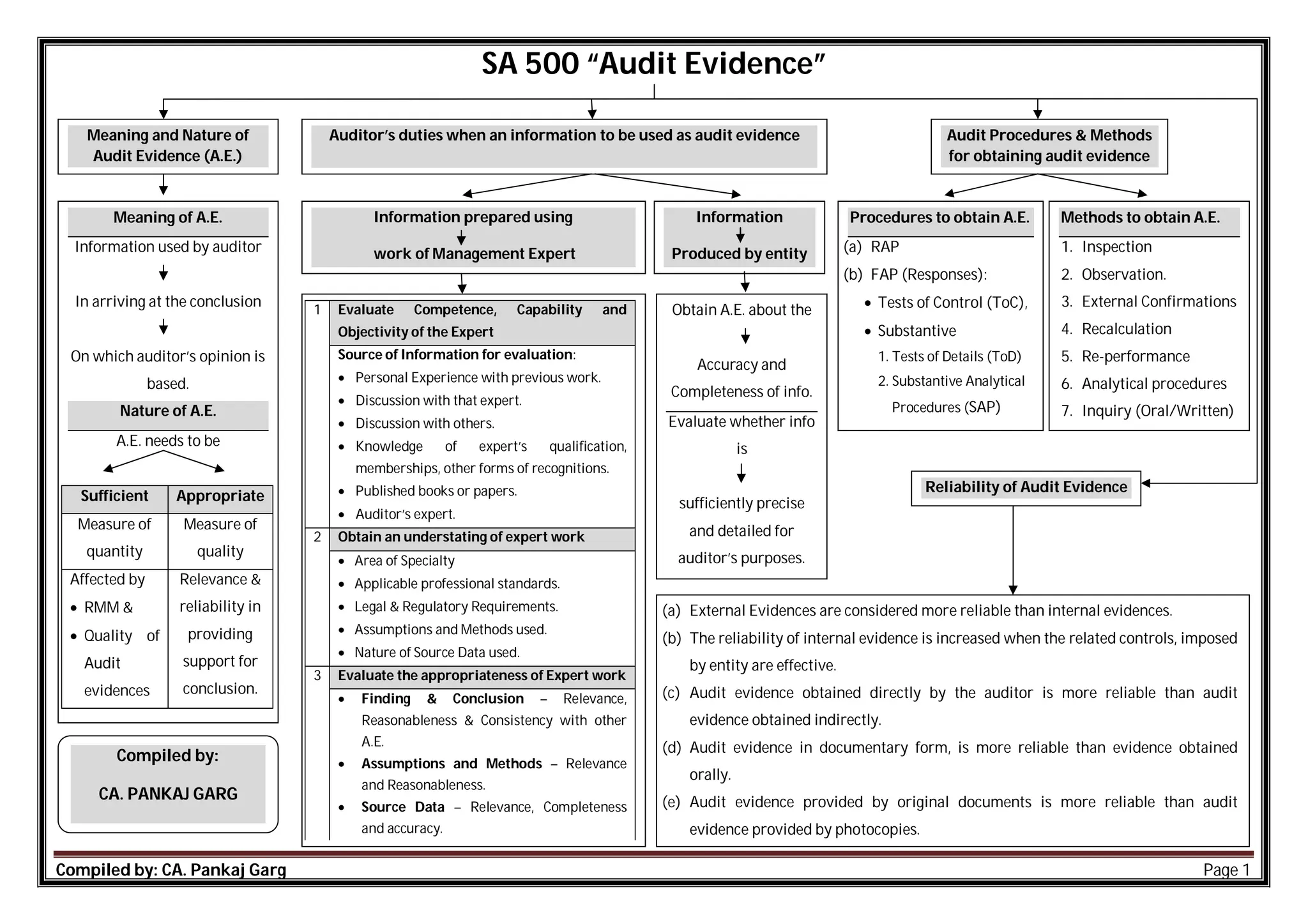
4. Application Exercise
Let's put these concepts into practice.
Scenario:
You are the auditor of a software company. The company has capitalized significant software development costs during the year, which are shown as an intangible asset on the balance sheet. Management asserts that these costs are correctly valued and will generate future economic benefits.
Your Task:
Identify at least three audit procedures from the list above that you would use to gather sufficient appropriate audit evidence for the valuation assertion of the capitalized software development costs. For each procedure, explain why it is relevant.
Click here for the analysis.
Here are a few effective procedures you could perform:
-
Inspection: You would inspect the underlying records that make up the capitalized cost. This would involve examining documents like:
- Invoices from third-party contractors.
- Payroll records for internal developers (to verify salaries capitalized).
- Time sheets to confirm that the developers' time was spent on this specific project.
- Why it's relevant: This procedure directly verifies the cost component of the asset's valuation, helping to confirm that the capitalized amount is mathematically correct and supported by actual expenditure.
-
Inquiry: You would hold discussions with the key personnel involved.
- Inquire with the project managers and developers about the project's status, technical feasibility, and expected completion.
- Inquire with the marketing director about the commercial viability and projected future sales from the software.
- Why it's relevant: The valuation of an intangible asset depends on its ability to generate future economic benefits. Inquiry helps the auditor assess management's assumptions about the project's future success, which is a key component of its valuation (especially for impairment testing).
-
Analytical Procedures: You could perform an analysis of the capitalized costs.
- Compare the budget for the project with the actual costs incurred to identify any significant overruns that might indicate problems.
- Develop a projection of future cash flows based on management's assumptions and compare it to the capitalized cost to assess for potential impairment.
- Why it's relevant: This helps to assess the overall reasonableness of the capitalized amount and its carrying value. Significant deviations from budget or weak cash flow projections could be indicators of an impairment risk, directly impacting the asset's valuation.
-
Re-performance/Recalculation: You could re-perform management's calculation for amortization.
- Recalculate the amortization expense based on the asset's useful life and ensure it's correctly applied.
- Why it's relevant: This directly tests the mathematical accuracy of the expense related to the asset, which affects its carrying value (valuation) at the balance sheet date.
Conclusion
In this lesson, we established the core principles of SA 500. You learned that an audit opinion must be built on a foundation of sufficient appropriate audit evidence. We dissected this critical phrase and explored the various procedures auditors use to gather this evidence.
Key Takeaways:
- Audit Evidence is all information used by the auditor to form an opinion.
- Evidence must be Sufficient (the right quantity), which is a matter of professional judgment based on risk.
- Evidence must be Appropriate (the right quality), meaning it must be both Relevant to the assertion being tested and Reliable (trustworthy).
- Auditors obtain evidence by performing procedures like Inspection, Observation, Inquiry, Confirmation, Recalculation, Re-performance, and Analytical Procedures.
Preview of the Next Lesson
We have just covered the general principles of obtaining audit evidence. However, some financial statement items have unique characteristics that require special audit consideration. In our next lesson, we will move to SA 501, "Audit Evidence—Specific Considerations for Selected Items". We will apply the foundational concepts from SA 500 to specific, often challenging, audit areas, starting with how to gather sufficient appropriate audit evidence for inventory and litigation/claims.