Hello! Welcome to the fourth lesson in our module on Responding to Assessed Risks.
In our last session, we introduced SA 240 and established the auditor's core responsibilities concerning fraud. We highlighted that because management is in a unique position to commit fraud, there is a risk of management override of controls in every audit. We also introduced the 'JEO' mnemonic for the three mandatory procedures to address this risk.
Today, we will move from what these procedures are to how to perform them effectively. This lesson is dedicated to providing a deep dive into the specific audit procedures you must perform to address this critical risk. Mastering this is essential, as questions on management override are common in CA Final exams, and these procedures are a compulsory part of every audit you will conduct.
By the end of this lesson, you will be able to describe specific audit procedures to address the risk of management override of controls with the conceptual clarity and technical precision required by the ICAI.
1. The Inherent Risk of Management Override
Before we jump into the procedures, let's reinforce why this risk is so important. SA 240 considers management override a significant risk due to fraud. This isn't a risk that you assess and potentially conclude is low; it's a risk presumed to be present in all entities.
Why? Because management:
- Can bypass controls that appear to be operating effectively.
- Can direct employees to record transactions incorrectly or conceal information.
- Can manipulate accounting records and prepare fraudulent financial statements directly.
The way management might override controls is unpredictable, making it a pervasive risk that requires specific, non-negotiable audit responses.
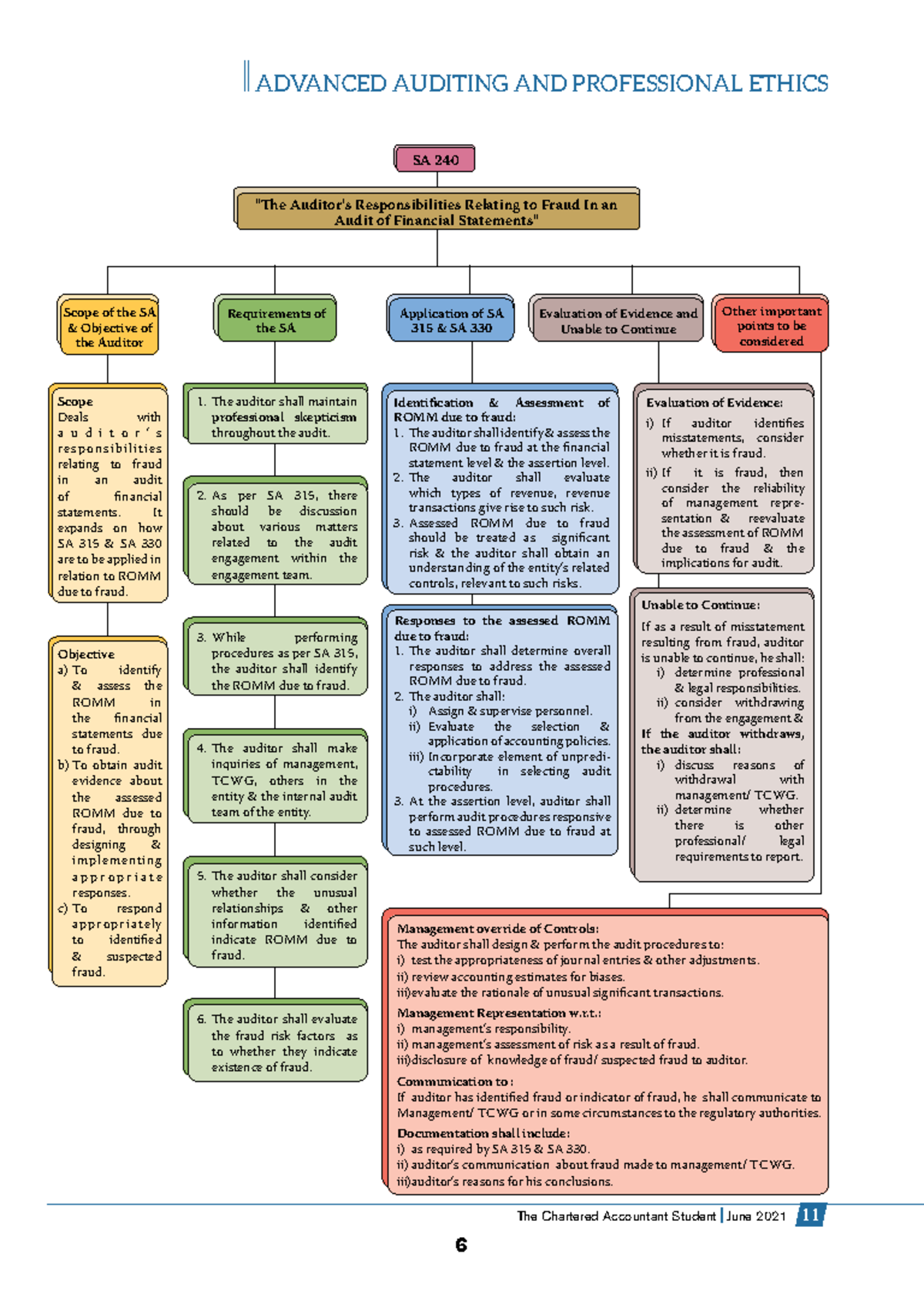
To get the precise language from the standard, let's read the paragraph that establishes this principle.
This paragraph from SA 240 explains why management override is considered a significant risk in every audit, regardless of the entity's environment or the auditor's past experience with management's integrity.
Please read Paragraph 31 under the heading 'Audit Procedures Responsive to Risks Related to Management Override of Controls'. It clearly states that the risk of management override is present in all entities.
This establishes the foundation for the mandatory procedures we will now explore in detail.
2. The Three Mandatory Procedures: A Deep Dive
SA 240, Paragraph 32, mandates that irrespective of your risk assessment, you shall design and perform specific audit procedures. Let's break down each one.
A. Journal Entry Testing
Fraud is often perpetrated through inappropriate or unauthorized journal entries used to manipulate financial results, especially near the end of a reporting period. Your job is to look for these.
How to perform the test:
- Make inquiries: Talk to individuals involved in the financial reporting process about any inappropriate or unusual activity they've noticed.
- Select and test entries: Focus on journal entries and other adjustments made at the end of the reporting period (e.g., year-end and post-closing entries).
- Consider testing throughout the period: Don't assume all fraudulent entries happen on March 31st. You may need to test entries made throughout the year.
What to look for (Characteristics of Fraudulent Entries):
- Entries made to unrelated, unusual, or seldom-used accounts.
- Entries recorded by individuals who typically do not make them (e.g., the CEO or a sales manager).
- Entries with little or no explanation or description.
- Entries made outside of business hours or on holidays.
- Entries containing round numbers or a consistent ending number (e.g., always ending in '999').
To get the full technical detail, let's turn to the standard.
To understand the exact requirements and practical guidance for testing journal entries, please read the following paragraphs from the 'SA 240' document. Pay close attention to the list of characteristics of fraudulent journal entries in paragraph A43.
Please read the following sections: Paragraph 32(a) under the heading 'Audit Procedures Responsive to Risks Related to Management Override of Controls'. Paragraphs A41 to A44 under the heading 'Journal Entries and Other Adjustments' (starts on page 27 of the PDF).
B. Reviewing Accounting Estimates for Bias
Financial statements are full of estimates (e.g., provision for doubtful debts, warranty provisions, fair value estimates). Management's judgment in making these estimates is a natural point of vulnerability for bias. They might intentionally understate or overstate provisions to either smooth earnings or achieve a specific profit target.
How to perform the review:
- Evaluate management's judgments: Even if individual estimates seem reasonable, when you look at them as a whole, do they show a pattern of optimism or pessimism that benefits management? For example, are provisions always at the lowest end of the reasonable range?
- Perform a retrospective review: This is a powerful technique. Compare the significant accounting estimates made in the prior year to the actual outcome. For example, if the provision for warranty claims last year was ₹1 Crore, but actual claims paid were ₹2 Crore, it might indicate an optimistic bias. This review isn't to second-guess your prior year's audit, but to inform your current year's assessment of management's estimation process.
Let's read the specific guidance on this.
Now, let's examine the specific requirements for reviewing estimates. The standard requires you to look for management bias, both in current judgments and by looking back at past estimates.
Please read the following sections: Paragraph 32(b) under 'Audit Procedures Responsive to Risks Related to Management Override of Controls'. Paragraphs A45 and A46 under the heading 'Accounting Estimates'. Focus on the purpose of the retrospective review explained in A46.
C. Evaluating Significant Unusual Transactions
Transactions that are outside the entity's normal course of business, or that appear unusual, warrant deep scrutiny. They can be used to engage in fraudulent financial reporting (e.g., creating off-balance-sheet structures) or to conceal the misappropriation of assets.
How to perform the evaluation:
Your key task is to understand and evaluate the business rationale (or the lack thereof) for the transaction. You need to ask "Why?"
- Does the transaction make commercial sense?
- Is the accounting treatment reflecting the economic substance, or is management more focused on achieving a particular accounting outcome?
Indicators of potentially fraudulent unusual transactions:
- The transaction's form seems overly complex (e.g., involves multiple entities in a group, or unrelated third parties for no clear reason).
- Management has not discussed the transaction's nature and accounting with Those Charged with Governance (TCWG).
- The transaction involves previously unidentified related parties or parties that lack the financial strength to support the transaction on their own.
Let's review the standard for the official list of indicators.
Finally, let's look at the procedure for unusual transactions. The key here is to look beyond the accounting treatment and question the underlying business purpose.
Please read the following sections: Paragraph 32(c) under 'Audit Procedures Responsive to Risks Related to Management Override of Controls'. Paragraph A47 under 'Business Rationale for Significant Transactions'. This provides a very useful list of indicators.
3. Application Exercise
Let's put this into practice with a short scenario.
Scenario:
You are the auditor of a manufacturing company. While reviewing the year-end closing process, you identify the following:
- A single, large journal entry dated March 31st transfers a significant amount from "Salaries and Wages" to "Capital Work-in-Progress".
- The entry was posted by the CFO's executive assistant, who does not have accounting responsibilities.
- The description simply states: "To capitalize project labour."
- In the same year, you note that management’s bonus is tied to achieving a certain Net Profit target, which the company was on track to narrowly miss before this entry.
Your Task:
Based on what we've just discussed, answer the following:
- Which of the three mandatory procedures is immediately triggered?
- What characteristics of a potentially fraudulent journal entry are present here?
- What specific audit steps would you take in response?
Click here for the analysis.
1. Triggered Procedure:
This immediately triggers the procedure to test the appropriateness of journal entries.
2. Characteristics of a Potentially Fraudulent Entry:
- Who: Made by an individual who does not typically make journal entries (CFO's assistant).
- What: The entry appears unusual (transferring salary costs to a capital account) and has a vague description.
- When: Recorded at the end of the period.
- Why (Motive/Incentive): It has a direct impact on profitability, helping management achieve a bonus target. This relates to the fraud risk factors we discussed in the previous lesson.
3. Specific Audit Steps:
- Inquire: Discuss the entry with the CFO and the executive assistant to understand the nature and purpose of the capitalization.
- Examine Supporting Evidence: Request and inspect documentation that justifies capitalizing these labour costs. This would include project plans, employee timesheets showing work on the specific capital project, and company policy on capitalization of costs.
- Evaluate Appropriateness: Assess whether the capitalization is in accordance with applicable Accounting Standards (e.g., AS 10 or Ind AS 16).
- Corroborate: Potentially interview the project manager or other personnel to confirm that these employees were indeed working on the capital project during the specified period.
Conclusion
Today we went beyond simply knowing the 'JEO' mnemonic and explored the practical application of the mandatory procedures required to address the risk of management override. By understanding the 'why' behind each test and the specific steps involved, you are better equipped to apply these concepts in your exams and in practice.
Key Takeaways:
- Management override of controls is a presumed significant risk in every audit due to management's unique position.
- SA 240 mandates three specific procedures in response:
- Testing journal entries, looking for specific characteristics of fraudulent entries.
- Reviewing accounting estimates for bias, including performing a retrospective review.
- Evaluating the business rationale of significant unusual transactions.
- Applying these procedures requires a high degree of professional skepticism and a questioning mind.
Preview of the Next Lesson
In our next lesson, we will continue our deep dive into SA 240 by focusing on another area that the standard identifies as a presumed fraud risk: revenue recognition. We will explain the presumption of fraud risk in revenue recognition and the audit procedures to address it.