Hello! Welcome back to our study of group audits.
In our last lesson, we established the critical roles within a group audit and explored the thoughtful process a Principal Auditor (PA) must undertake before accepting the engagement. We learned that this decision hinges on factors like materiality, knowledge, and risk. Crucially, we saw from the NFRA's guidance that once the role is accepted, the PA's responsibilities are not optional but presumptively mandatory.
Building directly on that foundation, this lesson delves into the practical first steps a Principal Auditor takes. We will move from the "if" and "why" of accepting the role to the "how" of beginning the work. These procedures are essential for the PA to start building the sufficient appropriate audit evidence needed for the final group audit opinion.
By the end of this 60-minute lesson, you will be able to: Describe the procedures to understand a component and its environment, and to assess the competence of a component auditor (SA 600).
1. Understanding the Component and Its Environment
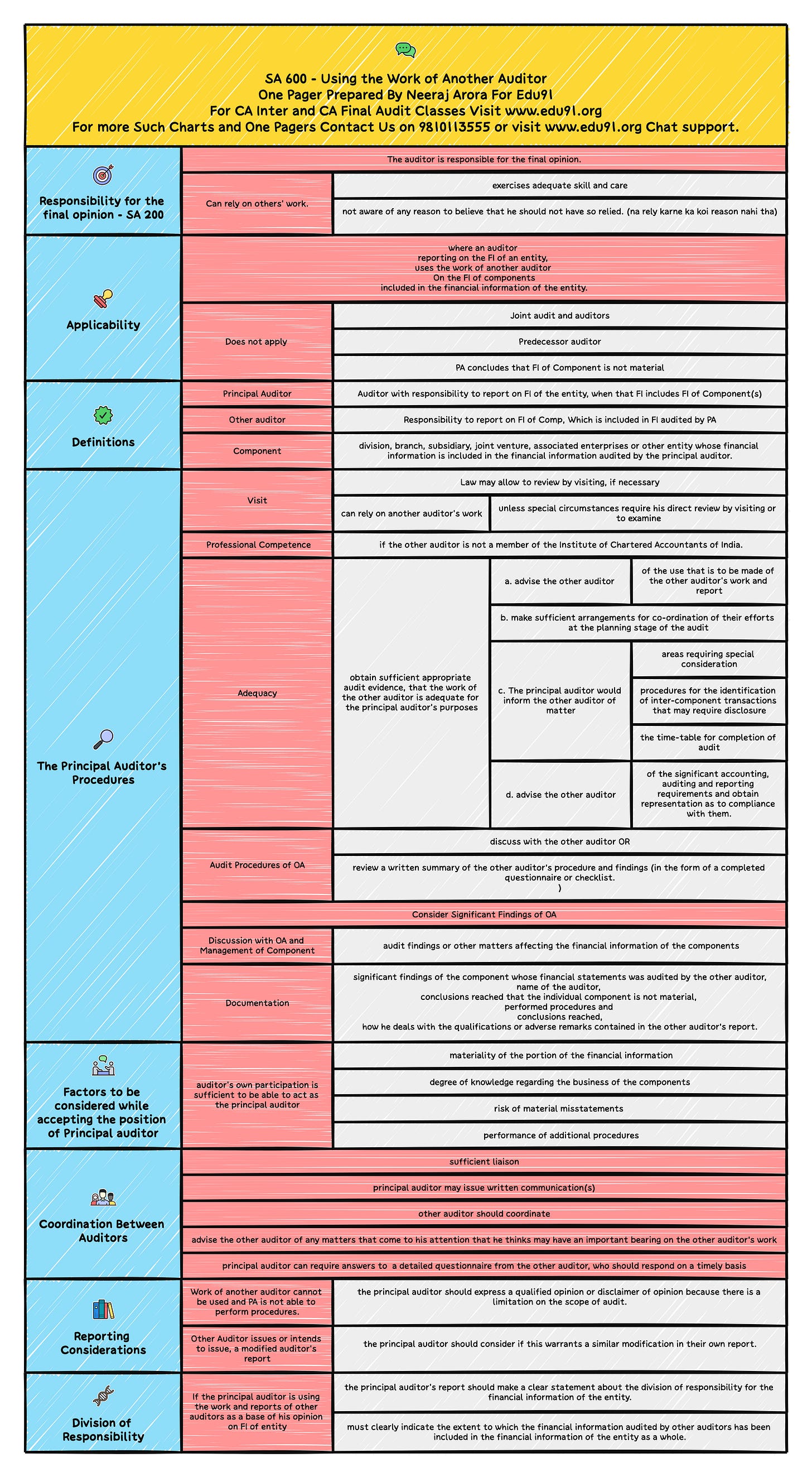
A Principal Auditor cannot evaluate the work of an Other Auditor (OA) in a vacuum. Before you can assess if the OA's work is adequate, you must first understand what they are auditing. This process mirrors the principles of SA 315 (Identifying and Assessing the Risks of Material Misstatement Through Understanding the Entity and Its Environment), but from the PA's perspective looking at the component.
Your objective here is to gain a sufficient understanding of the component's business activities and, most importantly, to identify the potential Risks of Material Misstatement (RoMM) within its financial information.
The PA can achieve this through several actions:
- Discussions with the Other Auditor and/or the component's management.
- Reviewing the Other Auditor's documentation, such as their written summary of procedures or risk assessment work.
- Inquiring about the business activities that are significant to the group.
The international standard on this topic, ISA 600, provides a clear perspective on the group auditor's responsibility to understand the components and the consolidation process.
Complexities of auditing GROUPS - ASA/ISA600
This video from AmandaLovesToAudit explains the group auditor's need to understand the group's structure and the components within it. It highlights how this understanding is crucial for identifying risks.
Please watch the video from 00:09:03 to 00:11:52 and then from 00:14:28 to 00:16:10. Focus on these key points: The requirement to understand the consolidation process itself, as this can be a source of risk. The group engagement team's responsibility to be involved in the component auditor's risk assessment process. The minimum communication required with the component auditor regarding significant business activities and risks.
As the video illustrates, your understanding of the component forms the basis for all subsequent procedures. If a component operates in a highly regulated industry or involves complex financial instruments, your expectations of the Other Auditor and the nature of your own involvement will be very different from a simple, low-risk component.
2. Assessing the Professional Competence of the Other Auditor
Once you have a grasp of the component's environment, the next logical step is to evaluate the person auditing it. The entire premise of using the work of another auditor rests on their professional competence. If the OA is not competent, their work cannot be relied upon, no matter how extensive it is.
The Rule in SA 600
The current SA 600 provides a specific starting point for this assessment.
SA 600 English Revision | CA Final Audit | CA Shubham Keswani (AIR 8)
Let's quickly review the basic rule as stated in the standard. This short clip from CA Shubham Keswani highlights the key trigger for performing a competence evaluation.
Watch the clip from 00:06:15 to 00:06:40. Note the specific condition under which SA 600 explicitly requires the PA to evaluate the OA's competence.
The standard states that the PA "should consider the professional competence of the other auditor in the context of the specific assignment if the other auditor is not a member of the ICAI."
This creates a rebuttable presumption: if the OA is a member of the ICAI, their basic competence is generally assumed. However, as you know from your practical experience and our previous lesson, auditing is far more nuanced than just holding a qualification.
A Deeper View: The Regulator's Perspective
The NFRA has been very critical of PAs who take a superficial approach to this responsibility. A CA qualification is the starting point, not the end of the evaluation. Real competence involves experience, resources, and specific skills relevant to the component being audited.
The NFRA circular we looked at in the last lesson provides a powerful clarification on this point.
[PDF] / Government of India /National Financial Reporting Authority ...
This section of the NFRA circular is essential reading. It moves beyond the simplistic 'member of ICAI' rule and explains what true professional competence entails from a regulatory standpoint.
Please read paragraphs 34, 35, and 36 of the circular. Focus on how the NFRA argues that: The standard does not prohibit considering the competence of an ICAI member. The PA's 'knowledge of professional competence' is meant to be an active assessment, not just confirming a qualification. Competence includes factors like experience, relevant skills, sector knowledge, and adequate resources.
This interpretation is not just a matter of opinion; it's the direction in which the standards are formally moving. The proposed revision to SA 600, which aligns more closely with the international standard, makes this a much more explicit requirement. It requires the Group Auditor to evaluate the Component Auditor's competence, capability, and the adequacy of their time for the engagement (as seen in resource LINK).
So, how does a PA gather this knowledge?
- Reviewing the previous audit work of the Other Auditor.
- Making inquiries about the OA's reputation among other professionals or bankers.
- If the OA is from an affiliated firm, understanding the firm's quality control policies and inter-firm review procedures.
3. Connecting Understanding and Competence
These two procedures—understanding the component and assessing the auditor's competence—are deeply intertwined. The nature, timing, and extent of the PA's procedures will depend on both.
Consider two scenarios:
- Component A: A domestic subsidiary involved in simple warehousing. The RoMM is low. The Other Auditor is a well-regarded CA firm with whom you have worked before.
- Component B: A foreign subsidiary in a developing country that trades in complex derivatives. The RoMM is extremely high due to valuation complexity and fraud risk. The Other Auditor is unknown to you.
In Scenario 1, your procedures to understand the component and confirm the OA's competence might be relatively straightforward.
In Scenario 2, your understanding of the component's high-risk nature would demand a much more rigorous assessment of the OA's competence. You would need to be satisfied that they possess not just a general auditing qualification, but specific, demonstrable expertise in auditing financial instruments. Your involvement would naturally be much greater.
This is the application of professional judgment and skepticism that we discussed in the first module. It's about tailoring your audit approach to the specific risks of the engagement.
Conclusion
In this lesson, we have moved from the decision to act as a Principal Auditor to the initial procedures required to fulfill that role. You have learned that the PA must actively engage with the component's reality, not just the OA's final report.
Key Takeaways:
- The PA's first procedural duty is to understand the component and its environment, including the specific risks of material misstatement. This provides the necessary context for the entire group audit.
- The PA must then assess the professional competence of the Other Auditor. While SA 600 sets a baseline (evaluating non-ICAI members), regulatory expectations and best practices demand a broader view of competence that includes experience, skills, and resources.
- These two procedures are linked. The higher the risk and complexity of the component, the more assurance the PA needs about the OA's specific competence to handle that engagement.
Preview of the Next Lesson
We have now established an understanding of the component and assessed the person auditing it. The logical next question is: "So what do we do with that information?"
In our next lesson, we will address that question directly. We will explore how the Principal Auditor uses this knowledge to: Determine the nature, timing, and extent of involvement in the work of component auditors. This is where the PA decides how deeply to engage with the OA's work to satisfy their own responsibilities.