Hello! Welcome back to our sessions on group audits.
In our last lesson, we took the first practical steps a Principal Auditor (PA) must take after accepting an engagement. We established that the PA must gain a solid understanding of the component and its environment, and critically assess the professional competence of the component auditor. This foundational knowledge is not just a box-ticking exercise; it directly dictates the PA's next moves.
Today, we address the crucial question that follows: "Now that I understand the risks and the auditor, how involved do I need to be?" This lesson focuses on the heart of the PA's procedural responsibilities under SA 600. We will explore how to translate your assessment into a concrete plan of action.
By the end of this 60-minute lesson, you will be able to: Determine the nature, timing, and extent of involvement in the work of component auditors.
1. The Core Principle: A Dynamic and Risk-Based Approach
There is no single formula for how much a Principal Auditor must be involved. Your involvement is not static; it's a dynamic process based on professional judgment. The nature, timing, and extent of your procedures will scale up or down based on a few key factors:
- Significance of the component: Is it material to the group financial statements as a whole?
- Risk of Material Misstatement (RoMM): Does the component operate in a high-risk industry, involve complex transactions, or have weak internal controls?
- Your assessment of the component auditor: How competent and independent did you find them to be in our previous lesson's assessment?
A helpful way to visualize this decision-making process is presented in a flowchart based on the international standard.
Complexities of auditing GROUPS - ASA/ISA600
This short clip from a video by AmandaLovesToAudit presents a flowchart that neatly illustrates how a group auditor decides the level of work needed for different components. This will help you visualize the logic.
Please watch from 00:20:44 to 00:21:52. Focus on how the decision path changes depending on whether a component is 'individually significant' or contains a risk of misstatement.
As the flowchart shows, a component that is neither significant nor risky might only require analytical procedures at the group level. Conversely, a significant component automatically triggers a full audit of that component's financial information, demanding deeper involvement from you, the Principal Auditor.
2. Nature and Timing: Proactive Coordination at the Planning Stage
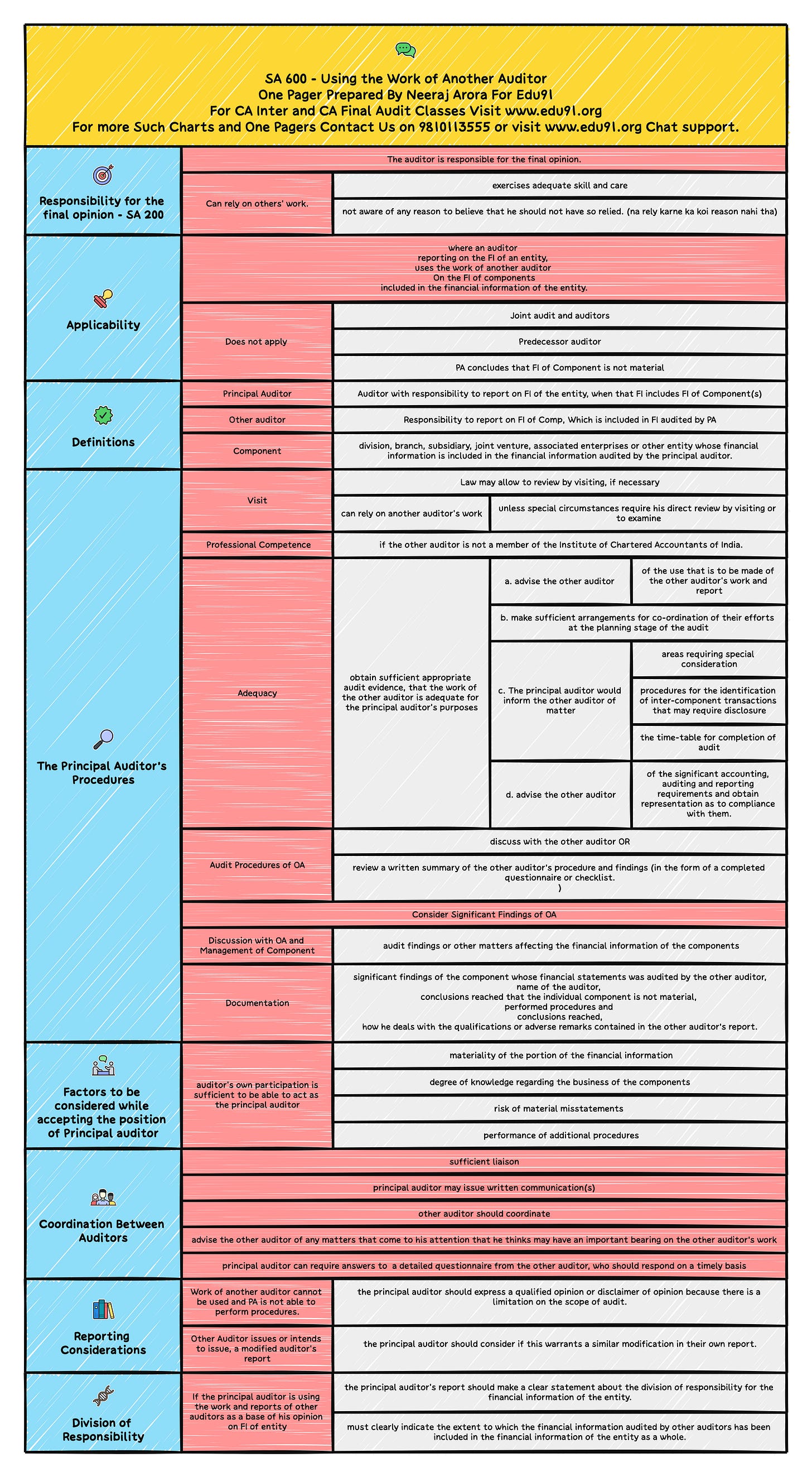
Your most effective involvement happens before the component auditor completes their work. The goal is to coordinate at the planning stage to ensure their audit approach aligns with the requirements of the group audit. This prevents issues later on. You need to clearly communicate your requirements to the component auditor.
The ICAI's study material outlines the key matters you must advise the component auditor on.
[PDF] AUDIT PLANNING, STRATEGY & EXECUTION - CA
Let's turn to the official text. This is the language ICAI expects you to know. Please read the section detailing the procedures a Principal Auditor should perform at the planning stage.
From the resource, find the sub-heading 'II. THE PRINCIPAL AUDITOR’S PROCEDURES'. Read the points under '3. Procedures to be performed by principal auditor...', specifically focusing on items (a) and (b) in the diagram. These detail what you need to advise the other auditor on.
To break this down for exam purposes, the key communications to the component auditor at the planning stage include:
- Areas requiring special consideration: These are the significant risks you've identified (e.g., complex revenue recognition, valuation of financial instruments).
- Procedures for identifying inter-component transactions: Essential for ensuring proper consolidation and disclosure of related party transactions.
- Significant accounting, auditing, and reporting requirements: Ensuring they follow the same group accounting policies and relevant standards.
- The time-table for completion: To ensure a smooth and timely group audit process.
This proactive guidance is a cornerstone of the PA's role.
3. Extent: Evaluating the Component Auditor's Work
After guiding the component auditor, your next task is to evaluate whether their work is adequate for your purposes. The extent of this evaluation will depend on the risk and significance we discussed earlier.
Your procedures to evaluate their work can include one or more of the following, on a scale from less to more intensive:
- Discuss with the component auditor their audit procedures and findings.
- Review a written summary of the component auditor's procedures. This can be done via a formal questionnaire or checklist that you provide.
- Visit the component auditor to have more detailed discussions and review their audit documentation (working papers). In special circumstances (e.g., high risk, or doubts about the component auditor's work), you might even visit the component and examine its books yourself.
If, during this process, the component auditor brings significant findings to your attention, your involvement deepens. You must:
- Discuss the findings with the component auditor and the component's management.
- Consider if supplementary audit procedures are necessary to gain sufficient evidence. These tests can be performed either by you or by the component auditor at your request.
SA 600 Revision | CA Final Audit | CA Shubham Keswani (AIR 8)
For a practical and exam-focused explanation of these procedures, let's watch a video by CA Shubham Keswani. He frames the PA's role as a 'big brother' guiding and checking the work.
Please watch the following segments: 00:04:12 to 00:06:18: Focus on the guidance provided at the planning stage (he uses a helpful mnemonic 'PA'). 00:06:18 to 00:07:30: Note the methods for checking the other auditor's work and the factors influencing how much to check. 00:10:55 to 00:12:04: Understand what a PA does upon learning of significant findings from the other auditor.
As the video emphasizes, the decision of how much work to do is driven by the circumstances (risk) and your assessment of the auditor (competence).
4. The New Direction: Understanding the Revised SA 600
For your upcoming exams, it is crucial to know that SA 600 has been significantly revised, with the new standard applicable for audits from April 1, 2024. The revision aligns Indian standards with international best practices and formalizes many of the proactive principles we've discussed. You are no longer just using another auditor's work; you are directing and supervising it as part of a single group audit engagement team.
The key shifts in the revised standard include:
- A Proactive Risk-Based Approach: The new standard explicitly rejects a passive, procedural approach and mandates a proactive, risk-based methodology.
- Enhanced Two-Way Communication: It requires more robust, structured, and timely communication between the group and component auditors throughout the audit.
- Strengthened Responsibility for Review: The group auditor must now more comprehensively direct, supervise, and review the work of component auditors. This includes determining the necessity and extent of reviewing the component auditor's audit documentation (working papers).
[PDF] AUDITING STANDARDS- THE PAST/PRESENT/ FUTURE - Kochi ICAI
To understand the significance of this change, let's look at a presentation that breaks down the key features of the Revised SA 600.
Please read the slides titled 'REVISED SA 600' and 'REVISED DOCUMENTATION AND REPORTING REQUIREMENTS'. Pay close attention to: The shift from a 'procedural methodology' to a 'proactive risk-based approach'. The explicit responsibility of the group engagement partner for the 'nature, timing and extent of direction and supervision of component auditors'. The factors to consider when deciding whether to review the component auditor's documentation.
This evolution of the standard reflects what regulators have been demanding for years. For you, this means that answers in your exam should reflect a proactive, skeptical, and hands-on approach by the Principal (now Group) Auditor, as this is the current expectation.
Conclusion
Today, we've detailed how a Principal Auditor determines their level of involvement with a component auditor. It's a judgment-based process that moves from proactive planning to reactive evaluation, all guided by risk.
Key Takeaways:
- The nature, timing, and extent of your involvement are not fixed but are scaled based on the component's materiality, its risk profile, and the competence of its auditor.
- Nature: Your involvement includes guiding the component auditor, discussing their work, reviewing summaries, and potentially performing supplementary tests.
- Timing: The most critical involvement happens early, at the planning stage, to align expectations and prevent problems.
- Extent: The amount of work you do can range from a simple review of a checklist to a detailed review of working papers and site visits, depending on the risk assessment.
- The Revised SA 600 (applicable for your exams) formalizes this, mandating a proactive, risk-based approach where the group auditor actively directs, supervises, and reviews the component auditor's work.
Preview of the Next Lesson
We have now covered how to use the work of another external auditor. The next standard in this series, SA 610, addresses a similar theme but with a different party. In our next lesson, we will explore the factors an external auditor must consider when thinking about leveraging the work of the company's own internal audit function. We will learn how to: Explain the factors for evaluating the internal audit function's relevance and the extent to which their work can be used by the external auditor (SA 610).