Hello! Welcome to the first lesson in our new module, Group Audits and Using the Work of Others.
In our previous module, we concluded our discussion on audit documentation, focusing on the strict rules for assembling and retaining the audit file under SA 230 and SQC 1. You learned the administrative steps that ensure the integrity of the audit record long after the report is signed.
As previewed, we are now shifting our focus to a topic you've identified as a priority: group audits. Modern companies rarely operate as single entities. They often have complex structures with subsidiaries, branches, and joint ventures, both domestically and internationally. This makes understanding your role in a group audit essential. Your articleship experience in a CA firm likely exposed you to the complexities of consolidating financial information from various components.
This lesson dives straight into SA 600, "Using the Work of Another Auditor." We'll explore the foundational roles and responsibilities that come into play when you are the auditor responsible for the main entity's consolidated financial statements, but other auditors are handling parts of the group.
By the end of this 60-minute lesson, you will be able to: Explain the role and responsibilities of a group engagement partner in a group audit, including acceptance and continuance decisions (SA 600).
1. Understanding the Key Players in a Group Audit
Before we discuss responsibilities, we need to be very clear about the terminology used in SA 600. The standard defines three key roles/entities in a group audit scenario. Misunderstanding these terms can lead to confusion.
- Component: This is a broad term for any part of the group whose financial information is included in the main financial statements. It could be a division, a branch, a subsidiary, a joint venture, or an associate.
- Other Auditor: This is the independent auditor responsible for auditing the financial information of a component. They are not the main auditor of the group.
- Principal Auditor: This is the auditor who is responsible for reporting on the financial statements of the entity as a whole (i.e., the consolidated financial statements). They are the "main" auditor who must form an opinion that includes the work done by other auditors on various components.
To see how these roles interact in a practical context, let's watch a brief introductory video.
CA Final Audit Revision Session & QnA Discussion-SA 600 for May 26 exam & onwards by CA Rishabh Jain
This clip from CA Rishabhh Jainn uses a simple company structure to clearly define and differentiate between the Principal Auditor, the Other/Branch Auditor, and a Component.
Watch the video from the beginning until 00:07:18. Focus on the example of company 'X Y Z' with its head office and branches to understand how the different auditor roles are established.
As the video explains, the existence of an "Other Auditor" for a "Component" is what creates the need for a "Principal Auditor" and brings SA 600 into effect. This is distinct from a joint audit (covered by SA 299), where multiple auditors share responsibility for the entire entity's audit. Here, the Principal Auditor holds ultimate responsibility for the group opinion.
2. The First Hurdle: Accepting the Role of Principal Auditor
Being appointed as the auditor for a parent company doesn't automatically mean you must accept the role of Principal Auditor. This is a critical decision that requires careful consideration. You need to assess if you can realistically take responsibility for the entire group audit, even the parts you don't audit directly.
SA 600 lays out specific factors to consider before accepting or continuing as the Principal Auditor.
SA 600 English Revision | CA Final Audit | CA Shubham Keswani (AIR 8)
This segment from CA Shubham Keswani's revision lecture concisely breaks down the four main factors you must evaluate when deciding whether to act as a Principal Auditor.
Watch the video from 00:02:31 to 00:05:39. Pay close attention to the four points discussed, using the Tata Motors and JLR example to solidify your understanding.
To summarize, the Principal Auditor must consider whether their own participation is sufficient. This involves evaluating four key areas:
- Materiality of the Portion Audited by You: You need to assess the significance of the financial information you audit yourself in relation to the group's total financial information. If the components audited by others are overwhelmingly material compared to what you audit, it may not be appropriate for you to be the Principal Auditor.
- Your Knowledge of the Component's Business: You must have a sufficient degree of knowledge about the business of the components you don't audit. Lack of understanding poses a significant risk.
- Risk of Material Misstatement (RoMM) at the Component Level: You need to evaluate the RoMM in the financial information of the components audited by others. High-risk components require more attention and may influence your decision to accept the role.
- Ability to Perform Additional Procedures: You must consider your ability to perform additional procedures to gain sufficient evidence regarding the components audited by others. If your involvement is restricted, you may not be able to fulfill your responsibilities.
These factors are not just theoretical; they form the basis of direct exam questions.
ICAI Suggested Answers - Question on Principal Auditor Acceptance
Let's look at how the ICAI expects you to answer a question on this topic. This resource presents a past exam question and the model answer.
Read Question 3 (a) and its corresponding answer. Note how the answer directly lists the four factors we've just discussed, as per SA 600.
This shows how translating the conceptual understanding of these four factors into the precise language of the standard is key to scoring well.
3. Fulfilling the Role: The Principal Auditor's Responsibilities and Procedures
Once you've accepted the engagement, your responsibilities as the Principal Auditor begin. You cannot simply take the Other Auditor's report at face value. Your primary responsibility is to obtain sufficient appropriate audit evidence to support your opinion on the group financial statements as a whole.
This involves active coordination, communication, and evaluation.
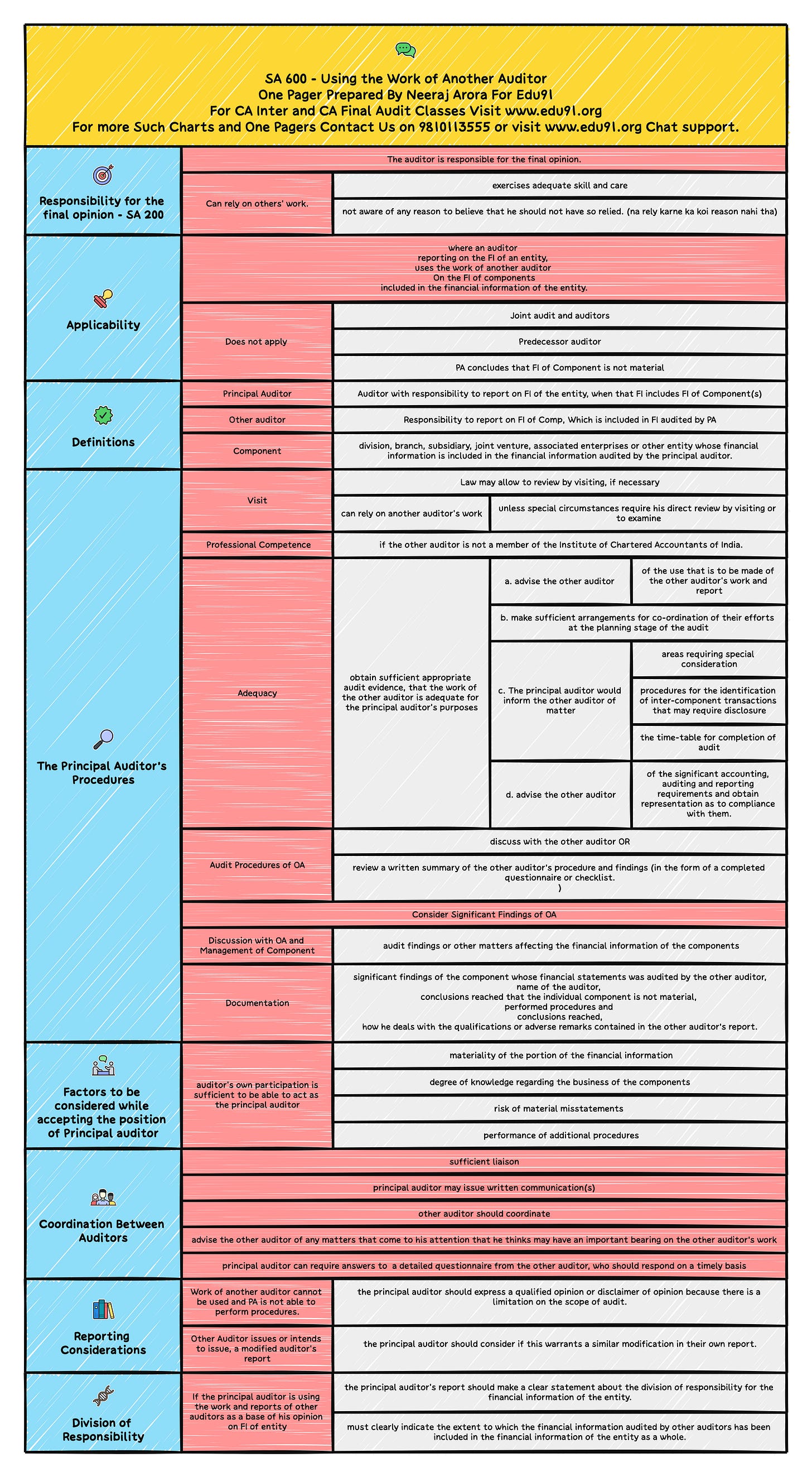
Your core procedures include:
-
Evaluating the Other Auditor's Professional Competence: While you can generally assume competence if the other auditor is an ICAI member, you must consider it more deeply if they are not (e.g., in the case of a foreign subsidiary). This goes beyond just their qualification to their experience and resources.
-
Coordinating and Communicating: You must establish a clear line of communication with the Other Auditor. This is not a passive role.
SA 600 English Revision | CA Final Audit | CA Shubham Keswani (AIR 8)
This video details the specific communication and coordination procedures a Principal Auditor must undertake. It explains what information must be shared with the Other Auditor at the planning stage.
Watch the segment from 00:05:39 to 00:10:17. Focus on the 'PAPA' mnemonic, which outlines the key areas you must advise the other auditor on: Procedures for inter-component transactions, Areas of special consideration (risks), and Accounting, Auditing, and Reporting requirements.
-
Evaluating the Other Auditor's Work: You need to perform procedures to be satisfied that the work of the other auditor is adequate for your purposes. This typically involves:
- Discussing their audit approach and any significant findings.
- Reviewing a written summary of their procedures, often through a questionnaire or checklist.
- It may sometimes be necessary to review their working papers, but this depends on the circumstances.
-
Dealing with Significant Findings: If the Other Auditor reports significant findings, you must consider them, discuss them with the Other Auditor and management, and determine if you need to perform supplementary tests yourself or request the Other Auditor to do so.
4. The Real-World Stakes: Lessons from the NFRA
Your responsibility as a Principal Auditor isn't just a matter of following a checklist. The National Financial Reporting Authority (NFRA) has made it clear that a passive or negligent approach to SA 600 can lead to catastrophic audit failures and severe professional consequences. Understanding the regulator's perspective is crucial for you as a future CA.
Some auditors have incorrectly interpreted SA 600 to justify blind reliance on component auditors. The NFRA has forcefully corrected these misinterpretations.
NFRA Circular on Responsibilities of Principal Auditor and Other Auditors
This NFRA circular is a critical read. It details how misinterpreting SA 600 contributed to major financial scandals in India and clarifies the non-negotiable responsibilities of a Principal Auditor.
Please read the following key sections of the circular carefully. This will provide you with the 'why' behind the rules and the serious implications of getting them wrong: Paragraphs 4 & 6: Read the 'Instances' and 'Observations by NFRA' sections. Note the high-profile cases mentioned (IL&FS, DHFL) and the specific failures of Principal Auditors. Paragraphs 9-12: Focus on how SA 600 cannot be read in isolation. The overall objectives of an audit (SA 200) apply universally to the Principal Auditor. Paragraphs 17-23: Understand the clarification on the word 'should'. The NFRA confirms that this implies a 'presumptively mandatory' responsibility, not an optional one. Paragraphs 25-27 & 33: Read the clarification regarding the sharing of working papers. It refutes the idea that confidentiality clauses prevent the Principal Auditor from reviewing a component auditor's work when necessary.
The NFRA circular drives home a powerful message: the Principal Auditor is the captain of the ship. They are ultimately responsible for the opinion on the group financial statements and cannot delegate this responsibility away by claiming they were just relying on someone else's work.
Conclusion
In this lesson, we have laid the groundwork for understanding audits in a group environment under SA 600. You've learned that the role of a Principal Auditor comes with significant authority and even greater responsibility. It begins with a thoughtful acceptance decision and extends to active coordination, communication, and evaluation of the Other Auditor's work.
Key Takeaways:
- The Principal Auditor is responsible for the overall group audit opinion, which includes financial information audited by Other Auditors for various Components.
- Accepting the role of Principal Auditor is a formal decision based on materiality, knowledge, risk assessment, and the ability to participate significantly in the audit.
- The Principal Auditor must actively engage with the Other Auditor, not passively rely on their report. This includes coordinating at the planning stage, communicating key risks, and evaluating the adequacy of their work.
- As emphasized by the NFRA, these responsibilities are mandatory. A failure to exercise due diligence can lead to major audit failures and severe regulatory action. The Principal Auditor cannot hide behind the work of the Other Auditor.
Preview of the Next Lesson
We have just scratched the surface of SA 600. Now that you understand the overall role and acceptance criteria, our next lesson will drill down into the specific procedures a Principal Auditor uses. We will cover the learning outcome: "Describe the procedures to understand a component and its environment, and to assess the competence of a component auditor (SA 600)." This will build directly on the foundations we've established today.